
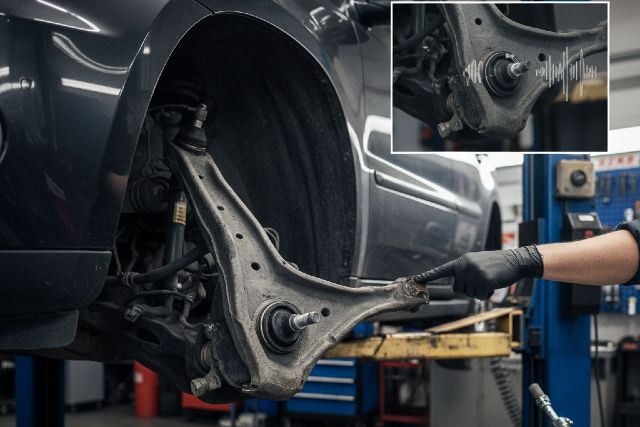

If you’re hearing a sharp clunk when you hit potholes, speed bumps, or rough pavement, it’s tempting to blame “the suspension” and move on. But when the sound seems to come from the top of the wheel area, especially on trucks, SUVs, and many front suspensions, the upper control arm is one of the first components worth inspecting. When bushings wear or the upper ball joint develops play, the suspension can shift under load and create that familiar knock. Parts manufacturers and suspension specialists commonly describe clunking over bumps as a symptom linked to worn control arm bushings or joints.
What the upper control arm does and why it clunks
The upper control arm connects the vehicle’s chassis or frame to the steering knuckle, working with the lower control arm to guide wheel travel and keep alignment angles stable. Most designs use bushings at the frame mounts and a ball joint at the knuckle end. Those bushings are supposed to absorb vibration while still holding the arm in a controlled path.
Clunking usually happens when a part that should be tight develops extra movement. Over bumps, suspension load changes quickly. If the upper control arm shifts at its mounts, or the ball joint has clearance, you can hear a knock as components snap between loaded and unloaded positions. MOOG, a major chassis parts manufacturer, notes that front-end clunking can be associated with worn control arm bushings that allow the arm to move and contact surrounding components.
Upper control arm clunking noise over bumps: the most common causes
Worn upper control arm bushings
Upper control arm bushings are designed to flex, but they are not supposed to let the arm slide or rotate excessively. Over time, rubber can crack, separate from its sleeve, or soften, especially with heat, age, road salt, or oil contamination. When that happens, the upper control arm can shift during bumps and create a dull thud. Multiple repair references describe knocking or clunking over bumps as a classic sign of failing control arm bushings.
A common pattern is that you hear the clunk most at low speeds on rough roads, and it may get louder when the suspension is working harder, such as when entering driveways at an angle.
Upper ball joint wear
If the upper control arm uses an upper ball joint, or if the joint is integrated into the arm assembly, internal wear can create play. Over bumps, the ball stud can shift inside the joint and knock. This can also show up as inconsistent steering feel, mild wandering, or a clunk that changes when turning.
This is more than a comfort issue when wear is severe. NHTSA recall documentation involving ball joints and control arm connections describes the risk of loss of directional control if the joint separates.
Loose or improperly torqued upper control arm hardware
Sometimes the upper control arm itself is fine, but the fasteners are not. This often happens after recent suspension work such as struts, alignments, ball joint replacement, or lift kit installation. A slightly loose bolt at the control arm mount or the ball joint connection can cause a distinct clunk because the assembly shifts under load.
This can be serious in the wrong scenario. NHTSA safety documentation and recall materials have highlighted cases where insufficient torque or missing hardware at upper control arm ball joint connections increased separation risk.
Bent upper control arm from impact
A hard pothole hit, curb strike, or off-road impact can bend an arm slightly. Even small deformation can change how bushings sit or how the joint articulates, which can lead to binding and a knock during suspension movement. If the clunk began immediately after an impact and alignment feels “off,” physical arm damage becomes more likely.
Not the upper control arm, but it sounds like it
Front suspension noises reflect through the subframe and body, so several components can mimic upper control arm noise. Sway bar end links and sway bar bushings are frequent offenders, especially when the noise is rapid and repetitive over small bumps. Strut mounts and tie-rod ends can also create clunks that feel like they are coming from the upper area of the wheel well. Many diagnostic guides list sway bar links and strut mounts among common causes of clunking over bumps.
How to diagnose an upper control arm clunk without guessing
Start by observing the pattern
Try to notice when the clunk is most likely to appear. If it happens mainly when one wheel hits a bump, it often points to a side-specific part like a control arm bushing, ball joint, or sway bar link. If it happens equally on both sides over symmetrical bumps, it can be more related to sway bar bushings or strut mounts.
Also pay attention to whether the clunk changes during braking or acceleration over uneven pavement. Control arm bushing movement can be more obvious during transitions because the suspension is being loaded in multiple directions.
Perform a careful visual inspection
Look at the upper control arm bushings for cracking, tearing, separation, or “shiny witness marks” around the mount where metal may have been moving. Check the upper ball joint boot for splits, grease leakage, or rust-colored dust near the joint, which can indicate wear. Inspect mounting points for obvious shifting and confirm that hardware appears present and seated.
Repair references commonly emphasize that visibly cracked bushings and damaged ball joint boots are key indicators when clunking is present.
Confirm play with a load-and-watch approach
Shops typically confirm the cause by applying controlled force and watching how components move. A failed bushing usually shows the control arm shifting relative to its frame mount. A worn ball joint shows movement at the joint interface between the knuckle and the stud. If you don’t have the equipment to do this safely, paying for a targeted suspension inspection is usually cheaper than replacing parts by trial and error.
Rule out the top sound-alikes
If the upper control arm looks fine, the next best move is to check sway bar links, sway bar bushings, and strut mounts. Sway bar links often clunk quickly over small bumps, while strut mounts may knock over larger bumps and sometimes creak while steering. Multiple suspension noise guides list sway bar components as frequent sources of bump-related clunks.
Solutions that actually fix the clunk and keep it gone
Verify torque and correct installation first
If the clunk started after repairs, the simplest fix can be verifying torque on upper control arm mounting bolts and the upper ball joint connection fasteners to factory specification. This matters because some bushings must be torqued at ride height rather than with the suspension hanging, otherwise the bushing can be preloaded and fail early.
It also matters for safety. NHTSA recall materials have documented cases where loose or missing hardware at upper control arm ball joint connections could increase separation risk.
Replace worn upper control arm bushings or replace the entire arm
Depending on the vehicle, bushings may be replaceable separately, or the preferred repair may be replacing the whole upper control arm assembly. Replacing the full arm often makes sense when the ball joint is integrated, when corrosion is severe, or when labor to press bushings approaches the cost of a complete arm.
Manufacturers and repair resources frequently connect control arm bushing wear with clunking over bumps and recommend replacement when cracking or excessive movement is confirmed.
Replace the upper ball joint when it’s serviceable
If your design allows ball joint replacement without replacing the arm, a new joint can eliminate the clunk. However, if the arm bushings are also worn or the arm is already removed, replacing the complete upper control arm can be a better long-term solution since you’re renewing both wear points at once.
Get an alignment after control arm work
Replacing an upper control arm can affect camber and caster, and even bushing position can slightly change how the vehicle tracks. Alignment after replacement helps prevent uneven tire wear and restores predictable steering. If the clunk was tied to bushing movement, correcting geometry afterward keeps the handling improvements you paid for.
How urgent is an upper control arm clunk?
An occasional noise from a sway bar link can be annoying but not immediately dangerous. A clunk connected to the upper control arm deserves more urgency because it’s part of the structure that controls wheel position. In the worst cases, severe ball joint wear or loose hardware can progress toward separation, which NHTSA recall documentation describes as a risk for loss of directional control.
More broadly, NHTSA crash investigation research has found that vehicle component failure or degradation accounts for a small share of critical crash reasons in investigated crashes, but that’s exactly why it’s worth addressing a known mechanical issue early, before it becomes the exception that causes a bigger problem.
Real-world scenarios that match what drivers experience
A common situation is a clunk that begins shortly after struts or suspension work. Everything feels fine until the first week of driving, then a single knock appears over speed bumps. Inspection often finds a fastener that was tightened but not torqued correctly, or a bushing bolt torqued with the suspension hanging. Correcting the torque at ride height can solve it, and it’s consistent with safety guidance that highlights the importance of correct hardware installation at ball joint and control arm connections.
Another frequent pattern is a high-mileage vehicle that develops a dull thud over broken pavement along with inner-edge tire wear. That combination often points to bushing wear allowing geometry shift. Replacing the upper control arm and aligning the vehicle typically removes the noise and stabilizes tire wear, matching common symptom descriptions for worn control arm bushings.
FAQs
Can an upper control arm cause a clunking noise over bumps?
Yes. When upper control arm bushings wear or the upper ball joint develops play, the suspension can shift during bump impacts and create a clunk. Suspension references and parts manufacturers commonly list clunking over bumps among symptoms of control arm or bushing wear.
Is it safe to drive with an upper control arm clunk?
It depends on the cause. If the clunk comes from looseness in the upper control arm, ball joint wear, or loose hardware, the issue can worsen and may create a safety risk. NHTSA recall documents describe loss of directional control risk if ball joint or control arm connections separate.
What does a bad upper control arm bushing sound like?
It typically sounds like a dull knock or thud over bumps, often most noticeable at low speeds or when one wheel hits uneven pavement. Clunking over bumps is repeatedly cited as a common symptom of worn control arm bushings.
Do I need an alignment after replacing an upper control arm?
In most cases, yes. Replacing an upper control arm can change alignment angles, and an alignment helps prevent tire wear and restores stable steering.
Could the clunk be something else?
Yes. Sway bar links, strut mounts, and other steering and suspension components can mimic upper control arm noise. Many guides list sway bar links among the most frequent sources of clunks over bumps.
Conclusion
If you’re dealing with an upper control arm clunking noise over bumps, the fix starts with confirming where the play is coming from. The most common culprits are worn bushings, a worn upper ball joint, or hardware that’s loose or incorrectly torqued. Manufacturers and repair references consistently link control arm bushing wear to bump-related clunks, and NHTSA documentation shows why ball joint and control arm connection integrity matters for safety.
Once you replace the worn component and verify proper torque, an alignment usually finishes the job by restoring correct geometry. The result is a quieter ride, more consistent steering, and better tire life.











Leave a comment