
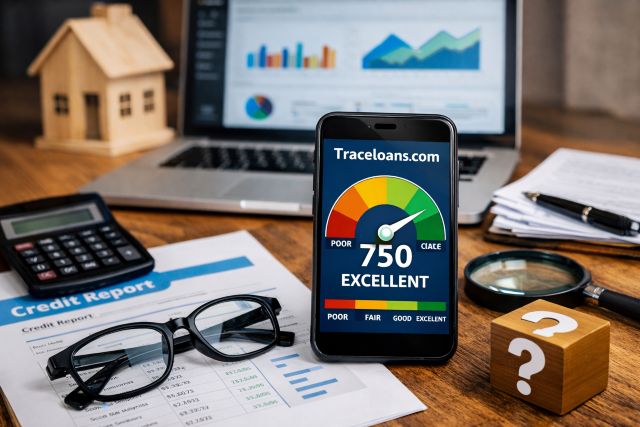

If you’ve searched for Traceloans.com Credit Score, you’re probably trying to answer one simple question: Can I trust what I’m seeing? That’s smart — because “credit score” can mean a few different things online, and not every site that talks about credit scores is actually providing your credit score.
In this review, we’ll break down what Traceloans.com appears to be, what “Traceloans.com Credit Score” commonly refers to, where accuracy can go wrong, and how to verify your real credit standing with confidence. We’ll also compare it with FICO® and VantageScore® and share practical ways to avoid being misled by “educational” scores, marketing scores, or mismatched scoring models.
What is the Traceloans.com Credit Score, exactly?
Here’s the most important clarity upfront: Traceloans.com presents itself primarily as an educational resource for loans, debt consolidation, and credit score topics, not as a credit bureau or an official scoring provider. On its “About Us” page, TraceLoans describes its mission as providing “clear, unbiased information” and being a “resource for all things loans.”
Its Privacy Policy also states it does not collect Personal Information and does not use “forms, registration pages, user accounts, or tracking tools designed to capture or store Personal Information.”
So why do people search “Traceloans.com Credit Score”?
In practice, the phrase usually shows up for one of these reasons:
People confuse TraceLoans content with a score tool. The site publishes credit-score guides (for example, “Credit Score Check Made Easy”).
Other websites use the phrase “Traceloans.com credit score” as a keyword and describe it like a “tool” or “dashboard.” (This is common in SEO ecosystems and isn’t proof the tool exists.)
Bottom line: Based on TraceLoans’ own “About Us” and Privacy Policy, there’s no clear evidence it provides a personalized, bureau-backed credit score directly on its site, and it explicitly says it doesn’t collect personal info — which makes it unlikely it’s generating a score tied to your credit file.
Is Traceloans.com Credit Score accurate?
Accuracy depends on what you mean by “accurate.”
If you mean: “Is the educational information correct?”
Some TraceLoans articles describe standard credit-score fundamentals like the 300–850 range and core scoring factors (payment history, utilization, etc.).
That kind of content can be useful as general education — if it’s sourced well and kept current.
But be careful: even “good” credit advice can become confusing if it doesn’t specify which scoring model is being discussed (FICO vs VantageScore), or if it oversimplifies.
If you mean: “Does it match the score a lender will use?”
That’s where reliability usually breaks down.
Even when two scores are both legitimate (say, FICO® and VantageScore®), they can differ because they’re different models. And within FICO alone, there are multiple versions (plus industry-specific scores). FICO itself notes standard FICO® Scores generally range 300–850, while some industry-specific versions can differ.
So a “score” can be real but still not match what your lender pulls.
Reliable credit scoring: what lenders actually use
To judge reliability, it helps to know the scoring landscape.
FICO®
FICO is the dominant brand lenders often use, and its educational materials explain how FICO Scores are used to evaluate risk and that the standard range is generally 300–850.
VantageScore®
VantageScore models also commonly use a 300–850 range, and many banks and free score portals provide VantageScore (often version 3.0).
Why your score changes across sources
A score can differ because of:
Different scoring model (FICO vs VantageScore)
Different version (FICO 8 vs FICO 9 vs industry score)
Different bureau file (Experian vs Equifax vs TransUnion)
Timing (a balance updated yesterday on one bureau but not the others)
Data quality (errors or outdated reporting)
And data quality is not a small issue: the FTC reported that one in five consumers had an error on at least one of their credit reports, and 5% had errors that could lead to less favorable terms.
Traceloans.com Credit Score reliability checklist
If you’re trying to decide whether anything labeled Traceloans.com Credit Score is trustworthy, ask these questions:
1) Does it clearly say which scoring model it uses?
A reliable score source will tell you whether it’s FICO® or VantageScore®, and ideally which version. If it doesn’t, you can’t meaningfully compare it to what lenders use.
2) Is it tied to your actual credit report data?
To produce a real score, a service needs data from one (or more) of the major bureaus. If a site states it doesn’t collect personal info, it’s hard to see how it could access your bureau file in a normal consumer-facing way.
3) Does it explain whether it’s “educational” vs “lender-use”?
Many score portals provide an “educational score.” It might be valid, but it may not be the one your lender uses for underwriting.
4) Does it encourage verification with your official reports?
The most consumer-safe approach is always: read your reports, then interpret your scores. TraceLoans itself points readers to AnnualCreditReport.com for free reports.
How to verify your real credit score (the practical way)
If you want something you can trust — especially before applying for a loan — use this “two-layer check”:
Step 1: Pull your credit reports first
Get your official credit reports through AnnualCreditReport.com, the federally authorized source for free credit reports.
Why this matters: your score is only as accurate as the data in your reports, and reporting errors are common enough to matter in real life.
Step 2: Compare at least two score sources
One that provides FICO (some banks do)
One that provides VantageScore (many free portals do)
If your scores are close, great. If they differ significantly, don’t panic — focus on your report data and the factors driving the gap (utilization, missed payments, collections, recent inquiries).
Common reasons “your score” looks wrong online
Even when a site is legitimate, you may see a number that feels off. Here are the most common causes:
Mismatched scoring model
A VantageScore can be meaningfully different from a FICO score. Experian explains that VantageScore 3.0 is commonly provided for free by financial institutions and sites, which is why so many people see it first.
Report timing differences
One bureau updates faster than another. If you just paid down a card, one file might reflect it sooner.
Credit report errors
Errors range from minor to serious, and consumer complaints about credit reporting have been a major issue in recent years according to the CFPB.
A realistic scenario: when “Traceloans.com Credit Score” could mislead you
Imagine you’re applying for an auto loan.
You read a “credit score check” guide on TraceLoans and then check a free score from a portal that uses VantageScore. You see 705, feel confident, and apply.
But the lender pulls a FICO Auto Score (or another FICO version) from a different bureau and sees 672. You still may get approved, but the APR might be higher than you expected.
Nothing “fraudulent” happened — you just compared different tools measuring risk differently. That’s why reliability isn’t only about whether a number is “real.” It’s about whether it matches the decision system your lender uses.
Is Traceloans.com safe to use?
From a privacy standpoint, TraceLoans’ policy claims it does not collect personal information and does not require personal details to access content.
That’s generally a positive sign for reading articles.
Still, you should be cautious any time a site routes you to third-party offers (common in loan/finance publishing). If you click out to lenders or partners, you are then under their privacy policy and data practices — TraceLoans explicitly notes that external links are governed by the linked sites’ policies.
Actionable tips to make any credit score “more reliable”
These tips work whether you found the term Traceloans.com Credit Score or you’re using any other portal:
Always identify the model (FICO vs VantageScore) before you interpret the number.
Treat a score as a snapshot, not a diagnosis — then read the report for root causes.
Check utilization first (high card balances are one of the fastest-moving score factors).
Dispute report errors quickly if you find accounts, addresses, or late payments that aren’t yours — FTC and CFPB research shows errors are common enough to justify regular review.
When you’re shopping for a loan, assume your lender may use a different score than your free portal.
FAQs
Is Traceloans.com Credit Score an official credit score?
Based on TraceLoans’ own site positioning as an educational resource and its privacy policy stating it doesn’t collect personal information, it does not appear to function like an official, bureau-backed scoring provider.
Why doesn’t my score match what a lender sees?
Because lenders may use a different scoring model (FICO vs VantageScore), a different version, or a different bureau file. Even legitimate scores can vary for these reasons.
What’s the most trusted way to check my credit?
Start with your official credit reports from AnnualCreditReport.com, then compare scores from sources that clearly label whether they’re providing FICO or VantageScore.
Are credit report errors really common?
Yes. The FTC found that one in five consumers had an error on at least one credit report, and 5% had errors that could result in less favorable terms.
Conclusion: Is Traceloans.com Credit Score accurate and reliable?
If your goal is education, the content around Traceloans.com Credit Score may be useful as a starting point, especially for understanding how credit scoring works and what to monitor. But if your goal is decision-grade accuracy — the score a lender will actually use — then you shouldn’t rely on any vaguely described “score” label.
The reliable path is consistent: pull your reports from official sources, confirm the scoring model, and cross-check across at least two reputable score providers. That’s how you turn the Traceloans.com Credit Score search into a confident, verified understanding of your real credit standing.













Leave a comment