


If your dashboard suddenly flashes service tire monitor system, it’s easy to assume you just need to add air and move on. Sometimes that’s true. But that exact message often means something slightly different: your vehicle’s tire pressure monitoring system (TPMS) is having trouble reading one or more sensors, learning wheel positions after a rotation, or completing its self-check.
The good news is that most “service tire monitor system” warnings can be fixed at home in under 15 minutes — if you use the reset method your vehicle actually supports. This guide walks you through the steps that work in the real world, explains why the light comes back on, and shows you when it’s time to stop resetting and start diagnosing.
What does “service tire monitor system” mean?
Service tire monitor system is a message commonly associated with vehicles that use a tire pressure monitoring system (TPMS). In everyday terms, it means the vehicle is flagging a problem with the monitoring system itself, not necessarily a tire that’s low on air.
TPMS generally falls into two categories. A direct system uses a pressure sensor in each wheel, while an indirect system estimates pressure changes using wheel-speed signals. Direct systems are common on many vehicles that display individual tire pressures.
Why the light appears even when your tire pressure looks fine
If you checked your tires and the pressures seem normal, the message can still appear for reasons that have nothing to do with current PSI.
A very common trigger is a tire rotation, wheel swap, or replacement sensor. The vehicle may need to relearn which sensor is on which corner. When it doesn’t learn correctly, it may report a system fault even if all four tires are inflated properly.
Another frequent cause is a sensor that intermittently drops offline because its internal battery is failing. TPMS sensor batteries are sealed inside the sensor body, and many sources cite an expected lifespan in the range of roughly 5–10 years, with some estimating 5–12 years depending on conditions and driving.
Temperature is also a real factor. When outdoor temperatures drop, tire pressure drops with them, and TPMS is built to warn at a defined low-pressure threshold rather than “slightly low.” Federal requirements describe warning behavior around that 25% underinflation point.
Do this quick check before you reset
Resetting without verifying basics is the main reason the warning comes back.
Start by checking pressures when the tires are cold and inflating to the door-jamb placard specification, not the maximum PSI printed on the tire sidewall. If a tire keeps losing pressure over days or weeks, treat it as a leak problem first. A reset won’t fix a nail, a leaking valve stem, or a bead leak.
While you’re there, take a close look at valve stems. Many direct TPMS setups are integrated into the valve stem area, and corrosion or damage can cause slow leaks or sensor issues.
Service tire monitor system reset steps that actually work
The right reset depends on how your vehicle’s TPMS is designed. Some vehicles auto-clear after correct inflation and a short drive. Others require a menu reset. Many require a sensor “relearn” procedure after rotations.
Reset method 1: Correct inflation, then let the system recheck
After inflating all tires to the door-placard PSI with cold tires, drive normally for about 10–20 minutes. Many vehicles re-evaluate sensor data during driving and will clear a non-fault condition automatically.
If the message clears and stays off the next day, you likely just had pressure drift or a temporary reading issue.
Reset method 2: Use the built-in TPMS reset in the vehicle settings
If your vehicle offers a TPMS reset through the driver information center or infotainment system, use that option immediately after inflation. This is especially common when a vehicle supports an indirect system reset or a direct system initialization step.
After initiating the reset, drive again so the system can confirm stable readings.
Reset method 3: Relearn the sensors after rotation or sensor replacement
If the warning appeared right after a rotation or tire service, a relearn is the most likely “real fix,” especially on vehicles that don’t auto-learn wheel positions.
Many vehicles that use a relearn process require the system to enter a learning mode and then confirm each wheel sensor in a specific sequence. One common OEM-style sequence used on many vehicles is to learn the sensors in order starting at the left front and continuing around the vehicle.
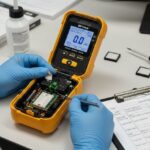
If your relearn method relies on “confirming” each wheel, a TPMS activation tool makes the process faster and helps identify a sensor that won’t respond. If one wheel consistently fails to confirm, that’s a strong clue you have a sensor or battery issue rather than a reset issue.
Why resets fail and the message keeps returning
If you used the correct reset or relearn method and the warning returns, it’s time to switch from resetting to diagnosing.
A dead or dying sensor battery is one of the most common culprits. Since the battery is sealed, replacement typically means replacing the sensor. Battery life expectations are often cited around five to ten years, and some sources extend that estimate up to twelve years depending on conditions.
Another common problem is compatibility. Aftermarket wheels and “universal” TPMS sensors must match your vehicle’s protocol and be programmed correctly. If they’re not, you can end up in a loop where the system intermittently reads sensors or refuses to learn them.
Damage during tire mounting can also cause faults. Sensors can be cracked, valve stems can leak, or the sensor can shift if the wheel was serviced aggressively. In those cases, the warning is doing its job by telling you the system can’t be trusted.
Why TPMS is worth fixing, not ignoring
TPMS is meant to reduce the chance you drive for long periods with dangerously underinflated tires. In a nationally representative NHTSA evaluation cited in a transportation safety report, direct TPMS was found to be 55.6% effective at reducing severe underinflation, defined as more than 25% below recommended pressure.
AAA has also published research indicating TPMS readings are generally accurate, while still recommending manual pressure checks as the best habit for long-term tire health.
Real-world scenarios that explain what to do next
If the warning appeared immediately after a tire rotation, focus on a relearn, because the system often needs to re-associate each sensor with its wheel position. If the warning flashes and then stays on, treat it like a system fault rather than a low-pressure alert, because that pattern often aligns with sensor communication issues.
If the warning appears mainly during cold mornings and clears later, pressure threshold changes due to temperature may be the trigger. Inflate to the door placard when cold and see if it stabilizes. If it still shows service tire monitor system even with correct pressure, the system likely has a sensor or learn issue, not a “needs air” issue.
FAQ
How do I reset the service tire monitor system message?
Inflate all tires to the door-jamb placard PSI with cold tires, then use your vehicle’s supported reset method. If your vehicle auto-rechecks, a 10–20 minute drive may clear it. If the message appeared after a rotation or sensor work, perform the correct sensor relearn for your vehicle so the system can reassociate each sensor with its wheel position.
Why won’t my TPMS message reset after I filled my tires?
Because “service tire monitor system” often indicates a TPMS fault rather than low pressure. The most common reasons are a failed relearn after rotation, an unresponsive sensor, sensor damage, or a dying sensor battery. Many sources cite sensor battery life around five to ten years, with some extending that estimate higher depending on conditions.
Is it safe to drive with the service tire monitor system light on?
It’s usually safe to drive carefully to inflate your tires or reach a service location, but you should treat it as important. If TPMS isn’t functioning, you may not get a reliable warning when a tire becomes severely underinflated, which is the core safety purpose of the system under federal standards.
How long do TPMS sensors last?
Factory TPMS sensor batteries are sealed and commonly estimated to last about five to ten years, with some sources estimating up to twelve years depending on conditions and use. When the battery dies, the typical fix is sensor replacement.
Do I need a tool to relearn TPMS sensors?
Not always, because some vehicles can relearn through the infotainment system or a built-in learning procedure. However, a TPMS activation tool makes it easier to trigger each sensor during relearn and helps confirm which sensor is failing if one wheel won’t respond.
Conclusion
When the service tire monitor system message appears, it’s best to think “TPMS can’t be trusted right now,” not just “one tire is low.” Start with correct cold inflation to the door placard and a short drive to let the system recheck. If the warning started after tire rotation or sensor work, a proper relearn is often the step that actually works, because the system needs to map each sensor to the correct wheel position.
If the warning keeps coming back, repeated resets usually won’t solve it. That pattern strongly points to a sensor issue, compatibility problem, or a battery near end of life, which many sources place in the five-to-ten-year range for factory sensors.













Leave a comment