Home Blog Page 6

Mental Health Posters for Students: Calming, Supportive & Classroom-Ready

0

Mental health posters can do more than decorate a wall. In a classroom, they can quietly set the emotional tone, normalize help-seeking, and give students simple words for what they’re feeling. When students see supportive messages about stress, emotions, and coping, they get a steady signal that the room is a safe place to learn, reset, and try again.

In this guide, you’ll learn how to choose mental health posters that feel calming rather than corny, supportive rather than clinical, and truly classroom-ready rather than just “printable.” You’ll also get real-world examples, evidence-backed context, and practical ways to make posters work alongside routines and SEL instruction. If your goal is a classroom that supports learning and well-being at the same time, mental health posters can be a simple, high-impact piece of the environment.

Why mental health posters belong in student spaces

Posters work like micro-reminders. They don’t replace counseling, family support, or school mental health services, but they can reinforce the language and routines that help students regulate. When the same short message is seen at the same moment each day, it starts to act like a cue. Students may not remember a long conversation about coping skills, but they will remember the phrase posted beside the calm corner or the turn-in tray when stress shows up.

Mental health posters also support consistency. Students move between classes, teachers, and expectations. A common set of visuals across a grade level can reduce confusion and help students feel anchored. When every room uses similar words for emotions and coping, students don’t have to decode a different system every hour.

Another benefit is stigma reduction. Many students hesitate to ask for help because they fear judgment or trouble. A poster that calmly explains how to get support can make the “first step” feel normal. Even when students don’t act on it immediately, they begin to understand that help-seeking is part of the culture.

What “classroom-ready” mental health posters really mean

Classroom-ready does not mean flashy. It means the poster fits how classrooms actually function on real days, including the loud days, the tired days, and the days when half the class is anxious about a test.

A classroom-ready poster is readable from across the room, with high contrast and clean spacing. It uses short phrases that students can process quickly, especially when overwhelmed. It is emotionally safe, avoiding shame, blame, or dismissive positivity. It is inclusive in language and imagery, so students from different backgrounds and identities can see themselves as welcomed and respected.

Most importantly, it is actionable. A good mental health poster gives a next step that can happen in the moment, such as breathing, grounding, naming a feeling, or asking for help. “You matter” can be comforting, but “Breathe in for 4, hold for 4, out for 6” is a tool students can use right now.

The mental health posters students respond to most

Calming posters for stress, anxiety, and overwhelm

These posters are most effective when they focus on regulation. Students need a simple cue they can follow without thinking too hard. Breathing prompts, grounding prompts, and “pause” prompts are popular because they are fast and non-judgmental.

A strong example is a breathing poster with a short pattern that students can memorize. Another is a grounding prompt that guides attention to the senses. A third is a reminder that feelings pass and that the next step can be small.

Calming posters work best when the classroom routine supports them. If students are allowed to take a short reset without punishment, the poster becomes a trusted support rather than decoration.

Emotional vocabulary posters that help students name feelings

Many classroom conflicts and shutdowns are really communication problems. When students don’t have words, feelings come out as behavior. Emotional vocabulary posters solve a practical problem by giving students language. They work especially well when they include both basic emotions and more specific variations. The goal is not to label students, but to give them options.

When a student can say “I’m overwhelmed” instead of “I hate this,” you can respond more effectively. When a student can distinguish between “annoyed” and “angry,” you can intervene earlier.

Coping strategy posters that offer small choices

A coping skills poster becomes more powerful when it reads like an invitation rather than an order. Students are more likely to engage when they have agency. Posters that encourage students to pick one strategy can reduce power struggles and help the class stay calm.

The best coping posters include strategies that are realistic in a classroom. If a poster recommends things students cannot do at school, it will feel out of touch. Simple classroom-friendly strategies include breathing, stretching, drinking water, a short walk with permission, a quiet corner, or asking for a break using a pre-taught signal.

Self-compassion and growth mindset posters for “after the mistake”

Many students spiral after errors. They assume a wrong answer means they are not smart, not capable, or not safe. Posters that support self-compassion can be especially helpful near areas where academic stress happens, such as the assignment board, test-taking spaces, or independent work stations.

The most effective self-compassion messages feel real. Students often reject overly cheerful slogans, but they respond to respectful, grounded language. A poster that reframes mistakes as information can reduce shame. A poster that uses the word “yet” can encourage persistence without pretending the work is easy.

Help-seeking posters that make support clear

Help-seeking posters are classroom-ready when they are specific and calm. Students should be able to understand exactly what to do if they need support. In a school setting, this often means clear pathways like asking the teacher privately, requesting a counselor pass, or using a class check-in routine.

These posters should never be dramatic or alarming. The goal is to normalize support and reduce fear. Many schools have policies and approved language for crisis-related messaging, so it’s wise to align with counselors and administration.

How to place mental health posters so they actually get used

Placement is not an afterthought. Students do not scan every wall. They notice what is in their path, what is near routines, and what is near the moments that matter.

Belonging and welcome posters work best near the entrance, where the tone is set. A student who feels anxious walking into class may be reassured by a message that says they are safe and wanted there. Help-seeking posters work well near a teacher help area or a posted “how to get help” station. This reduces the awkwardness of asking and makes the process predictable.

Calming posters belong near a calm corner or reset space, where students can use them immediately. Self-compassion posters can go near areas where frustration tends to rise, such as the turn-in tray, the “late work” folder, or the test station. Communication and respect posters work well in group-work zones, where small conflicts can escalate if norms are unclear.

If you remember one idea, let it be this. Put regulation tools where dysregulation actually happens, not where you wish it didn’t.

Design choices that feel calming, not cheesy

Students, especially in middle and high school, can detect forced positivity. The best mental health posters avoid “good vibes only” language because it can unintentionally invalidate real feelings. A calmer approach acknowledges emotions while offering direction.

Specificity helps. “Take one deep breath” is more usable than “Stay calm.” “What’s one thing you can control right now?” feels more respectful than “Don’t worry.”

Visual design matters too. A poster that is visually loud can increase stress. A classroom-ready design uses whitespace, clean typography, and simple icons. High contrast supports readability, and avoiding clutter supports regulation. If you are printing, choose a size large enough to read without squinting. If you’re posting in multiple places, keep style consistent so the classroom looks intentional, not chaotic.

Trauma-informed design emphasizes safety, choice, and predictability. Posters that offer options tend to land better than posters that command compliance. “Choose a coping strategy” is often more effective than “Stop that behavior.”

Mental health posters by grade level

Elementary classrooms

Elementary students benefit from posters that are concrete, visual, and routine-based. They often need a clear “what to do next” because their ability to self-direct under stress is still developing. Short phrases paired with simple visuals can make the message stick.

In an elementary scenario, imagine a student who starts crying during math because the work feels hard. A breathing poster near a calm corner can offer a nonverbal script. If the student has practiced it in calm moments, they can follow the poster without needing a lot of adult attention. That helps you support them while still teaching the group.

Middle school classrooms

Middle school students crave respect and autonomy. Posters work best when they sound like the teacher trusts students to make choices. The tone should be straightforward and not childish. Middle school is also a time when social pressure is intense, so posters that offer private coping options can help students regulate without feeling exposed.

In a middle school scenario, students might feel panicky before presentations. A grounding poster near the speaking area can give a discreet tool. Even students who would never talk about anxiety out loud may still use the poster silently.

High school classrooms

High school students often respond to minimal text and clean design. They want language that feels real and adult. Posters that connect stress to practical steps can be especially helpful during exams, college planning, or heavy project weeks.

A high school scenario might involve exam week. A poster near the entrance that says something like “Overwhelm is a signal. What’s the next right step?” can interrupt spiraling thinking. It doesn’t pretend everything is fine. It just offers direction.

Evidence-backed context: why small supports matter

It’s easy to underestimate small environmental supports because they feel too simple. But consistency is powerful. When students repeatedly see messages that validate emotions and offer coping steps, those messages become familiar. Familiarity can reduce threat response, especially for students who are anxious, stressed, or carrying trauma.

This does not mean every student needs the same approach. It does mean classrooms benefit from supportive norms that reduce shame, increase emotional literacy, and make help-seeking easier.

Making posters effective with routines, not just walls

Posters become effective when they are taught and practiced. If you want students to use a breathing poster, model it during a calm moment. If you want them to use a coping poster, walk the class through two or three strategies and clarify what’s allowed. If you want help-seeking posters to work, teach the process and reassure students they won’t be punished for asking for support.

A practical approach is to reference a poster during transitions. You might say, “Before we start, let’s do the breathing pattern on the wall,” or “If you feel stuck, check the ‘next step’ poster by the board.” Over time, students start using the posters without prompts.

A common mistake is putting up too many posters at once. When every wall is covered, nothing stands out. A calmer classroom typically uses fewer, more intentional visuals.

A simple classroom scenario that shows why this works

Consider a fifth-grade teacher who sets up a reset spot and uses a small set of mental health posters. One poster cues a pause and breathing routine. Another cues a grounding routine. A third cues returning to learning when ready.

The biggest change is not that students suddenly stop feeling upset. The change is that students have a predictable path through the feeling. When a student gets overwhelmed, they know what to do. They don’t need a long lecture. They follow the routine, and the teacher can keep the class moving while still supporting the student’s nervous system.

That’s what “classroom-ready” really looks like. It’s not inspirational. It’s functional.

FAQs about mental health posters for students

What are mental health posters?

Mental health posters are classroom or school visuals that promote emotional awareness, coping strategies, self-compassion, and help-seeking. They do this through short, supportive messages and simple, repeatable tools.

Do mental health posters actually help students?

They can help as part of a supportive classroom environment. Posters reinforce language and routines that students can use when stressed, especially when teachers model them and connect them to SEL instruction. Given the scale of adolescent mental health needs, small and consistent supports can contribute to a more supportive culture.

Where should I put mental health posters in a classroom?

Put them where students will need them in the moment. Place welcoming and belonging messages near the entrance, calming tools near a calm corner or reset spot, help-seeking guidance near a teacher help area, and self-compassion messages near high-stress academic zones like turn-in areas or test spaces.

What should a calming poster say?

A calming poster should offer a simple, actionable step that can be done quickly. Breathing prompts and grounding prompts work well because students can use them without needing extra materials or attention.

Are mental health posters appropriate for all ages?

Yes, when they are designed for the students’ developmental level. Elementary students usually need visual cues and very concrete steps. Middle school students respond better to autonomy and respectful language. High school students tend to prefer minimal design and practical, realistic phrasing.

Conclusion: building a calmer classroom with mental health posters

Mental health posters are a small tool with a surprisingly big impact when they’re chosen intentionally and taught as part of classroom routines. They make emotional support visible. They give students language for feelings. They normalize coping and help-seeking. They can also reduce stress in everyday moments by offering quick, practical next steps.

Given that adolescent mental health challenges are common worldwide and that many students report significant distress, it’s worth designing classrooms that support nervous system regulation alongside academics.

Upper Control Arm Clunking Noise Over Bumps: Causes + Solutions

0

If you’re hearing a sharp clunk when you hit potholes, speed bumps, or rough pavement, it’s tempting to blame “the suspension” and move on. But when the sound seems to come from the top of the wheel area, especially on trucks, SUVs, and many front suspensions, the upper control arm is one of the first components worth inspecting. When bushings wear or the upper ball joint develops play, the suspension can shift under load and create that familiar knock. Parts manufacturers and suspension specialists commonly describe clunking over bumps as a symptom linked to worn control arm bushings or joints.

What the upper control arm does and why it clunks

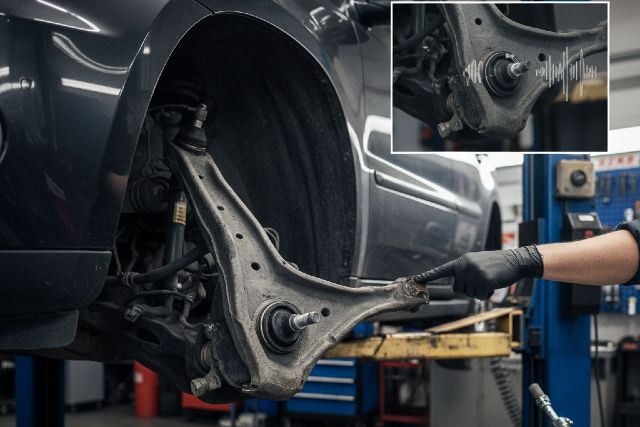
The upper control arm connects the vehicle’s chassis or frame to the steering knuckle, working with the lower control arm to guide wheel travel and keep alignment angles stable. Most designs use bushings at the frame mounts and a ball joint at the knuckle end. Those bushings are supposed to absorb vibration while still holding the arm in a controlled path.

Clunking usually happens when a part that should be tight develops extra movement. Over bumps, suspension load changes quickly. If the upper control arm shifts at its mounts, or the ball joint has clearance, you can hear a knock as components snap between loaded and unloaded positions. MOOG, a major chassis parts manufacturer, notes that front-end clunking can be associated with worn control arm bushings that allow the arm to move and contact surrounding components.

Upper control arm clunking noise over bumps: the most common causes

Worn upper control arm bushings

Upper control arm bushings are designed to flex, but they are not supposed to let the arm slide or rotate excessively. Over time, rubber can crack, separate from its sleeve, or soften, especially with heat, age, road salt, or oil contamination. When that happens, the upper control arm can shift during bumps and create a dull thud. Multiple repair references describe knocking or clunking over bumps as a classic sign of failing control arm bushings.

A common pattern is that you hear the clunk most at low speeds on rough roads, and it may get louder when the suspension is working harder, such as when entering driveways at an angle.

Upper ball joint wear

If the upper control arm uses an upper ball joint, or if the joint is integrated into the arm assembly, internal wear can create play. Over bumps, the ball stud can shift inside the joint and knock. This can also show up as inconsistent steering feel, mild wandering, or a clunk that changes when turning.

This is more than a comfort issue when wear is severe. NHTSA recall documentation involving ball joints and control arm connections describes the risk of loss of directional control if the joint separates.

Loose or improperly torqued upper control arm hardware

Sometimes the upper control arm itself is fine, but the fasteners are not. This often happens after recent suspension work such as struts, alignments, ball joint replacement, or lift kit installation. A slightly loose bolt at the control arm mount or the ball joint connection can cause a distinct clunk because the assembly shifts under load.

This can be serious in the wrong scenario. NHTSA safety documentation and recall materials have highlighted cases where insufficient torque or missing hardware at upper control arm ball joint connections increased separation risk.

Bent upper control arm from impact

A hard pothole hit, curb strike, or off-road impact can bend an arm slightly. Even small deformation can change how bushings sit or how the joint articulates, which can lead to binding and a knock during suspension movement. If the clunk began immediately after an impact and alignment feels “off,” physical arm damage becomes more likely.

Not the upper control arm, but it sounds like it

Front suspension noises reflect through the subframe and body, so several components can mimic upper control arm noise. Sway bar end links and sway bar bushings are frequent offenders, especially when the noise is rapid and repetitive over small bumps. Strut mounts and tie-rod ends can also create clunks that feel like they are coming from the upper area of the wheel well. Many diagnostic guides list sway bar links and strut mounts among common causes of clunking over bumps.

How to diagnose an upper control arm clunk without guessing

Start by observing the pattern

Try to notice when the clunk is most likely to appear. If it happens mainly when one wheel hits a bump, it often points to a side-specific part like a control arm bushing, ball joint, or sway bar link. If it happens equally on both sides over symmetrical bumps, it can be more related to sway bar bushings or strut mounts.

Also pay attention to whether the clunk changes during braking or acceleration over uneven pavement. Control arm bushing movement can be more obvious during transitions because the suspension is being loaded in multiple directions.

Perform a careful visual inspection

Look at the upper control arm bushings for cracking, tearing, separation, or “shiny witness marks” around the mount where metal may have been moving. Check the upper ball joint boot for splits, grease leakage, or rust-colored dust near the joint, which can indicate wear. Inspect mounting points for obvious shifting and confirm that hardware appears present and seated.

Repair references commonly emphasize that visibly cracked bushings and damaged ball joint boots are key indicators when clunking is present.

Confirm play with a load-and-watch approach

Shops typically confirm the cause by applying controlled force and watching how components move. A failed bushing usually shows the control arm shifting relative to its frame mount. A worn ball joint shows movement at the joint interface between the knuckle and the stud. If you don’t have the equipment to do this safely, paying for a targeted suspension inspection is usually cheaper than replacing parts by trial and error.

Rule out the top sound-alikes

If the upper control arm looks fine, the next best move is to check sway bar links, sway bar bushings, and strut mounts. Sway bar links often clunk quickly over small bumps, while strut mounts may knock over larger bumps and sometimes creak while steering. Multiple suspension noise guides list sway bar components as frequent sources of bump-related clunks.

Solutions that actually fix the clunk and keep it gone

Verify torque and correct installation first

If the clunk started after repairs, the simplest fix can be verifying torque on upper control arm mounting bolts and the upper ball joint connection fasteners to factory specification. This matters because some bushings must be torqued at ride height rather than with the suspension hanging, otherwise the bushing can be preloaded and fail early.

It also matters for safety. NHTSA recall materials have documented cases where loose or missing hardware at upper control arm ball joint connections could increase separation risk.

Replace worn upper control arm bushings or replace the entire arm

Depending on the vehicle, bushings may be replaceable separately, or the preferred repair may be replacing the whole upper control arm assembly. Replacing the full arm often makes sense when the ball joint is integrated, when corrosion is severe, or when labor to press bushings approaches the cost of a complete arm.

Manufacturers and repair resources frequently connect control arm bushing wear with clunking over bumps and recommend replacement when cracking or excessive movement is confirmed.

Replace the upper ball joint when it’s serviceable

If your design allows ball joint replacement without replacing the arm, a new joint can eliminate the clunk. However, if the arm bushings are also worn or the arm is already removed, replacing the complete upper control arm can be a better long-term solution since you’re renewing both wear points at once.

Get an alignment after control arm work

Replacing an upper control arm can affect camber and caster, and even bushing position can slightly change how the vehicle tracks. Alignment after replacement helps prevent uneven tire wear and restores predictable steering. If the clunk was tied to bushing movement, correcting geometry afterward keeps the handling improvements you paid for.

How urgent is an upper control arm clunk?

An occasional noise from a sway bar link can be annoying but not immediately dangerous. A clunk connected to the upper control arm deserves more urgency because it’s part of the structure that controls wheel position. In the worst cases, severe ball joint wear or loose hardware can progress toward separation, which NHTSA recall documentation describes as a risk for loss of directional control.

More broadly, NHTSA crash investigation research has found that vehicle component failure or degradation accounts for a small share of critical crash reasons in investigated crashes, but that’s exactly why it’s worth addressing a known mechanical issue early, before it becomes the exception that causes a bigger problem.

Real-world scenarios that match what drivers experience

A common situation is a clunk that begins shortly after struts or suspension work. Everything feels fine until the first week of driving, then a single knock appears over speed bumps. Inspection often finds a fastener that was tightened but not torqued correctly, or a bushing bolt torqued with the suspension hanging. Correcting the torque at ride height can solve it, and it’s consistent with safety guidance that highlights the importance of correct hardware installation at ball joint and control arm connections.

Another frequent pattern is a high-mileage vehicle that develops a dull thud over broken pavement along with inner-edge tire wear. That combination often points to bushing wear allowing geometry shift. Replacing the upper control arm and aligning the vehicle typically removes the noise and stabilizes tire wear, matching common symptom descriptions for worn control arm bushings.

FAQs

Can an upper control arm cause a clunking noise over bumps?

Yes. When upper control arm bushings wear or the upper ball joint develops play, the suspension can shift during bump impacts and create a clunk. Suspension references and parts manufacturers commonly list clunking over bumps among symptoms of control arm or bushing wear.

Is it safe to drive with an upper control arm clunk?

It depends on the cause. If the clunk comes from looseness in the upper control arm, ball joint wear, or loose hardware, the issue can worsen and may create a safety risk. NHTSA recall documents describe loss of directional control risk if ball joint or control arm connections separate.

What does a bad upper control arm bushing sound like?

It typically sounds like a dull knock or thud over bumps, often most noticeable at low speeds or when one wheel hits uneven pavement. Clunking over bumps is repeatedly cited as a common symptom of worn control arm bushings.

Do I need an alignment after replacing an upper control arm?

In most cases, yes. Replacing an upper control arm can change alignment angles, and an alignment helps prevent tire wear and restores stable steering.

Could the clunk be something else?

Yes. Sway bar links, strut mounts, and other steering and suspension components can mimic upper control arm noise. Many guides list sway bar links among the most frequent sources of clunks over bumps.

Conclusion

If you’re dealing with an upper control arm clunking noise over bumps, the fix starts with confirming where the play is coming from. The most common culprits are worn bushings, a worn upper ball joint, or hardware that’s loose or incorrectly torqued. Manufacturers and repair references consistently link control arm bushing wear to bump-related clunks, and NHTSA documentation shows why ball joint and control arm connection integrity matters for safety.

Once you replace the worn component and verify proper torque, an alignment usually finishes the job by restoring correct geometry. The result is a quieter ride, more consistent steering, and better tire life.

Chivalry Test: Are You Courteous, Clueless, or Classic?

0

If you’ve ever wondered whether opening a door is thoughtful or awkward, you’re not alone. This chivalry test is a modern way to measure everyday courtesy without turning your social life into a medieval rulebook. Chivalry once described a knightly code shaped around honor and conduct, but today it’s mostly shorthand for considerate behavior, respect, and good judgment in how you treat people.

The reason chivalry feels confusing now is simple: the same gesture can land as warm and supportive in one moment, and patronizing in another. Context, consent, and expectations shape how courtesy is received. Research on gender norms and helping behavior suggests that help can sometimes be perceived negatively if it clashes with someone’s autonomy or the situation’s social cues.

What chivalry means today

Historically, chivalry referred to the ideals associated with knights, including duty, honor, and courteous conduct, especially in social settings. Over time, the word broadened into a general idea of politeness and consideration. Today, many definitions still frame chivalry as polite behavior, sometimes specifically describing men’s behavior toward women, which is one reason the term triggers debate.

In practice, modern chivalry works best when it becomes people-first instead of gender-first. It’s less about rituals and more about respectful awareness. If your behavior is rooted in equality, your gestures feel like kindness rather than a performance.

The modern chivalry test framework

Before you score yourself, it helps to understand what a meaningful chivalry test actually measures. It isn’t about whether you always pay or always open doors. It’s about how you make other people feel in everyday moments, especially around respect and autonomy.

A strong modern framework has three elements. The first is intent, which asks whether you’re doing something to genuinely help or to be seen helping. The second is consent, which asks whether the other person wants the gesture at all. The third is consistency, which asks whether you treat courtesy as a habit or as a selective strategy.

Chivalry test: score yourself honestly

Use this chivalry test as a self-check. For each question, pick the option that best matches what you usually do, not what you wish you did. Give yourself two points for A, one point for B, and zero points for C.

Door moments in daily life

A means you hold the door when it makes sense for whoever is closest behind you, without making it a big deal. B means you only do it on dates or for certain people. C means you rush through and pretend you didn’t notice.

Paying on dates or hangouts

A means you talk about it early and confidently, using a simple line like “Do you want to split, or should I grab this one?” B means you assume one rule without discussion, like always splitting or always paying. C means you freeze and hope the other person resolves it.

Dating expectations around paying have shifted significantly and vary by generation and personal values, so clarity usually creates comfort faster than rigid rules.

Compliments

A means you compliment choices and character, such as style decisions, effort, or how someone handled a situation. B means you default to appearance-only compliments. C means you avoid compliments entirely because you fear they’ll be misread.

Planning and effort

A means you contribute ideas and follow-through, and you adapt based on what the other person enjoys. B means you plan only when you’re trying to impress. C means you expect the other person to do all the planning while you simply show up.

Helping behavior in everyday situations

A means you offer help and ask first, using something like “Want a hand?” B means you jump in automatically without checking. C means you avoid helping even when it’s clearly needed.

This is one of the biggest “modern chivalry” moments because unsolicited help can be interpreted in different ways depending on context and expectations.

When someone declines your gesture

A means you accept the decline easily and move on without making it weird. B means you get slightly defensive or awkward. C means you insist anyway.

Respect during conflict

A means you stay respectful even when you disagree or feel frustrated. B means you’re respectful until you feel “disrespected first.” C means you become petty, sarcastic, or mean.

How you treat service workers and strangers

A means you’re consistently polite and patient. B means you’re polite when you’re in a good mood. C means you’re abrupt, entitled, or dismissive.

Safety and awareness moments

A means you offer options without pressure, like “Want me to walk you to your car, or are you good?” B means you assume what they want and act on it. C means you never think about it.

Equality mindset

A means your baseline is “we’re equals,” and courtesy flows both ways. B means you think courtesy is mainly one person’s job. C means you think courtesy is outdated and not worth practicing.

Your chivalry test results

Add up your points and use the ranges below.

Courteous: 16–20 points

If you score in this range, you’re practicing the most reliable kind of chivalry: modern, respectful, and grounded. You understand that the best gestures are small, consistent, and free of pressure. People tend to feel comfortable around you because your courtesy doesn’t come with a hidden agenda.

Your advantage is adaptability. You can be warm without being performative, and you can be helpful without being controlling. That balance matters because modern expectations vary widely, especially in dating and social dynamics.

Classic: 8–15 points

If you score here, your style leans traditional. You likely value manners, initiative, and clear roles. Many people still find that charming, especially when it’s paired with genuine respect and emotional maturity.

The growth opportunity is learning when to pause and ask. Classic chivalry becomes modern chivalry when it’s based on consent rather than assumptions. You don’t need to abandon what feels natural to you; you only need to make it flexible.

Clueless: 0–7 points

If you score in this range, it doesn’t automatically mean you’re rude. It often means you’re operating on autopilot, missing cues, or avoiding small social moments because they feel awkward. The good news is that courtesy is a learnable skill, and small prosocial habits can improve how people experience you over time.

Start with one habit you can repeat without effort, like holding doors when it’s natural or offering help with a quick question instead of jumping in. Consistency will change your score faster than grand gestures ever could.

Why chivalry sometimes backfires

Chivalry tends to backfire when it becomes a performance or when it crosses into behavior that implies someone is less capable. That’s why some people associate chivalry with benevolent sexism, where “helpful” gestures can carry an unintended message of superiority or control. Academic discussions of gendered norms in everyday helping, including door-holding, highlight that social meaning depends on context and the recipient’s expectations.

Another common failure point is selective courtesy. If you are only polite to people you’re trying to impress, your “chivalry” reads like a tactic rather than character. People are surprisingly good at sensing the difference.

Finally, chivalry fails when a gesture comes with an invisible invoice. Courtesy can’t be traded for attention, affection, or compliance without becoming manipulation.

The modern chivalry formula that works almost everywhere

The simplest way to pass any chivalry test is to follow a pattern that respects both kindness and autonomy.

First, notice what’s happening instead of staying in your own head. Then offer rather than assume, keeping your tone light. Next, respect the answer immediately, even if the answer is no. Finally, be consistent, because consistency is what makes courtesy feel safe and real.

That approach works in dating, friendships, family life, and professional settings because it’s rooted in respect rather than roles.

Real-world scenarios you can copy

Imagine you’re at a café and the door swings heavy behind you. A modern, courteous response is holding it briefly for whoever is right behind you, regardless of gender, and continuing forward without making the moment feel like a performance. The gesture stays small, normal, and universally respectful.

Now imagine the bill arrives at dinner. A modern chivalry move isn’t “always pay” or “always split.” It’s initiating a simple, confident conversation that removes pressure. Expectations around who pays can vary widely, so a quick check-in often prevents awkwardness and resentment.

Finally, imagine you offer help carrying something and the other person says they’ve got it. The most attractive response is a calm “Got it,” with no sulking or insisting. That reaction signals respect, and it avoids the situation where help starts to feel controlling.

Featured snippet definition: what is a chivalry test?

A chivalry test is a self-assessment that measures how consistently you practice respectful, considerate behavior in everyday interactions, especially in social and dating situations, based on intent, consent, and consistency.

Common questions about chivalry

Is chivalry sexist?

Chivalry can be sexist if it’s based on assumptions that one person is inherently weaker, or if it’s used to control outcomes. But it doesn’t have to be sexist when it’s practiced as mutual courtesy rooted in equality and consent. Modern usage often works best when chivalry is treated as people-to-people respect rather than a gendered script.

Is chivalry dead?

Chivalry isn’t dead so much as evolving. Many people still value considerate gestures, but rigid rules are fading in favor of communication and mutual respect. What used to be “expected” is increasingly becoming “negotiated,” especially around dating roles and finances.

Should men always pay on dates?

There’s no universal standard anymore. People’s preferences vary by culture, age, and relationship goals. A practical approach is to address it directly and calmly, offering options without judgment. That makes you look confident and considerate at the same time.

Can women be chivalrous too?

Yes. If chivalry is understood as courtesy and respect, anyone can practice it. Many modern discussions emphasize moving away from strict gender roles and toward mutual consideration.

Conclusion: what your chivalry test score really means

Your chivalry test score isn’t about whether you’re old-school or modern. It’s about whether people experience you as respectful, aware, and emotionally safe. The best chivalry today looks like consistent courtesy, clear communication, and zero entitlement. When your gestures are grounded in respect and consent, they stay charming in every era.

Key Stuck in Ignition on a Push-Start or Keyless Car? Here’s the Real Fix

0

If you’re dealing with a key stuck in ignition, it can feel especially confusing when your car is push-start or “keyless.” You might be thinking, “Why is there even an ignition cylinder?” or “How can a modern car trap a key?”

Here’s what’s really happening. Many push-start vehicles still include a physical key or an emergency key slot, and most cars use safety interlocks that block key release unless certain conditions are met. That means your key isn’t “randomly stuck.” It’s usually being held by a park/shift interlock, steering lock pressure, low 12-volt power, or a worn ignition mechanism that can’t return cleanly to the release position.

What “Key Stuck in Ignition” Means in Push-Start and Keyless Cars

Even if you press a start/stop button, your car may still have a physical key system somewhere in the background. Some vehicles have a conventional ignition cylinder plus push-start features. Others have an emergency key slot or a hidden mechanical key inside the fob for doors and backup access. Toyota, for example, documents that when the Smart Key battery dies you can use the mechanical key to enter, then hold the Smart Key near the start button to start the engine.

So when the key won’t come out, it usually means the car believes it is not in the correct “safe state.” The most common blockers are that the vehicle doesn’t think it’s fully in Park, the steering lock is loaded with pressure, or the 12-volt battery voltage is too low to release the key-lock solenoid.

Why Your Key Gets Trapped: The Most Common Real Causes

The transmission isn’t fully recognized as Park

Many vehicles are designed so the ignition key cannot be removed unless the shifter is in Park. This is not just tradition — it’s a safety system built into shift interlock designs. Service documentation describing shift interlock operation explicitly notes that the ignition key cannot be removed until the gearshift lever is returned to Park.

In plain English, you might be “in Park,” but the sensor that tells the car you’re in Park might not be reading cleanly because of drivetrain load, a sticky shifter mechanism, or a failing switch.

Steering wheel lock pressure is binding the cylinder

If you parked with the steering wheel turned hard, the steering lock can clamp down. That pressure can bind the cylinder so the key can’t rotate to the exact release position.

Low 12-volt battery voltage prevents release

This is a big one people miss. Key release can be controlled by a key-lock solenoid or related mechanism. If the 12-volt system is weak, the car may not have the power needed to actuate a release properly, even though lights and accessories may still partly work. AAA frequently points to battery issues as a major reason drivers need assistance, and their maintenance guidance mentions batteries as one of the top call drivers.

A key-lock solenoid or interlock is malfunctioning

This isn’t guesswork—manufacturers and service bulletins describe diagnosing “cannot remove key from ignition” concerns by checking the key-lock solenoid output in body control data.

The ignition cylinder is worn or contaminated

If the key feels gritty or intermittently sticks, the internal wafers and springs can bind. This can worsen with heavy keychains and years of wear.

The Real Fix: Safe Steps That Actually Work (No Forcing)

Fix the Park signal problem first

Start by making the car absolutely sure it’s in Park. Put your foot firmly on the brake, then move the shifter out of Park and back into Park slowly and deliberately. If you parked on an incline, apply the parking brake first and let the vehicle settle slightly so drivetrain load isn’t fighting the parking mechanism.

This matters because shift interlock systems are designed around the idea that Park is the condition for key release, and service documentation describes that logic directly.

Relieve steering lock pressure the right way

If the steering wheel feels “stuck” against the lock, don’t muscle the key. Instead, gently try turning the key toward the release position while you turn the steering wheel slightly in the direction that has a bit of movement. Once the pressure is relieved, the cylinder often rotates easily and the key comes out.

A reputable automotive repair chain describes this as a common situation with a typically simple resolution — unlocking the wheel by relieving tension rather than forcing the key.

Make sure the car is truly OFF, not in accessory mode

On push-start vehicles, you can end up in accessory mode or ignition-on without realizing it. If the dash stays lit in a way that suggests the vehicle didn’t fully shut down, the system may not allow release. Cycle the start/stop button according to your model’s logic, and make sure the vehicle shows a true “off” state.

If your vehicle uses a removable emergency key in a slot or cylinder, it may still rely on the vehicle being in the correct electronic state before it allows release.

Restore 12-volt power if the battery is weak

If the car behaves strangely — dim interior lights, clicking, inconsistent electronics, or a refusal to fully power down — treat low 12-volt voltage as a serious suspect. Supplying stable power via a jump pack can restore proper interlock behavior.

AAA’s reporting and maintenance guidance repeatedly stress how often battery issues are behind breakdowns and service calls, which is consistent with real-world “interlocks don’t release” situations in modern vehicles.

If the key releases immediately after power is stabilized, you’ve learned something crucial: your key wasn’t “mechanically stuck” so much as “electronically held.”

If you’re using a key fob, handle a dead fob battery the smart way

A dying fob battery can create confusing symptoms in push-start systems. Some cars won’t recognize the fob reliably, which can prevent proper shutdown/authorization logic from completing.

Toyota’s official guidance is clear: if the Smart Key battery is dead, use the mechanical key to enter, then hold the Smart Key next to the start button while pressing it; Toyota also notes that if it still doesn’t work, the engine battery may be weak rather than the fob battery.

That single note is gold because it explains why two “battery problems” can look the same. If the fob battery is weak, recognition fails. If the 12-volt battery is weak, interlocks and modules can misbehave.

Address a binding cylinder with the right lubricant approach

If your vehicle has a real ignition cylinder and the key feels gritty, a dry lock lubricant is the safer approach than soaking it with oily spray that can attract dirt. If the problem is intermittent and getting worse, lubrication may buy time, but it’s often a sign of wear that will eventually require repair.

Reduce keychain weight as a preventative fix

If you have a conventional key-in-cylinder setup (even if the car also has push-start), a heavy keychain can increase wear and aggravate binding. It’s a small change that can noticeably reduce sticking over time, and it costs nothing.

When the “Real Fix” Is a Faulty Interlock or Solenoid

If Park is confirmed, steering tension is relieved, the car is truly off, and power is stable, but the key still won’t release, you may be in interlock/solenoid territory rather than user-error territory.

A manufacturer service bulletin on a “cannot remove key” concern outlines checking key lock solenoid output through body integrated unit data, which strongly suggests that on affected models the issue can be electrical or control-module related, not just “a stuck key.”

At this point, your smartest next move is often professional diagnosis, because repeated forcing can escalate a relatively straightforward repair into a broken key, damaged cylinder, or steering column trim replacement.

What Not to Do

When a key is stuck, the temptation is to yank harder. That’s how keys snap. A snapped key becomes a key extraction job, and if the cylinder is damaged in the process, it can become a steering column tear-down.

Also avoid prying aggressively at column trim or shifter trim. Modern interiors use clips that break easily, and misaligned trim can introduce new problems like shifter interference that mimics Park-sensor failures.

Real-World Scenarios That Match What Drivers Actually Experience

Imagine you park on a slope, put the shifter into Park, turn the wheel, and jump out quickly. The next time you try to remove the key, it won’t budge. In many cases, that’s not a “bad ignition.” It’s drivetrain load tugging against the parking mechanism plus steering lock pressure. Once you apply the parking brake, re-seat Park, and relieve steering tension, the key releases like nothing ever happened.

Another common situation is a weak 12-volt battery. You might still have enough power for lights, but not enough for reliable module behavior or solenoid actuation. AAA’s emphasis on batteries being among the most common roadside issues aligns with why drivers experience strange lock/interlock behaviors when voltage drops.

And then there’s the push-start confusion: the car is actually in accessory mode. The driver thinks it’s off because the engine isn’t running, but the vehicle logic doesn’t agree, so it doesn’t allow release.

FAQ: Quick Answers

Why is my key stuck in ignition if my car is push-start or keyless?
Because many push-start cars still use a physical key cylinder or emergency key slot, and the vehicle’s safety logic may block release unless it detects Park, full shutdown, and proper steering lock conditions. Shift interlock documentation explicitly ties key removal to being in Park.

Can a weak car battery cause a key to get stuck in the ignition?
Yes. If key release depends on a solenoid or electronic interlock, low 12-volt voltage can prevent the mechanism from releasing. AAA repeatedly identifies battery issues as a leading contributor to roadside events.

What’s the safest first thing to try?
Re-confirm Park carefully, especially on an incline, then relieve steering lock pressure while gently turning the key. Those two actions solve a large share of cases without tools and without force.

What if my key fob battery is dead—can that trap me in a weird state?
It can contribute to keyless recognition issues. Toyota’s official support guidance says you can often start the vehicle by holding the Smart Key next to the start button, and it also notes that if it still fails, the vehicle’s 12-volt battery may be the real issue.

When should I stop troubleshooting and call a pro?
If the key is twisting only with significant force, if it feels like it may snap, or if you’ve confirmed Park, relieved steering tension, and stabilized 12-volt power but the key still won’t release. A service bulletin approach to “cannot remove key” complaints includes checking key lock solenoid output, which is not something most drivers can verify roadside.

Conclusion: How to Fix a Key Stuck in Ignition Without Breaking Anything

A key stuck in ignition on a push-start or keyless car is usually an interlock condition, not a catastrophe. The most reliable fixes are the ones that satisfy the car’s safety logic: get a clean Park recognition, relieve steering lock pressure, ensure the vehicle is truly off, and restore stable 12-volt power when voltage is weak. AAA’s guidance reinforces that batteries and key-related problems remain among the most common reasons drivers need help, so this issue is far more normal than it feels in the moment.

If the problem persists after those steps, treat it as an interlock/solenoid or wear issue rather than “bad luck.” At that stage, professional diagnosis is often the fastest way to avoid snapping a key or damaging the cylinder, and service-bulletin style diagnostics show the issue can be electronic, not just mechanical.

po455 code: Ultimate Guide to Diagnosis and Repair

0

If you’re seeing the po455 code on a scan tool (often displayed as P0455), your vehicle is reporting that the evaporative emissions system can’t seal well enough to pass its self-test. In everyday terms, the car believes fuel vapors are escaping from a “closed” system because it detects what’s considered a large or gross leak. The upside is that this issue typically won’t leave you stranded. The downside is that it can keep the check engine light on, cause a fuel vapor smell, and prevent you from passing emissions inspection in many regions.

This guide explains what the po455 code means, what symptoms to expect, why it happens, and how to diagnose and repair it efficiently. You’ll also learn what technicians look for, when a smoke test becomes the smartest move, and how to confirm the repair so the code doesn’t come right back.

What does the po455 code mean?

The po455 code (P0455) is an OBD-II diagnostic trouble code that indicates the engine computer detected a large leak in the EVAP system. Most repair references define P0455 as “EVAP system leak detected (large/gross leak).”

The EVAP system is designed to capture gasoline vapors and route them to the engine to be burned instead of venting into the atmosphere. During an EVAP monitor test, the vehicle attempts to create and hold a specific amount of vacuum or pressure in the sealed system. If it can’t reach the target or can’t hold it, the computer interprets that as a leak. When it’s significant enough to be categorized as “gross,” you get P0455.

Why EVAP leaks matter in the real world

Even though an EVAP problem often feels “non-urgent,” evaporative emissions are a meaningful contributor to air pollution. Regulatory bodies treat evaporative emissions as a dedicated category because fuel vapors can contribute to smog-forming pollution. CARB maintains extensive evaporative emissions standards and compliance frameworks for on-road vehicles, reflecting how seriously these vapor losses are taken. The U.S. EPA also tracks evaporative emissions as part of its on-road emissions modeling and inventories.

From a driver’s perspective, that translates into a check engine light that won’t go away, an emissions test you may not pass, and the possibility of noticeable fuel odor if the leak is large enough or located where vapors collect.

Symptoms you may notice with po455 code

Most drivers first notice the check engine light. Many vehicles otherwise drive normally, because EVAP sealing is not the same as fuel delivery or ignition timing. Still, a few symptoms are common.

A fuel odor is one of the most frequent complaints, especially after refueling or when the vehicle is parked in an enclosed space. Some drivers notice the smell more on warm days, which makes sense because fuel vaporization increases with temperature.

In some cases, you may see inspection readiness problems. Even if the car runs fine, an EVAP code can prevent the EVAP monitor from completing properly, which can fail readiness-based inspections.

Occasionally, if the fault involves purge control, drivability symptoms can appear. Certain purge valve failures can create rough idle, hard starting after refueling, or stumble in specific conditions. Many diagnostic references explicitly include purge valve issues among common roots for EVAP leak codes because a valve that won’t seal can mimic a leak during the monitor test.

The most common causes of the po455 code

A large EVAP leak sounds dramatic, but very often the cause is simple. A loose, missing, incorrect, or worn gas cap is a classic trigger. Many reputable diagnostic summaries mention the gas cap as an early, high-probability check for P0455.

Cracked or disconnected EVAP hoses and vapor lines are another frequent culprit. These lines live in areas exposed to road debris, heat cycles, and corrosion, particularly near the charcoal canister and vent components.

Vent valve problems are also common. If the canister vent valve doesn’t seal when it’s supposed to, the system cannot build or maintain the vacuum/pressure needed for the self-test, and the computer interprets that as a gross leak.

A purge valve stuck open can create a similar effect. Even though nothing is physically “leaking” to the outside at the purge valve, an open path to the intake can prevent the EVAP system from sealing during the test, leading to the same code.

Finally, physical damage to the filler neck, fuel tank sealing points, or charcoal canister can cause large leaks. Consumer repair references frequently cite filler neck and tank-related sealing issues as common large-leak roots because they’re big openings and they’re exposed to rust and impact damage.

Is it safe to drive with po455 code?

In most cases, yes, you can drive with po455 code without an immediate safety risk, especially if the only symptom is the check engine light. EVAP systems are about vapor containment, not engine lubrication or coolant circulation.

That said, you should treat strong fuel odor seriously. If you smell raw fuel strongly, see wetness near the tank area, or suspect a liquid fuel leak, you should avoid driving and have the vehicle inspected promptly. Also, keep in mind that a constant check engine light can hide new problems. If another fault occurs, you may not notice it quickly because the warning light is already on.

How to diagnose po455 code efficiently

A good diagnosis follows a simple principle. You start with the easiest, highest-probability causes, then move toward higher-certainty testing, and you stop guessing as soon as you can prove where the system is leaking.

Confirm the code and look for related EVAP codes

Begin by scanning the vehicle and confirming P0455 is present and whether it’s pending or confirmed. Pay attention to additional EVAP-related codes, because combinations can narrow the search. Freeze-frame data can also hint at the conditions under which the test failed, such as fuel level and ambient temperature.

Check the gas cap and filler neck sealing surface first

This is the fastest win in the entire process. Remove the cap, inspect the rubber seal for cracking or flattening, clean any grit from the sealing surfaces, and tighten the cap fully. If the cap doesn’t tighten properly or looks worn, replacing it with an OEM-quality cap is often worth it before you spend time elsewhere. Many P0455 references specifically call the gas cap out as a common cause.

While you’re there, look closely at the filler neck. Rust, dents, or a compromised lip where the cap seals can create a large leak. It’s also common for issues near the refueling area to show up shortly after a fill-up, which is why many drivers connect the code with “it happened after I got gas.”

Do a careful visual inspection of EVAP hoses and vapor lines

If the cap and filler neck check out, move to the vapor lines. Look for cracked rubber, broken plastic lines, missing clips, and lines that have rubbed through on a bracket. Focus on the areas near the canister, vent valve, and any exposed routing under the vehicle, because that’s where road debris and corrosion take a toll.

Some large leaks are obvious once you’re looking at the right spot. A hose that has slipped off a fitting or split at a bend can create exactly the “gross leak” result the monitor is designed to catch.

Evaluate the purge valve because it can mimic a large leak

A purge valve that doesn’t seal can prevent the EVAP system from holding the required vacuum/pressure for its test. Many diagnostic summaries include purge valve faults as a likely cause for P0455, especially when the usual external leak points aren’t obvious.

If you have a scan tool that can command the purge valve on and off, you can check whether it responds properly. In a professional setting, technicians often verify whether the purge valve seals when commanded closed and whether it flows when commanded open. If it leaks when it should be closed, it can cause recurring EVAP codes even after you replace caps and hoses.

Consider the vent valve and charcoal canister area next

The vent valve is exposed to dust, water, and road salt, which makes it a frequent failure point. If the vent valve sticks open or cannot seal, the system can’t build vacuum and the test fails like a large leak.

It’s also worth inspecting the charcoal canister for cracks or damage. A canister that’s physically split or compromised can become a direct leak source, and in some cases, overfilling the tank repeatedly can saturate components and contribute to failures, depending on vehicle design.

Use a smoke test to stop guessing

If the simple checks don’t locate the issue quickly, an EVAP smoke test is typically the most time-efficient and accurate next step. A smoke machine introduces low-pressure smoke into the EVAP system. Wherever smoke escapes is the leak point, whether it’s a hairline split in a hose, a vent valve that won’t close, a canister seam, or a filler neck seal problem.

Many professional diagnostic workflows rely on smoke testing specifically because EVAP systems can be hard to diagnose by sight alone. When readers are stuck after a gas cap replacement, a smoke test is often the cleanest path to a confirmed answer.

Repairing po455 code: what fixes usually work

Once you’ve identified the cause, the repair becomes much more straightforward. The key is to avoid swapping parts because they “often fail” and instead match the repair to the confirmed failure.

If the gas cap seal is worn or the cap is incorrect, replacement is often the entire fix. This remains one of the most commonly cited solutions in P0455 write-ups.

If an EVAP hose or line is cracked or disconnected, replacing or re-securing that line usually resolves the gross leak. When replacing hose sections, make sure the hose material is appropriate for fuel vapor exposure and that the routing won’t create new rub points.

If testing indicates the purge valve leaks when it should be closed, replacement is typically the remedy. Purge valve faults can be particularly annoying because they can look like a “leak” even though the leak path is internal through the engine intake, and that’s why they show up in many diagnostic resources discussing P0455.

If the vent valve doesn’t seal, replacement is often required. A vent valve that’s contaminated or corroded can prevent the system from sealing during testing, producing exactly the large leak conclusion.

If the filler neck sealing surface is damaged or the tank/canister area has physical damage, repairs can range from replacing a filler neck section to addressing a cracked canister. Consumer repair references frequently include filler neck and tank-related causes among typical large-leak roots.

What to do after the repair so the code stays gone

After the repair, clear the code with a scan tool if you have one. Keep in mind that clearing codes often resets readiness monitors. If you’re due for inspection, you may need to complete a drive cycle so the EVAP monitor can run and pass.

If you don’t clear it, some vehicles will turn off the light after the EVAP monitor completes successfully across enough drive cycles. The timing varies because EVAP tests often require specific conditions, including certain fuel level ranges and stable driving.

If the code returns quickly, treat that as information. A fast return often points to a leak that’s still present or a valve that isn’t sealing when commanded. At that stage, smoke testing is usually the fastest way to get definitive proof of the leak location.

Real-world scenarios that match po455 code

Many P0455 cases start right after refueling. When the timeline is “I got gas, then the light came on,” it’s smart to focus first on the cap, the filler neck sealing surface, and the immediate plumbing near the refueling area.

Other cases are intermittent. Intermittent large leak codes can come from a vent valve that sticks occasionally, a hose split that opens with temperature changes, or a marginal connection that shifts with vibration. Intermittent issues are exactly where smoke testing shines because it gives you a visual confirmation instead of a guess.

A very common scenario is the “I replaced the gas cap but the code is still there” situation. That’s usually the cue to move on to vapor line inspection, purge valve sealing checks, and vent valve functionality, and then progress to a smoke test if the fault is still not obvious.

FAQ: po455 code quick answers

What is the po455 code? The po455 code (P0455) indicates a large EVAP leak, meaning the vehicle could not seal the evaporative emissions system well enough to hold vacuum/pressure during its self-test.

Can I drive with po455 code? In many cases, yes, the vehicle will drive normally. However, it can cause emissions test failure, fuel odor, and it may hide new faults because the check engine light is already on.

What’s the most common fix? The most common quick fix is tightening or replacing a faulty gas cap, followed by repairing cracked hoses or addressing purge/vent valve sealing issues depending on the confirmed cause.

Will the code go away after a gas cap replacement? It can, but it may take a few successful drive cycles for the EVAP monitor to run and pass, unless you clear the code with a scan tool.

Conclusion

The po455 code is a clear signal that your vehicle detected a large EVAP leak and cannot seal the fuel vapor system during its self-test. The smartest approach is to start with the simplest, most common causes, especially the gas cap and the filler neck sealing area, then move to vapor line inspection and purge/vent valve sealing checks. If the problem isn’t obvious, a smoke test is often the quickest way to find the exact leak point and avoid replacing parts that aren’t broken. EVAP controls are a major focus of emissions standards because fuel vapor losses contribute to pollution, and agencies like CARB and the EPA explicitly treat evaporative emissions as a key category.

If you share your vehicle year, make, model, engine, and any additional codes stored alongside P0455, I can tailor a vehicle-specific diagnostic path that matches how that platform runs its EVAP monitor and which components most often fail.

Hex Bolt Installation Tips: Torque, Washers, and Thread Locking

0

A hex bolt looks simple, but installation details decide whether the joint stays tight for years or slowly loosens after heat cycles and vibration. In real shops and real field repairs, most “bolt problems” are not mysterious material defects. They’re usually predictable outcomes from mismatched torque assumptions, inconsistent friction, the wrong washer choice for the surface and load, or a thread locking method that doesn’t match the environment.

This article focuses on what actually matters in everyday hex bolt work: how torque relates to clamp load, why washers can either protect preload or quietly destroy it, and how to choose thread locking that fits your service conditions. It’s written for people who assemble and maintain equipment, vehicles, structures, and machines, and it aims to reduce rework, loosening, leaks, and fatigue failures.

How a Hex Bolt Holds a Joint Together

A hex bolt doesn’t “hold” parts together in the way most people picture it. In a properly designed bolted joint, the bolt is tightened to stretch slightly, which creates preload (also called clamp load). That clamp load compresses the joint members and generates friction between the clamped surfaces. When the joint is loaded in service, that friction and compression resist movement. If the joint slips, the fastener is far more likely to loosen and fatigue.

NASA’s Fastener Design Manual treats torque, preload, friction, washers, locking methods, fatigue, and joint design as a connected system rather than separate topics, because reliability depends on how these elements work together.

Torque Isn’t Clamp Load, and That’s Where Most Trouble Starts

Torque is the most common tightening method because it’s convenient and fast. The problem is that torque is an indirect proxy for tension. A large portion of the torque you apply is consumed by friction in the threads and under the head or nut. That means two “identical” hex bolts torqued to the same number can end up with significantly different clamp loads if friction changes even slightly.

NASA technical guidance on preloaded joints explicitly discusses preload uncertainty and notes it depends on factors such as the torquing device, lubrication, measurement method, and friction variability from one bolt to another. The practical consequence is simple: if you treat torque as a guarantee instead of a controlled estimate, you’ll see unpredictable results over time.

If you ever wondered why one bolt in a pattern loosens while the others seem fine, friction scatter is a common culprit. One fastener had slightly more oil on the threads, or a washer with a different finish, or minor debris under the head. Your torque wrench delivered the same torque, but the joint didn’t get the same clamp load.

What Improves Torque Consistency in the Real World

You don’t need a lab to improve results. You need consistency in the things that dominate friction and settling.

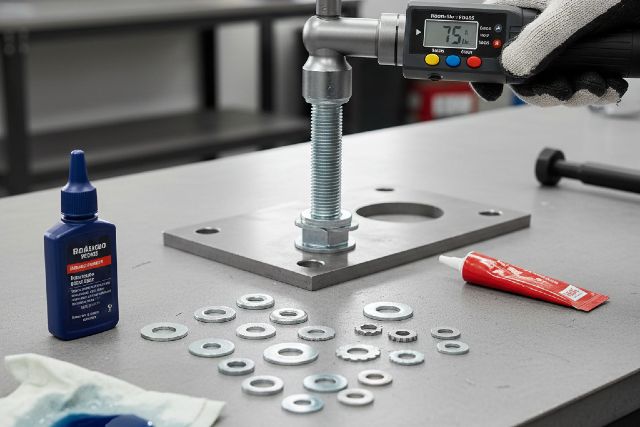
Clean and repeatable thread condition matters more than people expect. Dirt, corrosion, burrs, damaged threads, and plating differences all change the torque-tension relationship. Even when you “clean” a bolt, the feel can still vary if the under-head bearing surface is rough or if the washer face is inconsistent.

Lubrication is a big decision, not a minor detail. If a torque spec was developed for dry installation and you add oil, you can easily push clamp load higher than intended at the same torque. If a spec assumes lubrication and you assemble dry, you risk low preload and self-loosening. NASA’s preload work highlights lubrication and friction variability as major contributors to preload uncertainty.

Tool condition matters too. A torque wrench that is out of calibration doesn’t just “miss by a little,” it can systematically over- or under-tighten every fastener you touch. Calibration and proper technique help, but even perfect tools can’t overcome inconsistent friction.

On multi-bolt joints, uniformity matters as much as the final number. If a cover, flange, or bracket is pulled down unevenly, early bolts in the sequence may relax as the joint seats. That relaxation shows up later as “mysterious loosening” even though you swear you hit spec.

Hex Bolt Strength Classes and Why “Stronger” Isn’t Always Better

Bolt property class determines strength and how much preload a fastener can safely carry. ISO 898-1 is the key reference for mechanical properties of carbon and alloy steel bolts, screws, and studs by property class.

In practice, higher strength can be helpful, but it’s not automatically safer. If you’re clamping soft materials like aluminum, plastics, or thin sheet metal, the joint may crush or embed long before the bolt benefits from its higher capacity. If you’re tightening into a tapped hole, the internal threads may be the weak link. The “strong bolt” doesn’t matter if the threads in the part strip first.

Washers: The Quiet Factor That Can Save or Ruin Clamp Load

Washers are often treated like optional accessories, but they have a real mechanical role. They affect the bearing surface under the head or nut, protect the joint surface, and influence how much embedment and settling occurs. NASA’s Fastener Design Manual covers washers and locking approaches as part of the broader reliability picture for joints.

A flat washer can be a smart move when the joint material is soft, when the hole is oversized or slotted, or when you want to reduce surface damage and achieve more consistent under-head friction. The key is quality and hardness. A soft, cheap washer can deform under load. That deformation becomes settlement, and settlement reduces preload. Over time, reduced preload increases the likelihood of slip, vibration loosening, and fatigue.

Lock washers are commonly used, but it’s risky to assume they will prevent loosening in high-vibration, high-slip environments. In many real assemblies, self-loosening is driven by transverse movement and joint slip, not simply “rotation wanting to happen.” That’s why the industry talks so much about transverse vibration testing.

The Junker vibration test, described in DIN 65151, is widely referenced as a method to compare how well bolted joints and locking solutions maintain clamp load under transverse dynamic loading. Even if you never run this test yourself, the concept is valuable: if the joint experiences transverse vibration and slip, many locking methods will lose preload. The best “fix” often starts with better preload and better joint design to prevent slip, rather than relying solely on a washer to do the job.

For applications where vibration loosening is a recurring problem, wedge-locking washer systems are designed specifically to resist loosening under dynamic loads by using a cam principle. Junker-style testing is often used to demonstrate differences between locking approaches in these conditions.

Thread Locking: When Threadlocker Helps, and When It’s the Wrong Tool

Thread locking is about maintaining clamp load by resisting rotation loosening. It can also reduce leakage paths in some assemblies. The right choice depends on vibration, temperature, serviceability, and cleanliness.

Anaerobic threadlockers are popular because they’re simple and clean. LOCTITE 243, for example, is described by Henkel as a medium-strength, general-purpose threadlocker that works on many metals and can cure through many “as-received” fasteners with minor oil contamination. That oil tolerance is helpful in maintenance environments, but it’s not a license to ignore surface prep entirely. If the fastener is heavily contaminated or the surfaces are inconsistent, results will still vary.

Threadlocker is a strong option when vibration is present, when you can allow cure time, and when you want a locking method that doesn’t require special nuts, washers, or drilling for safety wire. It is less ideal when the joint is disassembled frequently, when temperatures exceed the product’s capability, or when chemical exposure may degrade the adhesive. Technical data sheets exist for a reason, and they’re worth checking before you standardize a threadlocker in a harsh environment.

Mechanical locking methods still have an important place. Prevailing torque nuts, all-metal lock nuts, and other mechanical approaches can be better when you need immediate resistance without cure time or when heat makes nylon inserts unsuitable. Transverse vibration testing discussions are often framed around comparing these approaches under DIN 65151 style conditions.

A Practical Hex Bolt Installation Workflow That Reduces Comebacks

A reliable installation starts before you pick up the wrench. Confirm that the hex bolt length and thread engagement make sense for the joint. If you’re threading into a tapped hole, make sure engagement is sufficient and that the internal threads are in good condition. If you’re using a nut, ensure the nut runs freely by hand for several turns. If it binds early, you may be cross-threading or dealing with damage that will distort the torque result.

Next, look at the seating surfaces under the head and nut. If paint, powder coat, or gasket material is in the bearing area, expect settlement. Settlement means preload loss. Some joints are designed with that in mind, but many field repairs are not. If you can’t avoid compressible layers, consider a tightening approach that accounts for seating and relaxation, such as staged tightening and a controlled recheck after initial seating, while recognizing that re-torquing changes friction conditions and can change the resulting preload. NASA guidance on preloaded joints discusses uncertainty factors and why the applied torque does not map perfectly to preload.

When washers are used, choose them intentionally. If the joint material is soft or easily damaged, a hardened flat washer can reduce embedment and provide a stable bearing surface. If the joint has a slotted hole or oversized clearance, a washer can help distribute the load more evenly and reduce localized deformation. If the application has repeated vibration loosening, consider whether the joint is slipping under load, because locking methods are fighting a losing battle when slip is uncontrolled. DIN 65151-style discussions highlight clamp load loss under transverse vibration as a key loosening mechanism.

If you use threadlocker, apply it consistently. Uneven application creates uneven friction and inconsistent torque feel. Follow the product instructions for amount, location on the threads, and cure expectations. Henkel’s LOCTITE 243 information emphasizes its general-purpose nature and oil tolerance, but the technical documentation still matters for best results.

When tightening, staged torque is one of the easiest improvements you can make on multi-bolt joints. Bringing fasteners up gradually helps the joint seat evenly and reduces the chance that early bolts lose preload as the assembly settles. If you’re working on something leak-sensitive like a cover or flange, this approach often makes the difference between “it seeps again next week” and “it stays dry.”

Finally, verification practices reduce surprises. In critical work, simple witness marking can help you identify rotation later. In production or high-risk maintenance, more advanced methods like tension-indicating bolts, direct tension indicators, or other measurement approaches can reduce uncertainty, as NASA notes that instrumented or load-sensing approaches can lower preload uncertainty compared with basic hand torque.

Common Questions About Hex Bolt Torque, Washers, and Thread Locking

What is a hex bolt, in practical terms? A hex bolt is a threaded fastener with a hexagonal head tightened by a wrench or socket to generate clamp load. Its primary function in most joints is to create preload so the joint surfaces stay compressed and resist movement through friction.

Is torque the same as bolt tension? No. Torque is only a proxy for tension because friction consumes much of the input torque in the threads and under the bearing surface. That is why preload uncertainty depends heavily on lubrication, tools, and friction variation.

Do washers increase clamping force? A washer doesn’t automatically increase clamp load. What it can do is help you achieve and maintain the intended preload by providing a stable bearing surface, reducing embedment in softer materials, and improving consistency under the head or nut. Washers are treated as part of the joint system in fastener design guidance, not as decoration.

What helps most with vibration loosening? The biggest lever is maintaining adequate preload and preventing joint slip, because transverse motion is a major driver of self-loosening. The Junker vibration test described in DIN 65151 is widely used to compare how well fasteners and locking solutions maintain clamp load under transverse dynamic loading, which mirrors the mechanism that loosens bolts in many real machines.

Can I use LOCTITE 243 on slightly oily fasteners? Henkel describes LOCTITE 243 as able to cure through many “as-received” fasteners with minor oil contamination and as suitable for a wide range of metals, including passive substrates. For best results, follow the product’s technical data guidance regarding application and curing conditions.

Conclusion: A Better Hex Bolt Installation Is Mostly About Consistency

A hex bolt becomes reliable when preload is predictable, and preload becomes predictable when friction, seating, washers, and locking choices are controlled instead of improvised. Torque is useful, but it is not clamp load, and authoritative fastener guidance highlights how preload uncertainty is influenced by tools, lubrication, and friction variability. Washers are not a formality; they can stabilize bearing surfaces and reduce embedment, or they can deform and quietly bleed away preload. Thread locking can be extremely effective when chosen appropriately, with products like LOCTITE 243 positioned as a general-purpose medium-strength option, but cure conditions and consistency still matter.

If you want a tailored recommendation, tell me the bolt size and property class, whether you’re using a nut or tapped hole, what the clamped materials are, and whether the joint sees vibration, heat, or frequent disassembly. I’ll suggest a practical torque approach, washer strategy, and thread locking plan for that exact scenario, and I’ll map it to the failure modes you’re most likely trying to avoid.

Trending Punch Needle Kits Right Now: The Cutest Designs Online

0

If you’ve been craving a cozy, low-pressure craft you can finish in a weekend, punch needle kits are having a major moment. They’re beginner-friendly, faster to complete than many embroidery projects, and the plush loop texture makes even simple patterns look impressive. That same texture also photographs beautifully, which helps explain why these kits keep appearing across online shops and social feeds. The broader DIY and arts-and-crafts market has continued to grow globally, supporting the ongoing popularity of accessible at-home hobbies like needle crafts.

Punch needle is also easier to “win at” early. Instead of learning multiple stitches on the surface of fabric, you build loops by punching yarn or thread through the foundation cloth. That speed-to-results is a big reason newcomers stick with it, especially when they start with a well-designed kit. Beginner guidance from established craft publishers emphasizes how important it is to pair the right fabric with the right needle and keep the material taut, since those factors largely determine whether loops stay secure.

What “trending” means for punch needle kits in 2026

When people search for trending kits, they usually want the cutest motifs that are popular right now, and they also want kits that are easy to buy and easy to finish. The best way to read “trend” in crafts is to look at what big marketplaces surface as popular categories and what major craft retailers stock repeatedly, since those reflect real-time shopper demand rather than just influencer aesthetics. Etsy’s punch needle kit categories and search-driven groupings are a useful barometer because they are shaped by what customers are actively browsing and purchasing.

Trend discovery platforms are also part of the picture. Pinterest is widely used to spot and track what people are saving and searching, especially in home décor and DIY categories. When the same motifs show up across marketplaces, retailers, and inspiration platforms, that’s usually the strongest signal that a design style is “in” right now.

Why punch needle kits feel easier than embroidery

Punch needle tends to feel more forgiving than traditional embroidery because the texture builds quickly and hides minor inconsistencies. In embroidery, uneven stitches can stand out. In punch needle, the fluffy loop surface blends small variations together. That said, most beginner frustration comes from two practical issues rather than a lack of skill.

The first issue is tension. Your foundation fabric needs to be pulled very tight so the needle can punch cleanly and the loops can form consistently. The second issue is materials compatibility. Fine punch needle projects often use tightly woven cloth and thread, while rug-style punch needle uses different fabrics and thicker yarn. If your loops ever fall out, it is often a sign that your fabric weave and needle/yarn size aren’t matched correctly. Expert tool makers provide clear troubleshooting guidance for these problems, and it can save you hours of trial and error.

Trending punch needle kits right now: the cutest designs online

The cutest trends tend to share a few traits. They work well with bold outlines, they look satisfying with plush texture, and they’re easy to finish into something you can display or use. Below are the designs that keep appearing across online kit listings and retailer assortments.

Mushroom punch needle kits that look straight out of a storybook

Mushrooms remain one of the most recognizable punch needle motifs online. They fit the cozy, cottagecore vibe, they’re easy to simplify into beginner-friendly shapes, and they look especially “puffy” when punched with soft yarn. The popularity of mushroom-themed punch needle kits shows up clearly in marketplace browsing categories and search-driven collections, which is a strong indicator that shoppers continue to seek them out.

A second signal is mainstream availability. Big craft retailers carry mushroom-themed punch needle kits as part of their needlecraft offerings, which suggests the motif has sustained demand beyond niche maker circles. If you want a low-risk first project, mushrooms are a smart pick because the shapes are forgiving and the color blocks are typically simple.

Floral punch needle kits with bold petals and modern color palettes

Florals never really go out of style, but the current “trending online” version looks more graphic than delicate. Think chunky daisies, tulips with thick outlines, and stylized leaves that fill a hoop with satisfying texture. These designs work particularly well for punch needle because curves become plush and dimensional.

You’ll often see florals recommended alongside beginner kits on marketplaces, partly because they can be completed with fewer colors, and partly because they’re giftable and universally appealing. If you want something that reads as boutique home décor, a bold floral hoop is one of the easiest ways to get that look.

Cute animal punch needle kits, especially cats, dogs, and tiny faces

Animals keep trending because they feel personal, even when the design is generic. A mushroom is cute, but a cat face coaster feels like it belongs to someone. Marketplace trend pages and search-focused collections frequently highlight animal themes such as cats, which suggests consistent shopper interest.

Animal kits also make great gifts because the recipient doesn’t have to be a “craft person” to appreciate a cute pet-themed décor piece. If you’re choosing your first animal kit, look for designs with strong outlines and minimal tiny details, since small facial features can be harder to keep crisp in loop texture.

Punch needle coaster kits that you can actually finish quickly

Coasters are one of the most practical formats, and they’re also one of the most finishable. That combination is why coaster-style punch needle kits show up so often in online kit groupings. They let you practice the basic rhythm of punching, turning corners, and filling shapes without committing to a large project.

If your first coaster has slightly uneven edges, it still works. That makes coasters a confidence-building entry point, and once you complete one, it’s easy to keep going and make a set.

Mini wall hangings and tiny tapestry kits for cozy home décor

Mini wall hangings are popular because they sit between “small beginner hoop” and “big statement rug.” They still feel decorative, but they don’t demand a large time investment. They also photograph beautifully, which helps them circulate on inspiration platforms.

Pinterest is often used for tracking and surfacing craft and décor ideas, and punch needle wall hanging inspiration continues to be discoverable there, reinforcing the format’s popularity as an approachable décor project. If you want something that looks like a boutique piece without buying more supplies, a mini wall hanging kit is a strong choice.

Hearts, ribbons, and soft nostalgia motifs

Hearts and ribbon-like shapes are trending across multiple aesthetics, from coquette-inspired décor to modern minimal romance themes. Punch needle amplifies that softness because loops add a plush finish that feels warm rather than flat. These motifs are often sold as small hoops, patches, or mini gifts, which keeps them accessible to beginners and impulse buyers.

This also aligns with broader trend forecasting that points toward personalization, expressive home décor, and nostalgia-forward aesthetics. If you like crafts that feel seasonal without being tied to a specific holiday, hearts and ribbons are an easy year-round pick.

How to choose punch needle kits that won’t frustrate you

A kit can be adorable and still be a headache if the materials are low quality or mismatched. The foundation fabric is one of the biggest predictors of success. A good kit uses fabric that grips the loops well and allows consistent punching without tearing. Beginner tutorials repeatedly emphasize that the fabric must be stretched tightly to hold loops properly.

Printed patterns are another quality-of-life feature. If a kit includes a pre-printed pattern, you avoid tracing errors and you can start stitching sooner. Tracing isn’t difficult, but it adds a step where beginners can lose confidence if lines end up faint or uneven.

Finally, think about your finish goal before buying. Some kits are meant to stay in a hoop as wall art. Others are designed to become coasters, pillows, or patches. If you know you want a functional object, choose a kit built for that use, since it will usually include the right finishing materials and dimensions.

Real-world kit picks based on your time and goals

If you want a cute project you can finish in one weekend, choose a coaster kit or a small hoop in the 6 to 8 inch range. These formats keep the project contained and reduce yarn switching, which is where beginners often slow down. Coasters are also frequently highlighted in online punch needle kit collections, suggesting they remain a popular entry project.

If you value very clear instructions, prioritize kits that include step-by-step photos or video guidance. Even then, it helps to keep a trusted beginner tutorial bookmarked so you can quickly check fundamentals like threading the needle, keeping tension, and understanding which side is the “loop side.”

If your goal is a boutique home décor look, pick graphic florals, mushrooms, or simple abstract shapes with a limited palette. These styles look intentional in loop texture and tend to hide minor unevenness along edges. They also feel more modern than overly intricate patterns, which can sometimes look busy once punched.

Tips to make your punch needle project look polished

The biggest visual difference between “first attempt” and “finished décor” usually comes from consistency. Aim to punch with steady spacing so the surface looks even. On curves, use slightly tighter spacing so your edges don’t look jagged. When outlining shapes, go slowly and treat that outline like the border of a coloring book; a clean outline makes everything inside it look better.

Avoid punching the same hole repeatedly. Overworking one spot can weaken the fabric and reduce its grip on loops. If you make a mistake, it’s often better to gently pull out a small section and redo it rather than repeatedly forcing the needle into the same area. If you notice loops slipping or falling out, troubleshoot the fundamentals first, because this is almost always a fabric tension or materials mismatch problem rather than a skill issue. Expert troubleshooting references can help you identify the specific cause and fix it quickly.

FAQ: punch needle kits

What are punch needle kits?

Punch needle kits are DIY sets that include a pattern, foundation fabric, and yarn or thread so you can create textured loop embroidery by punching the fiber through fabric using a punch needle tool.

Are punch needle kits good for beginners?

Yes, punch needle kits are widely considered beginner-friendly because the technique is straightforward and the loop texture builds quickly. Starting with a kit that includes the correct fabric and clear instructions makes the first project much easier.

Why do my punch needle loops fall out?

Loops usually fall out when the fabric is not tight enough, the fabric weave is too loose for your yarn or thread, or the needle and fiber size do not match the cloth. Checking tension and using a compatible fabric are the fastest fixes.

What punch needle designs are trending right now?

Mushrooms, bold florals, cute animals, coaster sets, and mini wall hangings continue to appear frequently in online kit categories and retailer selections, making them some of the most consistently popular styles.

Conclusion: choosing punch needle kits you’ll actually finish

The best punch needle kits right now combine a design you genuinely want to display with materials that make the process smooth. Mushrooms, modern florals, cute animals, coasters, and mini wall hangings are consistently popular online because they look great in plush loop texture and don’t require complicated detail work. If you start with a smaller project, you’ll learn the essentials faster, build confidence, and end up with something you’re proud to keep.

When you’re ready to level up, experiment with larger formats and custom palettes, but keep the same success formula in mind. Choose quality fabric, keep it taut, and match your needle and yarn to the kit’s intended style. That combination is what turns punch needle kits from a trend into a hobby you’ll keep coming back to.

7 Best Window Cleaning Kit Options for Homes, Cars, and Offices

0

If you’re shopping for a window cleaning kit, you’re probably after the same outcome every time: clear glass, zero streaks, and a setup that doesn’t turn a “quick clean” into a whole project. The challenge is that windows don’t all behave the same. Home panes deal with dust and pollen, cars collect oily film and haze (especially on the inside of the windshield), and offices get constant fingerprints and smudges from high traffic.

This article walks you through seven standout window cleaning kit options that make sense for real-life use in homes, cars, and offices. You’ll also learn what matters most for streak-free results, how to choose based on your specific needs, and the small technique tweaks that make a bigger difference than any “miracle spray.”

What a window cleaning kit should include

A window cleaning kit works best when it combines the right tool for loosening grime with the right tool for removing liquid without leaving residue behind. In practice, that usually means a scrubber or washer to lift dirt, a squeegee to pull solution off the glass, and microfiber cloths to detail the edges and corners where drips like to hide. For taller windows, you’ll also want reach, either through a telescoping pole or an outdoor hose sprayer option that lets you clean from the ground.

Microfiber matters more than most people realize. It picks up fine dust and oils instead of smearing them, which is exactly what you want on glass that shows every imperfection in sunlight. If you’ve been using paper towels and getting lint or hazy streaks, switching to microfiber is often the quickest improvement you can make.

The streak-free basics that work with any kit

Streak-free window cleaning is mostly about controlling two things: residue and drying speed. Residue comes from too much cleaner or dirty tools. Drying speed becomes a problem when you clean in direct sun or on very hot glass, because the solution flashes off before you can remove it evenly.

Start by removing dry dust first, especially on indoor windows and office glass. When dust mixes with liquid, it turns into a thin, muddy film that you then spread across the glass. Use your scrubber or a dry microfiber cloth for a quick pass to pick up loose debris. Then apply cleaner lightly rather than soaking the surface. More product feels like it should clean better, but on glass it often increases streaking because the extra solution dries unevenly.

When you squeegee, keep a steady pace and wipe the blade frequently. Even a tiny nick in the blade or a small buildup of grime can create a repeating line across the entire pane. Finish by drying the edges and corners with a clean microfiber cloth. This final detailing step is where most “almost perfect” windows become genuinely spotless.

1) Ettore Professional ProGrip Window Cleaning Kit

If you want a straightforward, pro-style setup that works beautifully for typical home windows, the Ettore ProGrip-style kit is a strong choice. It’s built around the classic pairing that professional cleaners have relied on for decades: a quality squeegee and a washer that holds enough solution to loosen dirt without flooding the pane.

This kind of kit feels especially efficient on interior home windows, sliding glass doors, mirrors, and any large pane where you can make clean, consistent passes. The main advantage is speed. You can wash the surface, squeegee it down, and detail the edges in a rhythm that quickly becomes second nature.

2) Unger Total Pro Kit

For anyone dealing with taller windows, office glass partitions, or any pane that makes you think about dragging out a ladder, a kit that includes a telescoping pole is a game changer. The Unger Total Pro-style kit is popular because it gives you the basics while adding reach, which increases both convenience and safety.

The big win here is that you can keep your body in a stable position while cleaning. That matters for comfort, but it also matters for reducing risky stretching and awkward angles. If your home has upper windows that you can reach from the ground with a pole, this type of kit can turn a job you avoid into something you can do quickly on a normal cleaning day.

3) Unger Pro Window Cleaning Kit

If you clean glass often, or if you manage a space with lots of windows, a more complete professional-style kit can be worth the upgrade. Unger’s more comprehensive pro kits tend to include additional pieces beyond the basic squeegee and washer pairing, which helps you stay consistent across different surfaces and conditions.

This is a smart option for small offices, storefront-style glass, and homes with lots of panes where you don’t want to constantly switch tools or improvise. The experience is smoother because you’re set up for the most common problems: stuck-on spots, frequent fingerprints, and larger glass areas that need fast, repeatable technique.

4) Invisible Glass Reach & Clean Tool

Car glass is a different world, and the inside windshield is where most people struggle. The dashboard blocks your reach, the angle is awkward, and the glass often has a stubborn film that keeps coming back. A reach tool designed specifically for tight angles is one of the most practical “car-first” additions you can buy.

The Invisible Glass Reach & Clean-style tool is designed to help you reach the lower corners and the deep base of the windshield without twisting your wrist into a painful position. It’s also helpful around home windows that are difficult to access, such as panes behind sinks or awkwardly placed mirrors.

In real terms, this tool solves the problem of “I cleaned it, but I can still see the haze.” It helps you apply even pressure, which reduces patchy cleaning and the smearing that happens when you’re cleaning with fingertips through a cloth.

5) Stoner Invisible Glass Premium Glass Cleaning Kit

If your priority is car windows, especially tinted ones, you’ll want to pay attention to cleaner compatibility. Many drivers prefer ammonia-free formulas for tinted glass, and premium kits built around that idea often include microfiber towels specifically meant to minimize lint and streaking.

A Stoner Invisible Glass-style premium kit is a strong pick when you want a complete car-glass routine in one package. It’s especially useful for commuter cars and family vehicles where fingerprints and interior haze build up quickly. This type of kit also transitions well to office glass doors and high-touch interior panes because it’s designed to handle oils and smudges efficiently.

6) Windex Outdoor Sprayer

For exterior home windows, convenience can matter as much as perfection. If you’re not trying to detail every edge and corner, a hose-connected outdoor sprayer kit can be a practical solution. The Windex Outdoor Sprayer-style option is designed to attach to a garden hose so you can spray the solution and rinse without climbing or squeegeeing.

This is often the right tool for maintenance cleaning, seasonal pollen cleanup, and quickly improving the look of patio doors and outdoor panes. It’s especially attractive if your main pain point is “I can’t reach, and I don’t want to use a ladder.”

That said, it’s helpful to set expectations. Outdoor sprayers can do a great job for routine exterior cleaning, but if you have heavy residue, hard-water spots, or very dirty panes, you may still need a scrub-and-squeegee approach for truly polished results.

7) Kärcher WV 6 Plus Window Vac

In offices, large glass walls, and spaces where dripping is a constant annoyance, a window vacuum can feel like a cheat code. Instead of relying solely on towels to catch runoff, a window vac is designed to suction up the dirty water after you wash the pane. This reduces drips down the glass and helps protect window sills, floors, and trim.

The Kärcher WV 6 Plus-style device is particularly useful when you’re cleaning many panes in one session. It also helps in situations where you’re dealing with condensation cleanup, such as glass in humid environments. If your problem is less about “how do I remove dirt” and more about “how do I avoid mess,” this is one of the most satisfying upgrades you can make.

How to choose the best window cleaning kit for your space

For most homes, a pro-style squeegee-and-washer kit is the best all-around choice because it provides repeatable, streak-free results once you learn the basic technique. If your home has taller windows, a kit that includes a telescoping pole often delivers more value than buying a bigger squeegee, because reach is the true limitation in that scenario.

For cars, the inside windshield and tight corners are usually the deal-breakers. That’s why reach tools and a good microfiber routine often outperform “more powerful cleaner.” Car glass tends to show oils and haze more dramatically than home windows, especially at night when headlights amplify film.

For offices, the volume of glass and the frequency of smudges matter most. You’ll want tools that let you work quickly without dripping everywhere. A more complete pro kit makes sense if your glass is large and frequent, while a window vac becomes appealing when floors, sills, and nearby electronics make runoff a headache.

The most common reasons people get streaks

One of the biggest causes is cleaning in direct sun. The solution dries too quickly, leaving behind uneven residue. Another common issue is using too much cleaner, which increases the amount of liquid that needs to be removed evenly. Dirty tools are also a quiet culprit; a slightly grimy microfiber cloth or a squeegee blade with buildup can create streaks that repeat in the same pattern across the pane.

Finally, many people skip edge detailing. Even if your center glass is perfect, a thin line of solution along the frame dries into a visible outline. A quick wipe around the perimeter with a dry microfiber cloth is often what takes the finish from “clean” to “professionally cleaned.”

DIY solution vs store-bought cleaner

There’s no single perfect answer, because different messes respond better to different approaches. Light dirt and everyday dust often clean easily with mild solutions, while oily film and heavy grime may benefit from dedicated glass products designed to cut grease without leaving residue. Vinegar-based mixes are popular for certain situations, especially when you’re trying to reduce streaks and avoid heavy fragrance or additives. Mild dish soap in water can also work well when the glass is genuinely dirty, because it helps break up grime and oils.

If you go the DIY route, the biggest success factor is restraint. Use a small amount of solution and pair it with a proper removal method, such as a clean squeegee pass followed by microfiber detailing. Most DIY failures come from oversaturating the surface and then trying to wipe it dry with the wrong towel.

Common user questions about window cleaning kits

What is the best window cleaning kit for home use?

For most homes, a window cleaning kit built around a quality squeegee and washer is the best starting point because it delivers consistent results on standard panes. If you have tall windows, a kit with a telescoping pole becomes the better choice because it solves the reach problem that stops most people from cleaning regularly.

How do I clean windows without streaks?

The most reliable streak-free approach is to remove dust first, apply a small amount of solution, squeegee in steady passes, wipe the blade frequently, and finish the edges with a dry microfiber cloth. Try to avoid cleaning in direct sun or on very hot glass, because fast drying increases streaking.

What window cleaning kit works best for cars?

Car cleaning is usually won or lost on the inside windshield. A reach tool designed for tight angles, paired with microfiber towels and a cleaner that doesn’t leave residue, is often the most effective combination. This setup helps you reach the lower corners and apply even pressure, which reduces haze.

Is a window vac worth it for offices?

A window vac can be worth it if you have many panes to clean, if drips create extra work, or if you want faster cleanup with less mess. It’s especially useful on large office glass walls and partitions where runoff is the main annoyance.

Conclusion

Choosing the right window cleaning kit is easier when you start with where you’ll use it most. For everyday home windows, a professional-style squeegee-and-washer kit is often the most efficient path to streak-free glass. For taller panes and office partitions, adding reach through a telescoping pole can make the job safer and more manageable. For cars, especially the inside windshield, a reach tool and a microfiber-first routine solve the problems that cause haze and stubborn corner streaks. And if you’re managing lots of glass in an office setting, a window vac can reduce drips and speed up cleanup dramatically.

No matter which kit you choose, the fastest route to better results is usually technique. Use less solution, avoid hot direct sun, keep your tools clean, and finish the edges carefully. Do that consistently, and your windows will look noticeably clearer, longer — whether they’re at home, in your car, or in a busy office.

H2S Monitor Maintenance Checklist: Keep Your Detector Accurate All Year

0

An h2s monitor is only useful if it’s trustworthy in the moment you need it. Hydrogen sulfide (H₂S) is especially dangerous because you can smell it at low levels, but your sense of smell can fade quickly even while the gas is still present. OSHA explicitly warns not to rely on odor due to “olfactory fatigue.” That’s why maintenance isn’t paperwork. It’s part of hazard control.

This article explains how to keep your h2s monitor accurate all year with a practical, field-ready routine. It covers bump tests, calibration strategy, sensor care, storage, documentation, and common troubleshooting scenarios, along with FAQ-style answers that work well for featured snippets.

What accuracy really means for an H2S monitor

Accuracy is more than “it turns on.” In day-to-day safety work, accuracy means the sensor responds to H₂S at the correct concentration, alarms trigger at your setpoints, and the reading is stable enough that you can make decisions quickly. When accuracy slips, it usually doesn’t fail dramatically. It drifts quietly, giving you slower response times or under-reading, which is the most dangerous failure mode because it creates false confidence.

It’s also important to remember that H₂S risk is not theoretical. NIOSH lists hydrogen sulfide as having an IDLH (Immediately Dangerous to Life or Health) value of 100 ppm, which underscores how fast conditions can become life-threatening in certain scenarios.

Bump test vs calibration

A bump test is a quick functional test where you expose the detector to a known concentration of test gas to confirm the sensor responds and the alarms activate. OSHA’s safety bulletin explains that ISEA updated its position statement to recommend a bump test or calibration check before each day’s use, following manufacturer instructions.

Calibration is a more thorough accuracy verification process using certified gas. It may include adjustment if the instrument is outside acceptable limits. Think of bump testing as confirming the detector “can detect,” while calibration verifies it “detects correctly.”

H2S monitor daily maintenance checklist

Daily maintenance is where most preventable failures are caught. The goal isn’t to create extra steps. It’s to avoid stepping into a space with a device that only looks ready.

Start with a fast visual inspection. Look for cracked housings, damaged clips, blocked sensor ports, and any sign of moisture or contamination around the inlet. If the ports are clogged, your sensor can’t “breathe” properly and response time can slow.

Power it on and let it complete its startup checks. If your model displays faults, don’t ignore them because “it usually works.” A sensor fault is the detector telling you it cannot be trusted today.

If your procedure allows a fresh-air zero, do it only in known clean air. This is a subtle but common failure point: if you zero in contaminated air, you can bias readings and reduce safety margin.

Then perform a bump test. OSHA’s bulletin, reflecting ISEA guidance, supports bump testing or calibration checking before each day’s use, following the manufacturer’s instructions. If the unit fails the bump test, remove it from service and run a full calibration or troubleshoot per your program. ISEA guidance also states instruments failing a bump test must be adjusted via full calibration before further use.

Weekly maintenance that prevents slow-response problems

Weekly care is mostly about preventing small buildup and minor wear from turning into a failed bump test on a critical day.

Clean the exterior with the manufacturer-approved method and keep solvents away unless the manufacturer explicitly allows them. In many industrial environments, the bigger issue isn’t visible dirt, it’s fine dust and grime that gradually blocks the gas path.

Check inlet areas and any filters or protective membranes your model uses. If airflow is restricted, the sensor’s response slows, and a “late alarm” is almost as bad as no alarm.

Review any stored logs or recent alarms. Even if readings were “fine,” recurring spikes, unusually frequent alarms, or longer-than-usual time to clear can indicate sensor stress or contamination. If you use a docking station, confirm it’s recording and timestamping correctly so your documentation doesn’t fall apart during an audit.

Monthly maintenance for drift control and confidence

Monthly checks are where a strong program separates itself from a weak one. A detector can pass daily bump tests and still gradually drift, especially if it’s exposed to harsh conditions.

Run a calibration check using certified gas at the concentration your procedure specifies. If it’s outside tolerance, perform a full calibration. If it repeatedly drifts month after month, treat that as a pattern and investigate root causes such as storage conditions, exposure to interferents, clogged filters, or a sensor nearing end-of-life.

This is also a good time to confirm alarm setpoints match your site’s risk assessment and written program. Many teams copy setpoints from an old site policy and never revisit them after work processes change.

Calibration frequency: set it by use conditions, not a calendar guess

There isn’t one “perfect” calibration interval for every site. A detector used occasionally in clean environments has different needs than a unit used daily in wastewater, oil and gas, confined spaces, or agriculture.

OSHA guidance emphasizes following the manufacturer’s instructions and using appropriate test gas for bump tests and accuracy checks. Manufacturer guidance often provides a maximum interval, but real conditions can require more frequent calibration.

For example, a Honeywell BW Clip Real Time operator manual states BW recommends performing a calibration at least once every 180 days (6 months), while noting accuracy depends on calibration gas standard accuracy and calibration frequency. Honeywell guidance documents commonly describe calibration frequency varying from every 30 to 180 days, and calibrating after a failed bump test.

A practical way to set your interval is to start conservative, review performance trends, and then adjust based on evidence. If your units often need adjustment, shorten the interval. If your units consistently pass checks with stable response time, you may be able to extend within manufacturer limits.

Seasonal maintenance: how summer and winter quietly ruin accuracy

Summer problems usually come from humidity, sweat, and heat cycling. When a monitor lives on a worker’s chest in high humidity, the inlet can accumulate moisture and grime faster than you expect. Condensation also happens when you move from air-conditioned vehicles into hot, humid process areas. Moisture can slow diffusion to the sensor and create unstable readings.

Winter issues often involve cold-soak conditions and then rapid warming. That temperature swing can create condensation inside the device. Cold also affects battery performance and can reduce runtime, which matters because low power can create unexpected shutdowns or reduced alarm strength.

A simple habit that helps across seasons is controlled storage. Store detectors in a clean, dry case, away from direct sunlight and extreme temperatures. If you operate in persistent high humidity, use a storage case strategy that reduces moisture buildup, while staying within manufacturer guidance.

Calibration gas and accessories: the maintenance behind the maintenance

Even if your process is perfect, bad gas or poor delivery equipment can undermine results.

Certified calibration gas should be within its expiration date and stored properly. Regulators and tubing should deliver consistent flow. If the flow is inconsistent, your bump test can look like a sensor problem when it’s actually a delivery problem.

If your site uses docking stations, build a quick verification routine. Confirm the dock is configured to your policies, it flags failures clearly, and it retains test records in a way you can actually retrieve later. This reduces “paper compliance” and improves real readiness.

Troubleshooting patterns you should recognize early

If your monitor repeatedly fails bump tests, it’s rarely random. It usually points to one of a few predictable issues.

One common pattern is slow response. If a unit alarms but takes longer than usual to react, suspect restricted gas path, clogged filters, or environmental contamination. Another pattern is frequent calibration adjustments. That can indicate sensor aging, exposure to interferents, or a unit stored improperly between shifts.

If your monitor reads oddly in fresh air, treat that seriously. Don’t “fresh-air zero” your way into silence unless you are confident you are in uncontaminated air, because incorrect zeroing can mask hazards.

When in doubt, follow the manufacturer troubleshooting guide and remove questionable units from service. The cost of downtime is tiny compared to the cost of a missed exposure.

Real-world scenario: how maintenance prevents the most dangerous failure mode

Consider a confined-space entry at a wastewater site on a humid day. The crew performs the daily bump test and one h2s monitor shows a sluggish response. Instead of forcing it into service, they swap it for a verified unit and send the sluggish one for calibration. Calibration confirms it was drifting out of tolerance.

That single maintenance decision avoids the most dangerous failure mode: a detector that appears “working” but under-reads or alarms late. In H₂S environments where smell cannot be trusted, an under-reading monitor can quietly turn a routine job into an emergency. OSHA warns that you can lose the ability to smell H₂S even while it remains present.

FAQs about H2S monitor maintenance

How often should I bump test an H2S monitor? OSHA’s safety bulletin notes ISEA guidance recommending a bump test or calibration check before each day’s use, in accordance with the manufacturer’s instructions.

How often should I calibrate an H2S monitor? Follow your manufacturer’s guidance and adjust based on site conditions. Some manufacturer documentation recommends calibrating at least once every 180 days (6 months), while other guidance notes calibration intervals can vary from 30 to 180 days and should be performed after failed bump tests.

What should I do if my H2S monitor fails a bump test? Remove it from service and perform a full calibration or troubleshooting per your procedure. ISEA guidance states instruments failing a bump test must be adjusted by full calibration before further use.

Can I rely on the “rotten egg” smell to detect hydrogen sulfide? No. OSHA and NIOSH warn that your sense of smell can become rapidly fatigued, so odor cannot be relied upon to warn of continuous presence or harmful levels.

What is the IDLH for hydrogen sulfide? NIOSH lists an IDLH of 100 ppm for hydrogen sulfide.

Conclusion

Keeping an h2s monitor accurate all year is about consistency, not complexity. Daily bump testing aligned with OSHA/ISEA guidance, calibration checks at intervals that match your environment, clean sensor pathways, correct test gas, and disciplined documentation work together to prevent silent drift and false confidence. Because H₂S odor can’t be trusted as a warning and conditions can become life-threatening quickly, maintenance is part of doing the job safely, every season.

Service Tire Monitor System Light Explained: Reset Steps That Actually Work

0

If your dashboard suddenly flashes service tire monitor system, it’s easy to assume you just need to add air and move on. Sometimes that’s true. But that exact message often means something slightly different: your vehicle’s tire pressure monitoring system (TPMS) is having trouble reading one or more sensors, learning wheel positions after a rotation, or completing its self-check.

The good news is that most “service tire monitor system” warnings can be fixed at home in under 15 minutes — if you use the reset method your vehicle actually supports. This guide walks you through the steps that work in the real world, explains why the light comes back on, and shows you when it’s time to stop resetting and start diagnosing.

What does “service tire monitor system” mean?

Service tire monitor system is a message commonly associated with vehicles that use a tire pressure monitoring system (TPMS). In everyday terms, it means the vehicle is flagging a problem with the monitoring system itself, not necessarily a tire that’s low on air.

TPMS generally falls into two categories. A direct system uses a pressure sensor in each wheel, while an indirect system estimates pressure changes using wheel-speed signals. Direct systems are common on many vehicles that display individual tire pressures.

Why the light appears even when your tire pressure looks fine

If you checked your tires and the pressures seem normal, the message can still appear for reasons that have nothing to do with current PSI.

A very common trigger is a tire rotation, wheel swap, or replacement sensor. The vehicle may need to relearn which sensor is on which corner. When it doesn’t learn correctly, it may report a system fault even if all four tires are inflated properly.

Another frequent cause is a sensor that intermittently drops offline because its internal battery is failing. TPMS sensor batteries are sealed inside the sensor body, and many sources cite an expected lifespan in the range of roughly 5–10 years, with some estimating 5–12 years depending on conditions and driving.

Temperature is also a real factor. When outdoor temperatures drop, tire pressure drops with them, and TPMS is built to warn at a defined low-pressure threshold rather than “slightly low.” Federal requirements describe warning behavior around that 25% underinflation point.

Do this quick check before you reset

Resetting without verifying basics is the main reason the warning comes back.

Start by checking pressures when the tires are cold and inflating to the door-jamb placard specification, not the maximum PSI printed on the tire sidewall. If a tire keeps losing pressure over days or weeks, treat it as a leak problem first. A reset won’t fix a nail, a leaking valve stem, or a bead leak.

While you’re there, take a close look at valve stems. Many direct TPMS setups are integrated into the valve stem area, and corrosion or damage can cause slow leaks or sensor issues.

Service tire monitor system reset steps that actually work

The right reset depends on how your vehicle’s TPMS is designed. Some vehicles auto-clear after correct inflation and a short drive. Others require a menu reset. Many require a sensor “relearn” procedure after rotations.

Reset method 1: Correct inflation, then let the system recheck

After inflating all tires to the door-placard PSI with cold tires, drive normally for about 10–20 minutes. Many vehicles re-evaluate sensor data during driving and will clear a non-fault condition automatically.

If the message clears and stays off the next day, you likely just had pressure drift or a temporary reading issue.

Reset method 2: Use the built-in TPMS reset in the vehicle settings

If your vehicle offers a TPMS reset through the driver information center or infotainment system, use that option immediately after inflation. This is especially common when a vehicle supports an indirect system reset or a direct system initialization step.

After initiating the reset, drive again so the system can confirm stable readings.

Reset method 3: Relearn the sensors after rotation or sensor replacement

If the warning appeared right after a rotation or tire service, a relearn is the most likely “real fix,” especially on vehicles that don’t auto-learn wheel positions.

Many vehicles that use a relearn process require the system to enter a learning mode and then confirm each wheel sensor in a specific sequence. One common OEM-style sequence used on many vehicles is to learn the sensors in order starting at the left front and continuing around the vehicle.

If your relearn method relies on “confirming” each wheel, a TPMS activation tool makes the process faster and helps identify a sensor that won’t respond. If one wheel consistently fails to confirm, that’s a strong clue you have a sensor or battery issue rather than a reset issue.

Why resets fail and the message keeps returning

If you used the correct reset or relearn method and the warning returns, it’s time to switch from resetting to diagnosing.

A dead or dying sensor battery is one of the most common culprits. Since the battery is sealed, replacement typically means replacing the sensor. Battery life expectations are often cited around five to ten years, and some sources extend that estimate up to twelve years depending on conditions.

Another common problem is compatibility. Aftermarket wheels and “universal” TPMS sensors must match your vehicle’s protocol and be programmed correctly. If they’re not, you can end up in a loop where the system intermittently reads sensors or refuses to learn them.

Damage during tire mounting can also cause faults. Sensors can be cracked, valve stems can leak, or the sensor can shift if the wheel was serviced aggressively. In those cases, the warning is doing its job by telling you the system can’t be trusted.

Why TPMS is worth fixing, not ignoring

TPMS is meant to reduce the chance you drive for long periods with dangerously underinflated tires. In a nationally representative NHTSA evaluation cited in a transportation safety report, direct TPMS was found to be 55.6% effective at reducing severe underinflation, defined as more than 25% below recommended pressure.

AAA has also published research indicating TPMS readings are generally accurate, while still recommending manual pressure checks as the best habit for long-term tire health.

Real-world scenarios that explain what to do next

If the warning appeared immediately after a tire rotation, focus on a relearn, because the system often needs to re-associate each sensor with its wheel position. If the warning flashes and then stays on, treat it like a system fault rather than a low-pressure alert, because that pattern often aligns with sensor communication issues.

If the warning appears mainly during cold mornings and clears later, pressure threshold changes due to temperature may be the trigger. Inflate to the door placard when cold and see if it stabilizes. If it still shows service tire monitor system even with correct pressure, the system likely has a sensor or learn issue, not a “needs air” issue.

FAQ

How do I reset the service tire monitor system message?

Inflate all tires to the door-jamb placard PSI with cold tires, then use your vehicle’s supported reset method. If your vehicle auto-rechecks, a 10–20 minute drive may clear it. If the message appeared after a rotation or sensor work, perform the correct sensor relearn for your vehicle so the system can reassociate each sensor with its wheel position.

Why won’t my TPMS message reset after I filled my tires?

Because “service tire monitor system” often indicates a TPMS fault rather than low pressure. The most common reasons are a failed relearn after rotation, an unresponsive sensor, sensor damage, or a dying sensor battery. Many sources cite sensor battery life around five to ten years, with some extending that estimate higher depending on conditions.

Is it safe to drive with the service tire monitor system light on?

It’s usually safe to drive carefully to inflate your tires or reach a service location, but you should treat it as important. If TPMS isn’t functioning, you may not get a reliable warning when a tire becomes severely underinflated, which is the core safety purpose of the system under federal standards.

How long do TPMS sensors last?

Factory TPMS sensor batteries are sealed and commonly estimated to last about five to ten years, with some sources estimating up to twelve years depending on conditions and use. When the battery dies, the typical fix is sensor replacement.

Do I need a tool to relearn TPMS sensors?

Not always, because some vehicles can relearn through the infotainment system or a built-in learning procedure. However, a TPMS activation tool makes it easier to trigger each sensor during relearn and helps confirm which sensor is failing if one wheel won’t respond.

Conclusion

When the service tire monitor system message appears, it’s best to think “TPMS can’t be trusted right now,” not just “one tire is low.” Start with correct cold inflation to the door placard and a short drive to let the system recheck. If the warning started after tire rotation or sensor work, a proper relearn is often the step that actually works, because the system needs to map each sensor to the correct wheel position.

If the warning keeps coming back, repeated resets usually won’t solve it. That pattern strongly points to a sensor issue, compatibility problem, or a battery near end of life, which many sources place in the five-to-ten-year range for factory sensors.