Home Blog Page 5

Pocket Door Kit Buying Guide: Pick the Right Track, Frame & Hardware

0

A pocket door kit is one of the most practical upgrades you can make when a swinging door steals valuable space. Instead of opening into the room, the door slides into a cavity inside the wall, which can completely change how a small bathroom, closet, pantry, laundry, or home office feels day to day. The catch is that pocket doors only feel “high-end” when the track, frame, and hardware are correctly matched to your door slab and your wall conditions. Choose a kit that’s under-rated for weight, too flimsy for drywall, or incompatible with your framing, and the door can drag, wobble, or become difficult to latch.

This guide breaks down how to pick the right track, frame, and hardware so your pocket door glides smoothly, closes cleanly, and stays serviceable for years, not weeks.

What a pocket door kit actually includes

At its core, a pocket door system is a moving door plus a hidden “runway” inside your wall. A typical pocket door kit combines the pocket frame (the structure that forms the cavity), the track and hangers (the moving parts that carry the door), and the guides (the parts that keep the door from swinging at the bottom). Some kits are sold as a full frame-and-hardware package, while others are sold as hardware-only, meaning you may be buying only the track and rollers without the pocket frame that creates the wall cavity.

If you’re converting an existing hinged doorway into a pocket door, most homeowners end up needing a frame kit (or a pre-assembled frame system) because the wall has to be rebuilt to create the pocket. If you already have a framed pocket cavity, a hardware-only replacement can make sense, but you still need to confirm compatibility with your door thickness, door weight, and existing track mounting.

Why the track and rollers matter more than people expect

When someone says a pocket door “feels cheap,” they’re usually describing the motion, the noise, or the last few inches of travel. That experience is dominated by the track and the roller/hanger design. High-quality systems call out details like ball-bearing hanger wheels and smooth travel as a core feature of better performance. For example, Johnson Hardware’s soft-close pocket frame system highlights smooth ball-bearing hanger wheels combined with soft-close operation as a premium installation feature.

The most important mindset shift is to stop thinking of the track as a simple metal strip and start treating it like load-bearing hardware. If the track flexes, if the rollers are under-rated, or if the hangers aren’t designed to stay stable under repeated daily use, you can end up with dragging, door sway, or a door that never “settles” into a consistent latch position.

Start with the door slab, because it determines everything

Before you compare brands or features, lock down your door slab details. Door weight, door thickness, and material drive the correct choice more than any other factor. Hollow-core interior slabs are lighter and easier on hardware. Solid-core doors are heavier and better for sound control, but they demand stronger rollers and a sturdier frame to avoid sag and long-term wear.

Manufacturers often publish weight limits and compatibility ranges, and those specs should be your baseline rather than a guess. As one example, Johnson Hardware’s 1500PF pocket door frame kit is described as standard-duty and designed to carry doors up to 125 lbs in standard 2×4 timber stud walls (or 4-inch steel stud walls with an adapter). If your solid-core slab approaches or exceeds that range, you should move up to a heavier-duty hardware line, or select a system designed for heavier panels and higher usage.

If you want a real-world rule that keeps you out of trouble, don’t buy a kit that “barely meets” your door weight. Choose a kit that comfortably exceeds it. The extra headroom tends to translate into quieter operation and less frequent adjustment.

Pocket door kit sizing: the wall and the rough opening are not afterthoughts

Pocket doors reclaim swing space, but they require the wall to do more work. You’re framing both the visible doorway and the hidden pocket cavity, which means the overall rough opening width typically increases compared to a hinged door opening. This is where planning pays off. Even excellent hardware can’t compensate for a rough opening that’s out of plumb, a header that isn’t properly supported, or a pocket cavity that ends up slightly twisted after drywall.

In load-bearing scenarios, header sizing is not optional and should follow code requirements for your spans and loads. The International Residential Code provides header provisions and span tables under the wall construction sections, including R602.7 Headers (with tables for exterior bearing walls and related header span guidance). If you’re unsure whether a wall is bearing, treat it as if it is until a qualified pro confirms otherwise. A pocket door kit isn’t a structural solution; it’s a door system that needs the structure done correctly.

Choosing a pocket door frame kit that stays straight after drywall

A pocket door frame isn’t just a way to “make a hollow space.” It has to resist bowing after drywall and trim are installed, and it has to remain stable even when people push the door sideways or pull it hard at the end of travel. That’s why many higher-quality systems emphasize reinforced uprights or split studs designed to prevent bowing. Hafele’s Slido pocket door frame set, for instance, describes steel-reinforced split studs intended to prevent bowing of the pocket walls, and also notes serviceability features like a track that can be removed without opening the drywall.

This matters more than it sounds. A pocket cavity that bows inward even slightly can create rubbing that shows up mid-travel, and those rub points are infamously hard to “fix with adjustment” because the cavity itself is no longer straight. If you plan tile near the opening, or if the door will be used constantly, frame rigidity becomes a major predictor of long-term satisfaction.

Wall thickness: why 2×4 vs 2×6 changes your kit choice

Most residential pocket door kits are designed around common stud walls, often 2×4 construction. If you’re working with a thicker wall, such as 2×6 framing, plumbing walls, or walls built out for sound insulation, you need to confirm that the kit is designed for that thickness or that the manufacturer provides compatible parts. Even when a kit “fits,” you still want to consider how finishing will work, because the final jamb depth and trim details will influence how cleanly the door closes and how well it latches.

Also consider what’s inside the wall. Pocket cavities and utilities don’t like each other. Electrical boxes, plumbing vents, and supply lines can compete with the space your door needs to retract. Planning this early prevents the classic moment where a door is installed and then won’t fully disappear because something inside the cavity is in the way.

Track choices: what separates “smooth” from “sticky”

Track design and roller quality determine how the door feels every time you touch it. If you’re optimizing for a premium glide, look for systems that emphasize smooth travel and durable hangers, and that provide reliable retention so the door can’t jump the track if it’s bumped.

It’s also worth thinking about serviceability. A pocket door can be a long-term feature, so you want a system that makes future maintenance possible without destroying finished walls. Hafele’s note that the track can be removed without opening drywall is exactly the kind of detail that can save major time and expense later.

Soft-close and soft-open: when it’s worth paying more

Soft-close is not a gimmick when the door is used many times a day. It changes the feel of the final inches of travel and helps reduce the slamming and bounce that can loosen hardware over time. Some systems go further and include soft-open as well, controlling motion at both ends.

Manufacturers describe soft-close and soft-open as mechanisms that brake the door smoothly and prevent slamming or pinched fingers. For example, Home Depot’s listing for a Cavity Sliders SofStop soft close/soft open kit describes smooth braking into the closed position and being pulled into the open position, specifically calling out slam prevention and finger safety. Johnson Hardware’s 1500SC pocket door frame is explicitly designed to soft-open and soft-close heavy solid-core doors up to a published weight rating, framing the combination of ball-bearing hangers and soft operation as a premium result.

If you’re choosing where to spend on upgrades, soft-close tends to rank high for bathrooms, laundry rooms, and any door that sees constant use. In a low-traffic closet, you may not care. In a busy hallway bath, you probably will.

Hardware that makes the door easy to live with

Pocket doors require flush, low-profile hardware so the door can disappear into the wall cavity. This is the area where “almost right” can become annoying. A pull that looks good but is uncomfortable to grip will irritate you every day. A latch that doesn’t align well with the jamb will make the door feel imprecise. In bathrooms or bedrooms, you’ll typically want a privacy function designed specifically for pocket doors, which usually means a flush pull paired with a privacy latch.

If accessibility is relevant, the clear width of the opening is a key factor. The ADA Standards include a minimum clear width requirement for door openings. Section 404.2.3 notes that door openings must provide 32 inches minimum clear width, and it also addresses deeper openings requiring more clearance. Pocket doors can be helpful for circulation because they remove swing conflicts, but compliance still depends on the finished opening dimensions and usable hardware.

Real-world room scenarios: matching the kit to daily use

In a small bathroom remodel, the biggest wins are often space and usability. A pocket door can prevent collisions with vanities and make the room easier to navigate. In that case, a solid-core door paired with a kit rated comfortably above the slab weight can improve privacy and sound, while soft-close makes the door feel calmer and more refined, especially in the morning-and-night rush.

In a pantry or laundry room, the door is often used with hands full. That’s where smooth glide and dependable guides matter because people tend to bump these doors, close them quickly, or pull them from an angle. Soft-open/soft-close helps here too because it reduces slamming and keeps motion controlled even when someone uses an elbow or hip to nudge the door.

In a home office or flex space, sound control becomes more important. A pocket door can work well, but you want the heavier slab and sturdy hardware combination, plus careful finishing at the jamb so the door closes with a decisive latch feel. A pocket door won’t seal like an exterior door, but a thoughtful slab choice and good trim execution can make it feel more private than most people expect.

Installation reality check: why pocket doors fail and how to avoid the common traps

Pocket doors usually earn a bad reputation when the wall is out of square, the frame bows after drywall, or the door weight exceeds the hardware rating. Once a pocket cavity is finished, fixing a fundamental framing issue is expensive, so prevention is the smart play.

The first trap is assuming pocket doors install like a normal prehung. They don’t. The rough opening must be straight, the header must be solid, and the pocket frame must stay aligned while it’s fastened. In load-bearing walls, the header must be appropriately sized per code and load conditions; that’s why the IRC’s header provisions exist. The second trap is underestimating door weight. If the slab is heavy and the kit is near its capacity, you’re more likely to see degraded glide and more frequent adjustment over time. Specs like Johnson’s 125-lb design guidance for a standard-duty frame are meant to keep the system operating within its intended performance window.

The third trap is crowding the cavity. Even small protrusions, like a misplaced fastener or a poorly planned electrical run, can catch a door edge and create scratches, noise, or incomplete retraction. Pocket doors need a clean runway.

FAQs

What is included in a pocket door kit?

A pocket door kit typically combines the pocket frame that forms the wall cavity with the track and hangers that carry the door, plus guides that stabilize the bottom edge. Some products are sold as hardware-only, so it’s important to confirm whether a listing includes the pocket frame or only the sliding components. A full frame system may also highlight long-term serviceability features, such as removable track access without opening the drywall.

What weight rating do I need for a solid-core door?

You should choose a kit whose published door weight capacity comfortably exceeds your slab’s weight. Standard-duty systems may be designed for doors up to a certain threshold, such as Johnson’s 1500PF frame described for doors up to 125 lbs. If you’re installing a heavier solid-core door or want soft-close operation with heavy use, consider systems designed for heavier slabs and controlled motion, such as Johnson’s 1500SC designed for soft-open and soft-close operation on heavy solid-core doors within its published rating.

Are pocket doors ADA compliant?

They can be, but compliance depends on the finished clear opening width and the usability of the hardware. ADA section 404.2.3 specifies that door openings must provide a clear width of 32 inches minimum. A pocket door can improve circulation by removing swing clearance conflicts, but you still need to design the opening to meet the required clear width.

Do pocket doors require a special header?

If the wall is load-bearing, the opening must be framed with an appropriate header sized for the span and load conditions. The International Residential Code addresses headers under wall construction provisions, including R602.7 Headers and related span tables. Even in non-bearing walls, a solid header is essential for keeping the track straight and the door travel smooth.

Is soft-close worth it?

Soft-close is often worth it in high-traffic areas because it changes the feel of daily use and reduces slamming. Product descriptions for soft-close/soft-open kits commonly emphasize smooth braking and slam prevention, which can make the door quieter and feel more refined in busy rooms.

Conclusion: pick a pocket door kit that matches real life, not just the opening

The right pocket door kit is the one that matches your door slab weight and thickness, your wall construction, and how often the door will be used. When you choose a track and hanger system with a comfortable weight rating, a frame that resists bowing after drywall, and hardware that fits your privacy and accessibility needs, a pocket door stops feeling like a compromise and starts feeling like an intentional upgrade. Use published specs for weight and wall compatibility as your guardrails, and remember that good framing and a straight rough opening are what allow premium hardware to perform like premium hardware.

How to Use a Turbidity Meter: Step-by-Step for Accurate Results

0

If your NTU readings feel inconsistent, the issue is rarely the water and almost always the workflow. A turbidity meter can produce highly repeatable results, but only when sampling, vial handling, calibration, and timing are treated as part of the measurement. This guide walks you through a practical, step-by-step method you can use in a lab, plant, or field program, with technique details that reduce “mystery spikes” and operator-to-operator variation. We’ll also anchor key points to widely recognized references such as EPA Method 180.1 and ISO 7027-1.

What a turbidity meter measures

A turbidity meter measures how cloudy water is by detecting how suspended particles scatter or reduce light passing through the sample. Most instruments report results in NTU (Nephelometric Turbidity Units) and use nephelometric measurement principles like those described in EPA Method 180.1.

You’ll see “turbidimeter” and “nephelometer” used interchangeably in many settings. ISO 7027-1 describes two quantitative approaches using optical instruments: nephelometry, which is commonly applied to low-turbidity water such as drinking water, and turbidimetry, which is often more suitable for highly turbid waters such as wastewater.

Why your turbidity readings vary more than you expect

Turbidity is unusually sensitive to small handling changes because you’re measuring light interaction with particles that can settle, clump, or trap microbubbles. Two technicians can test “the same” sample and get different values if one shakes aggressively (introducing bubbles) while the other mixes gently. Vial condition matters just as much. Smudges, droplets, and scratches can scatter light and create artificial changes, especially at low NTU where the signal is subtle.

A helpful reality check is visual. The Australian Drinking Water Guidelines note that “crystal-clear” water usually has turbidity less than 1 NTU, while around 5 NTU appears slightly muddy or milky in a glass and above 60 NTU becomes difficult to see through. That’s a wide span of appearances, but your meter is often used to distinguish changes far smaller than what the eye can detect.

When a turbidity meter is most useful in the real world

In drinking-water and treatment operations, turbidity is valued because it can be measured quickly and is widely used for operational monitoring within Water Safety Plan-style control programs described in WHO resources.

In environmental monitoring, turbidity helps quantify storm impacts, sediment disturbance, and plume behavior. In industrial or wastewater applications, it can act as a process indicator that flags clarifier or filtration upsets before other parameters shift.

Before you measure: set yourself up for accurate NTU results

Start by confirming the basics on your instrument. Make sure the units are correct, the sample chamber is clean and dry, and the lid closes properly. Ambient light leakage is a surprisingly common cause of noisy readings.

Next, make sure you have the right standards and a sensible verification routine. EPA Method 180.1 states an applicable range of 0–40 NTU and notes that higher values may be obtained by dilution. That matters because if you routinely measure above that range without diluting, you can push the method beyond where it’s intended to operate.

If your program depends on consistent day-to-day comparability, a “calibrate on schedule, verify daily” approach is often more stable than calibrating constantly. ISO 7027-1 also reinforces that method choice and technique should match the turbidity level and the kind of water being measured.

How to use a turbidity meter step-by-step for accurate results

Step 1: Collect a representative sample without introducing bubbles

Use a clean container and collect from a point that represents the water you care about. If you sample from a container that has been sitting, you risk capturing a layer that is clearer than the bulk water because particles settle. If you sample too aggressively, you risk introducing air.

In the field, measure as soon as practical. In the lab, keep the time between collection and measurement consistent. Turbidity can change simply because particles settle or because the sample warms or cools.

Step 2: Mix gently and consistently

Your goal is to re-suspend particles without creating foam. A reliable technique is slow inversion. Do it the same way every time because consistency is what makes your dataset trustworthy. If the sample is very prone to bubbles, let it rest briefly after mixing so fine bubbles can rise.

Step 3: Prepare the vial like it’s part of the instrument

This is the most important skill to master. Many “bad readings” are really “bad vial prep.”

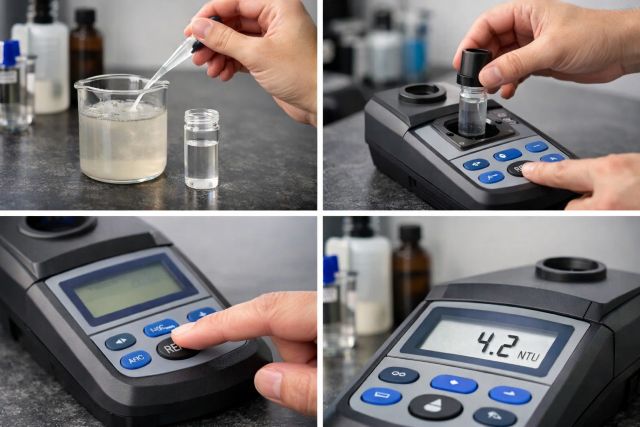
Rinse the vial if your SOP allows, then fill to the intended line. Cap it and inspect the outside under good light. Wipe the exterior with a lint-free cloth. If you see fingerprints, water droplets, or haze, assume it will affect the optics.

Also inspect for scratches. A scratched vial can scatter light in a way that looks like real turbidity, especially at low NTU. If repeatability matters, reserve specific vials for low-turbidity work and retire any that are visibly worn.

Step 4: Remove bubbles before placing the vial in the meter

Hold the vial up and look for tiny bubbles clinging to the inner wall. If you see them, don’t “hope for the best.” Tap gently or let the vial rest briefly. If the sample was poured too vigorously, you may need to refill more gently.

This one step is often the difference between stable readings and frustrating variability.

Step 5: Calibrate or verify calibration using appropriate standards

Follow your instrument’s calibration procedure and match your standards to the range you actually measure. EPA Method 180.1 describes nephelometric measurement and emphasizes an applicable range of 0–40 NTU, with dilution used for higher values.

In many routine programs, operators do a quick calibration verification with a known standard at the start of a shift or sampling day. This is especially helpful in drinking-water monitoring where changes can be small but operationally meaningful. WHO-linked resources describe turbidity as a fast, practical operational parameter in Water Safety Plan approaches to drinking-water quality management.

Step 6: Insert the vial correctly and control orientation

Place the vial into the chamber gently and close the lid fully. If your meter supports vial indexing or has an orientation mark, use it consistently. Even minor differences in vial orientation can change how scratches or tiny imperfections interact with the instrument’s light path.

If your instrument provides an averaging or stabilization option, use it consistently as well. In low NTU ranges, a few seconds of stabilization can reduce noise.

Step 7: Measure, repeat if needed, and document like a professional

Take your reading and record it with context. At minimum, keep the sample ID, location, time, operator, instrument ID, and any notes about dilution, unusual color, bubbles, or handling issues.

If the value is critical, run a second measurement after reinserting the vial in the same orientation. If results disagree more than your program tolerates, assume the vial or sample prep is the issue and re-prepare the vial rather than averaging two questionable numbers.

Step 8: Dilute correctly when turbidity is high

When turbidity exceeds the intended method range, dilution is the standard solution. EPA Method 180.1 explicitly notes that higher values may be obtained with dilution of the sample.

A common dilution approach is to dilute with turbidity-free water (or your program’s specified diluent), measure the diluted sample, then multiply by the dilution factor. The key is to mix gently and measure promptly, because settling happens faster in some high-solids samples.

Interpreting turbidity results without overreacting

Turbidity is most powerful when you watch trends. A single reading can be misleading if the vial was smudged or the sample had bubbles. A consistent upward trend, verified with good technique and a passing standard check, is usually a real signal.

It also helps to calibrate your expectations. The Australian Drinking Water Guidelines provide an intuitive reference for what different NTU values look like, noting that less than 1 NTU is typically crystal-clear and around 5 NTU looks slightly milky.

In drinking-water treatment contexts, the practical value is operational. WHO resources highlight turbidity’s usefulness for rapid monitoring of control measures within Water Safety Plan frameworks, which are designed to keep water quality under control from source to consumer.

Real-world scenarios that show how the method prevents bad decisions

Imagine you’re monitoring finished water and your readings creep from 0.2 NTU to 0.8 NTU over a few hours. If you don’t trust your technique, you might waste time recalibrating repeatedly or, worse, ignore a real process issue. A better response is to verify with a known standard, re-read with a freshly wiped vial, and confirm the trend is real. Once you’ve confirmed the measurement integrity, you can investigate filtration performance, coagulant dosing, or raw water shifts.

Now consider a storm-event creek sample that reads above the method’s practical window. If you record an off-scale number or treat the first reading as “truth,” your dataset becomes hard to compare across events. Using dilution aligns with the approach described in EPA 180.1, helps the instrument work in its intended range, and produces a defensible result.

FAQ about turbidity meters

What is a turbidity meter used for?

A turbidity meter is used to measure water clarity by quantifying light scattering from suspended particles, typically reporting the result in NTU for operational control, compliance monitoring, or environmental assessment.

How often should I calibrate a turbidity meter?

Calibration frequency depends on your QA plan, instrument stability, and how critical the data is. Many programs calibrate on a schedule and verify daily with a known standard so they can detect drift early and keep results comparable over time.

Why are my turbidity readings higher than expected?

The most common reasons are microbubbles, fingerprints or droplets on the vial, scratches on the vial, dirty optics, or a calibration/verification failure. Correct vial handling and a standard check usually pinpoint the cause quickly.

What’s the difference between ISO 7027-1 and EPA Method 180.1?

EPA Method 180.1 describes nephelometric turbidity measurement and specifies an applicable range of 0–40 NTU with dilution used for higher values. ISO 7027-1 describes two quantitative approaches and notes nephelometry is often applied to low-turbidity water while turbidimetry is more applicable to highly turbid water.

Conclusion: consistent technique is the secret to reliable turbidity meter data

A turbidity meter is only as accurate as the technique around it. If you collect carefully, mix gently, remove bubbles, treat the vial like part of the optics, and verify calibration routinely, you’ll get stable NTU results that hold up in audits and in real operational decisions. Aligning your workflow with recognized references like EPA Method 180.1 and the method concepts described in ISO 7027-1 helps ensure your numbers are both repeatable and defensible, whether you’re tracking filtration performance, monitoring a source during storms, or documenting compliance data.

Pink Candy: Top Brands, Types, and Where to Buy Them

0

Pink candy has become more than just a sweet treat. It is now a visual statement used for celebrations, gifting, branding, and themed events. From Valentine’s Day and baby showers to weddings and birthdays, pink candy instantly creates a playful and joyful mood. In recent years, demand for pink candy has increased significantly, driven by social media trends, aesthetic dessert tables, and the growing popularity of color-themed gifting.

The global confectionery market continues to grow steadily, with the United States alone generating more than 54 billion dollars annually in candy sales. Non-chocolate candy, including gummies, hard candy, and chews, accounts for a large share of this growth. Pink candy plays a key role in this segment because it appeals to both children and adults and works well across multiple occasions.

What is pink candy?

Pink candy refers to any confection that appears pink in color, whether naturally or through approved food coloring. In many cases, pink candy is associated with strawberry, raspberry, cherry, watermelon, or cotton candy flavors. The color itself creates a flavor expectation, even before the candy is tasted. This psychological connection between color and flavor is one reason pink candy is so effective for themed events and gift presentations.

Food coloring used in pink candy is regulated by authorities such as the U.S. Food and Drug Administration. Some candies use synthetic color additives for consistency, while others rely on natural sources like fruit and vegetable concentrates. Consumers who are ingredient-conscious often check labels carefully, especially when buying candy for children or large groups.

Why pink candy is so popular

Pink candy stands out visually, especially in photos and social media posts. It signals celebration, romance, sweetness, and fun. This makes it ideal for holidays like Valentine’s Day, when pink and red treats dominate store displays and online searches. Seasonal spikes in pink candy sales are common during February and spring events, including weddings and baby showers.

Another reason for its popularity is emotional buying behavior. Candy is considered an affordable indulgence, meaning people continue to purchase it even during economic uncertainty. This encourages brands to experiment with limited editions, new flavors, and color-specific assortments, including all-pink candy mixes.

Different types of pink candy

Pink candy comes in many forms, and choosing the right type depends on the occasion, temperature, and how long the candy will be displayed or stored.

Pink gummy candy is one of the most popular choices. Gummies are easy to portion, visually appealing, and widely available in strawberry, raspberry, and mixed berry flavors. They work well for candy tables, party favors, and bulk purchases because they remain fresh longer than many other types of candy. However, they should be kept away from heat, as they can melt or stick together during shipping.

Pink chocolate candy offers a more premium look. This category includes white chocolate dyed pink, strawberry-flavored chocolate coatings, and specialty ruby chocolate, which has a naturally pink hue and a slightly tangy taste. Pink chocolate is ideal for gift boxes and dessert boards but requires careful temperature control to prevent melting.

Hard pink candy and pink lollipops are excellent for long-lasting displays. These candies are shelf-stable, cost-effective, and resistant to heat. Pink swirl lollipops, strawberry drops, and pink rock candy are commonly used for party favors and welcome bags because they maintain their shape and color over time.

Airy pink sweets such as cotton candy, marshmallows, and meringues are chosen mainly for their visual appeal. They create a soft and whimsical aesthetic, especially for children’s parties. While they look impressive, they must be stored carefully to avoid staleness or crushing.

Seasonal pink candy is often released in limited quantities. Conversation hearts, jelly hearts, and pink candy-coated chocolates are typically available around Valentine’s Day. These products are highly popular but can sell out quickly, making early purchasing essential.

Popular pink candy brands

Well-known candy brands offer reliability and familiarity, which is important when buying for large groups. Brands like Starburst, Skittles, Jelly Belly, and Haribo are widely recognized and trusted. Many of these brands release pink-focused assortments or include pink pieces in their mixed bags. Familiar brands reduce the risk of disappointment, especially in corporate or classroom settings.

Boutique candy brands and specialty chocolatiers focus more on presentation and customization. They often offer pink-themed gift boxes, curated assortments, and hand-crafted chocolates. These options are more expensive but deliver a higher perceived value, making them ideal for weddings, anniversaries, and premium gifts.

For consumers seeking alternatives, some brands focus on naturally colored pink candy made with fruit and vegetable extracts. Interest in these options has grown due to increased awareness of food dyes and ingredient transparency. The FDA provides guidance on color additives and labeling, helping consumers make informed decisions.

Pink candy flavors and expectations

Pink candy is most commonly associated with strawberry flavor, which is widely accepted and enjoyed across age groups. Raspberry and mixed berry flavors are slightly more tart and often appeal to adults. Watermelon is a popular choice for gummies and sour candy because of its refreshing taste. Cherry is sometimes closer to red in color but still fits pink-themed assortments. Cotton candy flavor is nostalgic and works best in hard candy and airy sweets.

When selecting pink candy for events, it is best to limit the number of flavor profiles. Too many competing flavors can feel chaotic. A focused selection creates a more cohesive experience for guests.

Where to buy pink candy

Pink candy is widely available both online and in physical stores. Big-box retailers and grocery stores are convenient options for last-minute purchases. They often carry seasonal pink candy displays ahead of major holidays. These stores are ideal for familiar brands and easy returns.

Online marketplaces offer a broader selection, including bulk and color-specific assortments. While variety is a major advantage, quality can vary depending on the seller. Checking reviews and choosing factory-sealed packaging helps reduce risks related to freshness and melting.

Specialty candy retailers online provide the most reliable source for bulk pink candy. Many allow shoppers to filter by color, shade, and candy type. These retailers are popular for weddings, corporate events, and large parties because they offer better packaging and consistent quality.

Local candy shops and chocolatiers provide customization and personal service. They are excellent for unique gifts and premium experiences, although shelf life should always be confirmed before purchasing.

Storage and freshness tips for pink candy

Proper storage is essential to maintain color, texture, and flavor. Pink candy should be kept in a cool, dry place away from direct sunlight. Heat causes chocolate to melt and gummies to stick together. Air exposure can dry out marshmallows and cotton candy. When refrigerating chocolate, it is important to allow it to return to room temperature slowly to avoid condensation.

Pink candy and food coloring awareness

Many pink candies use approved food dyes to achieve consistent color. These additives are regulated in the United States, and labeling requirements allow consumers to identify them easily. Recent public discussions around food dyes have increased demand for naturally colored alternatives, especially for children’s events.

A practical approach is to offer a mix of classic and naturally colored pink candy, ensuring all guests feel comfortable with their choices.

Frequently asked questions about pink candy

Pink candy is most commonly strawberry flavored, but it can also be raspberry, watermelon, cherry, cotton candy, or mixed fruit. Not all pink candy tastes the same, so checking the flavor description is important.

All-pink candy can be purchased most easily from specialty candy retailers online. These stores offer color-sorted bulk options that are difficult to find in regular supermarkets.

Hard candy and wrapped chews are the least likely to melt on a party table. Gummies are generally safe indoors, while chocolate requires temperature control.

Pink candy can usually be purchased several weeks in advance if stored properly. Hard candy and gummies have the longest shelf life, while chocolate should be bought closer to the event date.

Conclusion

Choosing the right pink candy comes down to understanding texture, flavor expectations, and storage conditions. Gummies and hard candy offer reliability, while pink chocolate adds elegance and impact. Whether you are planning a party, creating a gift box, or stocking a candy table, pink candy provides versatility and visual appeal that few other treats can match. With thoughtful selection and proper storage, pink candy can transform any occasion into a memorable experience.

Wood Effect Wallpaper Ideas That Instantly Transform Any Room

0

If you want the warmth of timber without the price tag, mess, or permanence, wood effect wallpaper is one of the quickest upgrades you can make. It brings instant texture, visual depth, and that “finished” look designers chase — without cutting a single plank. In just a few hours, you can shift a room from flat to inviting, from bland to characterful, and from “temporary” to intentionally styled.

What makes wood-look wallpaper especially useful is how many moods it can create. Depending on the print, you can get the calm of pale oak, the charm of shiplap, the drama of dark walnut, or the modern edge of slatted paneling. Wallpaper itself is also enjoying renewed attention in interior design, with trend coverage highlighting how it adds personality through pattern, texture, and even “fifth wall” applications like ceilings.

Why wood textures feel so “right” at home

There’s a reason wood tones rarely go out of style. They read as natural, warm, and grounding, which aligns closely with biophilic design — an approach that brings nature-inspired elements into interiors to support comfort and wellbeing. Peer-reviewed research has found that indoor biophilic environments can improve stress and anxiety recovery responses after a stressor, with measurable changes occurring quickly during recovery periods.

Even though wallpaper isn’t real wood, a convincing grain pattern still delivers that “nature cue” visually. In a home setting, that can translate into rooms that feel calmer and more lived-in, especially when the wallpaper is paired with soft textiles, warm lighting, and natural accents.

How to choose a wood effect wallpaper that looks realistic

A wood print can look beautifully believable or obviously “printed,” and the difference usually comes down to a few details.

Start with scale. If the plank pattern is oversized in a small room, it can look theatrical. If it’s too tiny, the wall may feel busy and jittery. Samples matter here because the same wallpaper can look completely different under warm bulbs versus cool daylight.

Next, pay attention to variation. Real timber isn’t uniform, and the best wood effect wallpaper includes subtle shifts in tone, knots, grain direction, and the occasional “imperfect” mark. That irregularity is what sells the illusion.

Finally, watch undertones. Many wood looks lean warm (gold, honey, red) or cool (ashy, gray). Matching undertones to your flooring and major furniture keeps the room cohesive. When undertones clash, the wall can feel strangely “off,” even if you can’t immediately explain why.

If you want a renter-friendly option, peel-and-stick varieties can work well, but it’s smart to patch test first. Practical guidance from renter-focused wallpaper resources often recommends testing a small area and leaving it for several days to confirm adhesion and removability on your specific paint finish.

Wood effect wallpaper ideas that instantly transform the look of a space

Modern slat-wall style without construction

If you love the look of vertical slats or fluted panels but don’t want to measure, cut, sand, and seal, a slat-pattern wood effect wallpaper can get you surprisingly close. It creates a clean, architectural rhythm that feels modern and intentional, especially behind a TV unit or sofa.

This look is strongest when the rest of the room stays calm. Think solid-color upholstery, minimal décor, and lighting that skims the wall gently. If you add too many competing patterns, the slats lose their impact and the room can feel noisy.

Reclaimed plank wallpaper for instant character

Reclaimed wood looks are the shortcut to a space that feels like it has history. These prints often include mixed plank widths, worn edges, and varied tones that mimic salvaged boards. They’re especially effective in dining rooms, entryways, and bedrooms where you want personality without adding clutter.

The key to making reclaimed wood feel current is contrast. Pair it with clean lines, modern hardware, or sleek lighting so the room doesn’t slide into “theme décor.” Wallpaper trend coverage frequently emphasizes the power of texture and statement surfaces to elevate a room without major renovation.

Whitewashed wood effect wallpaper to brighten smaller rooms

Whitewashed, bleached, or light oak patterns are ideal when you want texture but also want the room to feel bigger and brighter. They bounce light and create a soft backdrop that works with coastal, Scandinavian, and modern-classic styles.

This option can be a lifesaver in narrow hallways, small bedrooms, and compact bathrooms. If you choose a washable finish and keep it away from direct splash zones, the effect can feel spa-like without the cost of tile or real paneling.

Shiplap and beadboard looks for cottage warmth

Shiplap-style wallpaper gives you that paneled charm fast, and it’s popular because it reads as “built-in” even when it’s just a wall covering. It’s especially flattering in nurseries, mudrooms, and powder rooms, where a subtle architectural pattern can make the space feel intentional.

If you want this to feel more timeless than trendy, choose soft whites or warm off-whites rather than stark, high-contrast outlines. Wallpaper trend reporting frequently notes that modern wallpaper is less about dated florals and more about fresh pattern, texture, and personality.

Dark walnut or espresso for boutique-hotel drama

If you want a room to feel luxurious and moody, darker wood looks can do that instantly. A deep walnut print behind a bed or in a home office can suggest a library-like warmth, especially when paired with brass accents, layered lighting, and creamy textiles.

The trick is to avoid going dark everywhere. Let the wallpaper be your statement, then balance it with lighter rugs, bedding, or curtains. Good lighting is non-negotiable here because dark wood effects can swallow light if the room is underlit.

Where wood effect wallpaper works best in your home

Living room wood effect wallpaper placement

A living room usually benefits from one clear focal wall, such as behind the sofa or the TV area. The goal is to create depth without making the space feel visually chopped up. A slatted wood look feels modern behind media units, while reclaimed looks suit reading corners or areas where you want a cozy, layered feel.

Bedroom wood effect wallpaper ideas for a headboard wall

In bedrooms, the headboard wall is the easiest win because it frames the bed like a design feature. Light oak prints pair beautifully with linen bedding and warm neutrals for a calm look. Dark walnut prints work well when you want a more cocooning, hotel-like vibe.

Bathroom wood effect wallpaper ideas that feel spa-like

Bathrooms are a special case because moisture and ventilation matter. If you choose a washable wallpaper and place it where it won’t get soaked, wood textures can soften a bathroom’s hard surfaces and create a relaxing, organic mood. This aligns nicely with biophilic design principles that focus on nature-inspired interior elements.

Home office wood effect wallpaper for a professional background

A wood-look wall behind your desk can instantly make video calls look more polished. Slatted designs read modern and structured, while reclaimed designs feel creative and relaxed. The best choice depends on the impression you want to make and how busy your shelves and décor already are.

Because biophilic design research often discusses wellbeing benefits when nature-inspired features are integrated into interiors, many people also like wood textures in workspaces for a calmer “visual temperature.”

Dining room wood effect wallpaper for warmth and contrast

Dining rooms love texture because it makes the space feel intimate and inviting. A reclaimed plank look behind a sideboard adds character, while a smoother oak print can make a modern dining room feel warmer. If your dining furniture is already wood, aim for a clearly different tone so it looks curated rather than accidentally matched.

Styling tips that make wood-look wallpaper feel expensive

A wood wall looks most convincing when you treat it like a material, not just a pattern. That means letting it breathe. Give it space by keeping nearby décor simpler and repeating a few complementary tones elsewhere in the room, such as in cushions, throws, ceramics, or frames.

Lighting matters more than people expect. A warm lamp or sconce that grazes the wall will emphasize “texture,” even on a flat wallpaper, and it helps the print feel more dimensional. If your room uses very cool lighting, some wood tones can look gray or dull, so it’s worth checking your bulbs before committing.

Finally, don’t ignore edges. Clean trim lines, tidy outlets, and neat corners make the whole project look professional. Wood patterns highlight seams, so precision pays off.

Installation guidance without the overwhelm

If you want a smooth result, focus on prep and patience. Walls should be clean, dry, and as smooth as possible because wood-grain patterns show bumps more than many other prints.

For peel-and-stick wallpaper, slow positioning helps you avoid wrinkles and misalignment. It’s also wise to patch test first, especially in rentals, because paint type and wall texture can affect both adhesion and removal.

For paste wallpapers, follow the manufacturer’s instructions exactly. Many modern wallpapers are designed for straightforward application, but the right method depends on whether it’s paste-the-wall, paste-the-paper, or a specialty material.

Frequently asked questions about wood effect wallpaper

What is wood effect wallpaper?

Wood effect wallpaper is a wall covering designed to mimic real wood surfaces like oak planks, reclaimed boards, shiplap, or modern slats. High-quality versions use realistic grain detail and tonal variation so walls look warmer and more textured without installing actual wood.

Is wood effect wallpaper good for renters?

It can be, especially peel-and-stick versions. The safest approach is to test a small area first and leave it in place for a few days, then remove it to confirm it won’t damage your paint. This patch-test approach is commonly recommended in renter-focused guidance.

Can you use wood effect wallpaper in bathrooms?

Yes, with the right material and placement. Choose a washable option, make sure ventilation is good, and avoid direct water contact zones. Used thoughtfully, it can create a softer, spa-like contrast to tile and fixtures.

Will wood effect wallpaper make a small room look smaller?

It depends on the tone and contrast. Light oak and whitewashed wood often make rooms feel brighter and more open, while dark, high-contrast prints can make a room feel more enclosed unless lighting and textiles balance the look.

What décor pairs best with wood effect wallpaper?

Warm neutrals, soft whites, black accents, muted greens, and brushed metal finishes tend to pair beautifully. If your wallpaper undertone is warm, lean into creams and earthy tones. If it’s cool, crisp whites and charcoal accents usually look cleaner.

Conclusion: a fast, high-impact upgrade that looks like real craftsmanship

When you want a room to feel warmer, richer, and more intentional, wood effect wallpaper is one of the most effective tools you can use. It can mimic modern slats, reclaimed planks, or airy whitewashed boards, giving you the visual comfort of wood with far less cost and commitment. Wallpaper’s popularity for adding personality and texture continues to show up in trend coverage, which is good news if you want a design-forward change without a full renovation.

If you want the best results, pick a print with realistic variation, order a sample to check it in your lighting, and treat installation details as part of the final finish. With the right choice and a careful application, your wood-look wall won’t just decorate the room — it will transform it.

Best Laptop Case for Students: Light, Tough, and Affordable

0

College life is basically a daily obstacle course for your tech. Your laptop gets pulled out in lectures, carried across campus, stuffed into backpacks with chargers and notebooks, and sometimes exposed to rain or accidental spills. That’s why choosing the right laptop case isn’t just about style. For students, it’s about getting protection that stays light, handles real-world bumps, and doesn’t cost an unreasonable amount.

Students also depend on laptops more than ever. UC Davis’ Winter 2025 student survey reports laptop ownership is near-universal among respondents, reinforcing what most campuses already feel like: almost everyone is carrying a computer daily. When your laptop is your class hub, research station, and assignment machine, a smart case is one of the easiest ways to reduce risk without changing your routine.

This guide walks you through how to choose the best laptop case for students with a focus on three priorities: lightweight comfort, tough protection, and affordability. You’ll also learn the differences between sleeves and structured cases, how to size correctly, what materials matter, and which features actually make a difference when life gets hectic.

What “Best” Means in a Student Laptop Case

The “best” laptop case for students usually isn’t the fanciest. It’s the one you’ll actually keep using every day because it fits how you move around campus.

A lightweight case matters because you’re carrying it constantly. Even small weight adds up between classes, labs, and library sessions. A tough case matters because laptops rarely get damaged during “normal” use; they get damaged during the rushed moments. Think bag tipping off a chair, backpack dropping onto a hard floor, or someone bumping your seat while your laptop is inside your bag. Affordable matters because student budgets are real, and the point of a case is to prevent expensive problems—not become one.

If you want a simple mental model, the best student-friendly laptop case is the one that protects corners and edges, resists water and abrasion, and still slides in and out of your backpack without feeling bulky.

Laptop Case vs Laptop Sleeve for Students

Many students search “best laptop case” when what they actually need is a sleeve. The difference is mostly about structure and how you carry your laptop.

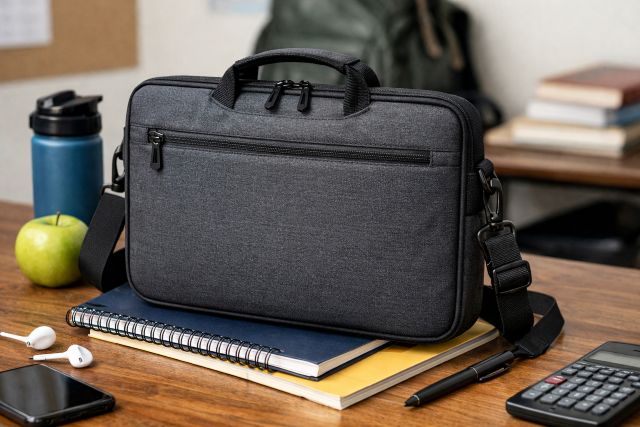
A laptop sleeve is usually lighter, slimmer, and designed to slide inside a backpack. If you already carry a backpack with decent padding, a sleeve gives you an extra protective layer while keeping your setup simple. A structured laptop case tends to add shape and sometimes a more rigid shell, which can help more when you carry the laptop by itself or you commute in crowded transport where bags get squeezed.

For most students, the sleeve-plus-backpack combo is the sweet spot: it’s light enough for daily use and protective enough for typical campus hazards. A structured case becomes more valuable if you often carry your laptop in your hands, move between internships and campus without a backpack, or take public transportation where impacts are more common.

How to Choose the Right Laptop Case Size

Sizing is where a lot of “good” cases fail. Many products are labeled by screen size, but two laptops with the same screen size can have very different physical dimensions.

The most reliable approach is to check your laptop’s width, height, and thickness, then compare them to the case’s internal dimensions. If the listing only tells you the “fits 13-inch laptops” line, treat that as marketing, not a measurement. A case that is too tight puts pressure on corners and edges, and zipper tension over time can become a real problem. A case that is too loose lets the laptop slide around, which reduces protection during a drop.

If you use a thin snap-on shell or keyboard cover, account for that thickness. And if you prefer carrying a charger in the same case pocket, don’t choose a case that fits “exactly.” Tight cases plus bulky accessories often create pressure points right where you don’t want them.

Laptop Case Features That Matter for Student Life

The features that matter most are the ones that prevent the most common types of damage. Scratches are annoying, but drops and pressure are what usually lead to expensive issues.

Corner and edge protection is crucial because laptops rarely land flat. A fall often sends the corner into the floor first, and that’s where screens, frames, and internal mounts can take a hit. Look for cases that clearly mention reinforced corners or thicker impact zones at the edges.

Shock-absorbing padding matters more than simple thickness. Good padding compresses and rebounds; it acts like a buffer. If a case feels soft but collapses completely when pressed, it may not do much when your bag hits the ground.

Water resistance is another student essential. Even if you’re careful, weather and crowded spaces create risk. A case doesn’t have to be fully waterproof to be useful; a water-resistant outer fabric and decent zipper design can buy time and prevent minor exposure from turning into major trouble. When you consider how manufacturers frame repair and service options, accidental damage can be costly or complicated depending on coverage. Apple’s Mac repair and service page, for example, emphasizes different service options and costs depending on coverage type. The practical takeaway for students is simple: preventing damage is usually cheaper than dealing with it.

Zipper quality is the quiet deal-breaker. Cheap zippers fail at the seams, snag, or split under pressure. On a student schedule, that’s not just inconvenient—it can mean carrying your laptop unprotected for days.

Finally, an inner lining that’s smooth and soft reduces micro-scratches and keeps your laptop looking better over time. That’s useful if you plan to resell your device later or just want it to stay clean-looking through the semester.

Lightweight Doesn’t Have to Mean Flimsy

Many students want the lightest possible laptop case because campus life already involves books, chargers, water bottles, and everything else. The key is choosing a case that uses protection efficiently.

A good lightweight laptop case focuses padding where it matters most: on the front and back panels, and especially around corners. It avoids unnecessary bulky compartments that tempt you to overstuff. If your day is mostly lecture halls and library work, a slim padded sleeve that slides into your backpack is often the best balance of comfort and protection.

Here’s a real campus scenario that shows why: imagine you’re moving between classes every hour and pulling your laptop out repeatedly to take notes. A bulky hard case slows you down and makes the laptop harder to pack quickly. A slim, well-designed sleeve gives you fast access, less weight, and still meaningful impact protection.

Affordable Laptop Case Buying Strategy

“Affordable” should mean you’re getting reliable protection for the money, not the lowest possible price.

In practice, a smart student budget is one where you’re paying for padding quality, stitching strength, and zipper durability rather than a logo. If you’re trying to keep costs down, look closely at the construction details. Are the seams reinforced? Is the zipper track smooth and sturdy? Does the case mention water-resistant fabric or coating? Those details usually matter more than aesthetics.

Also, think about the cost of replacement cycles. A very cheap case that tears in three months isn’t really affordable if you end up buying two more during the academic year. Spending slightly more once can cost less overall.

Materials Guide: What Holds Up to Student Use

Material choice affects weight, durability, and water resistance. The best laptop case material depends on how you carry your laptop and where you use it.

Neoprene is common because it’s light and flexible, and many sleeves use it. It can be a great budget-friendly option, but water behavior depends on treatment and design. Some neoprene sleeves handle light moisture well, while others can soak and hold water.

Nylon and polyester are popular in student-friendly cases because they resist abrasion and often come with water-resistant coatings. These materials can survive daily rubbing against books, chargers, and bag interiors better than many softer fabrics.

Semi-rigid EVA-style shells are excellent when you want strong impact protection without extreme weight. These can be especially helpful if you commute daily or your bag experiences pressure in crowded transport. The tradeoff is bulk and slightly less flexibility on fit.

Canvas often looks great and can be durable, but it may be heavier and can absorb water unless treated. If you love the look, prioritize versions that explicitly mention water-resistant coating.

Commuting, Travel, and Fast Laptop Access

Students travel more than they think: weekends home, internships, conferences, study trips, and flights. Laptop cases that work well in travel situations reduce stress.

If you fly, TSA guidance explicitly says to remove laptops from your bag and place them in a separate bin for X-ray screening, with TSA PreCheck travelers having different rules. In practical terms, this favors laptop cases and sleeves that allow quick removal without wrestling the device out of a too-tight fit. A zipper that opens wide and a snug-but-not-tight interior can make security checks smoother.

Even outside airports, fast access matters on campus. If you’re in a lecture hall, you don’t want to fight with your case while your professor is already moving through slides. The best laptop case for students is the one that supports your workflow, not the one that forces you to slow down.

Choosing the Right Laptop Case Based on Your Student Routine

If you want a clear way to decide, base your choice on how you carry your laptop most days.

If your laptop lives inside a backpack, a padded sleeve is often ideal. You get scratch protection, impact buffering, and easy packability. If your backpack is minimally padded, upgrading your case protection becomes more important, and a thicker sleeve or a structured case can compensate.

If you often carry your laptop on its own, or you walk short distances between dorm and class without a bag, a handle-style sleeve or structured case becomes more useful. It’s not just about convenience; it’s also about reducing the chance of dropping the laptop while juggling other items.

If you commute by bus or train, pressure protection matters. Bags get squeezed, corners get hit, and laptops can take side impacts. In that situation, a semi-rigid case design can be worth the extra bulk.

If you’re in labs, workshops, fieldwork, or busy shared spaces, water resistance and abrasion resistance jump in priority. A case that shrugs off scuffs and light moisture is often the smarter long-term choice.

FAQ: Best Laptop Case for Students

What is the best laptop case for students?

The best laptop case for students is one that fits your laptop’s exact dimensions, adds corner and edge protection, and stays lightweight enough for daily carrying. For most students who use backpacks, a padded sleeve with reinforced corners and a water-resistant exterior is the best blend of comfort, protection, and affordability.

Is a laptop sleeve enough for college?

A laptop sleeve is enough for many college students when it’s paired with a decent backpack. It adds scratch protection and impact buffering for daily movement around campus. If you commute in crowded transport or frequently carry your laptop without a backpack, you may want a more structured laptop case for extra protection.

Should I choose a hard case or a soft case?

Soft cases and sleeves are lighter and easier to pack, which makes them ideal for most student routines. Hard or semi-rigid cases can protect better against side impacts and pressure, which can be useful for commuters. The best choice depends on whether your laptop is mostly inside a backpack or often carried on its own.

How much should a student spend on a laptop case?

A student should spend enough to get reliable padding and a durable zipper, because these are the parts that determine whether the case protects or fails. The most affordable choice long-term is usually a case that lasts the whole academic year, not the cheapest one that needs replacing after a few months.

Do laptop cases protect against water damage?

Some laptop cases reduce water risk by using water-resistant fabric and better zipper design, but very few are truly waterproof. The goal is to protect against light rain, splashes, and minor spills long enough for you to wipe things down and move the laptop to safety.

Conclusion: The Best Laptop Case Is the One You’ll Use Every Day

The best laptop case for students is lightweight enough to carry without thinking, tough enough to protect corners and edges, and affordable enough to feel like a smart investment. A well-made laptop case also supports your daily workflow by making your laptop easy to access in class, safer in transit, and less vulnerable to the small accidents that happen on busy campuses.

If you want one reliable default choice, go with a slim padded laptop case or sleeve that fits your laptop precisely, includes reinforced corners, and uses a water-resistant outer material. It delivers the “light, tough, and affordable” balance students actually need, and it stays practical from week one through finals.

Brown Sandals: Best Styles for Comfort, Travel, and Everyday Wear

0

Brown sandals are one of the easiest warm-weather staples to wear on repeat because they blend naturally with denim, linen, neutrals, and brighter summer colors. The catch is that comfort varies wildly from pair to pair. Some styles feel fine for a quick coffee run and then turn into blister machines or leave your arches aching by the time you get home. If you want brown sandals you can genuinely rely on for travel days and everyday life, you need a pair that fits your foot shape and supports how you actually move.

Foot discomfort is also far more common than most people realize. Large-scale research reviews have reported foot pain prevalence across groups ranging roughly from 13% to 36%, depending on populations and how pain was defined. That’s exactly why “cute” alone isn’t a strategy. The best brown sandals are the ones that still feel good at hour six, not just minute six.

Why brown sandals work for comfort and style

Brown sandals are uniquely forgiving as a fashion choice because warm tones look less harsh than black in daytime outfits and complement skin tones naturally. Shades like tan, cognac, and chocolate also tend to age gracefully, especially in leather, since minor scuffs blend into the overall patina. That style versatility becomes truly valuable when the sandal is also built for comfort, because you’ll reach for it more often and pack it more confidently.

Comfort isn’t just a feeling; it’s influenced by design choices that can change how pressure is distributed under your foot. Research on arch-support designs and plantar pressure shows that supportive structures can measurably shift loading patterns during walking.

What makes brown sandals comfortable

The most comfortable brown sandals usually share a few traits. They have a contoured footbed that supports the arch and cups the heel rather than a flat, thin sole. They hold the foot securely so you don’t have to grip with your toes to keep the sandal on. They combine cushioning with stability so you get impact absorption without feeling wobbly. They include some adjustability, which matters more than you’d think on hot days or travel days when feet swell.

If you want an extra credibility check when shopping, look for brands or models that appear in the APMA Seal database. The APMA Seal of Acceptance is given to products that have been reviewed by podiatrists and found to promote good foot health.

Brown sandals for everyday wear

Supportive strappy brown sandals

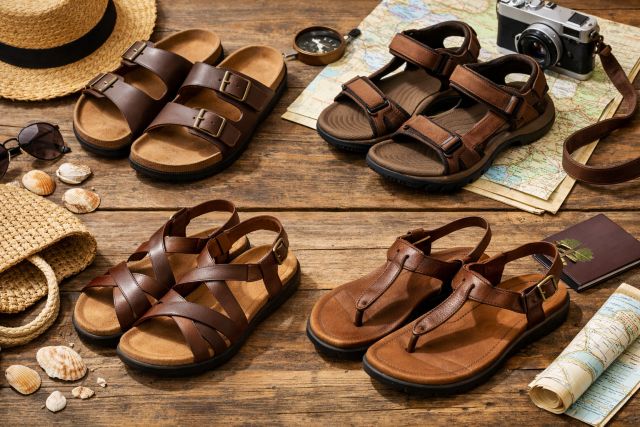
Strappy brown sandals can be a daily favorite because they feel airy and pair with almost everything, from jeans to midi dresses. For comfort, the key is that the straps must stabilize the foot. A strong everyday pair usually has a strap that anchors the forefoot and another that prevents sliding forward. When straps do their job, your gait feels more natural and you’re less likely to feel that end-of-day fatigue that comes from constantly “holding on” with your toes.

A real-life test helps. Walk briskly for about 30 seconds. If you notice your toes gripping the footbed to keep the sandal from flying off, that design may feel tiring on longer days.

Brown slide sandals that don’t wreck your feet

Slides are convenient, but they’re also the easiest style to buy in a version that’s uncomfortable. Many slides are too floppy and encourage toe gripping, which can contribute to fatigue. If you love slides, choose a version with a contoured footbed and a structured upper. A wider, more stable slide with good arch support can feel dramatically better than a thin foam version, especially for errands, casual work settings, or weekend wear.

Health guidance on choosing supportive sandals often warns against thin, unsupportive designs when you plan to walk or stand for long periods.

Brown fisherman sandals for airy coverage

Fisherman sandals have become popular because they offer more coverage than minimalist straps while still feeling breathable. They work especially well for everyday city life because they look intentional and can lean casual or polished depending on the outfit. Comfort comes down to toe room and flexibility. A good fisherman sandal should let your toes spread naturally rather than squeezing them into a narrow front.

Brown wedge sandals for comfortable height

Wedges can be a smart choice when you want height but don’t want the instability of a thin heel. A wedge supports more of the foot and often distributes pressure more evenly than a heel that concentrates load on a small area. The most wearable wedges have a stable base and a slope that doesn’t feel too steep. When the wedge is overly pitched forward, you may feel pressure building under the forefoot over time.

Brown sandals for travel

Travel sandals should handle long walks, long waits, heat, and unpredictable surfaces. That means grip, security, and comfort that doesn’t fall apart after day two of sightseeing.

Brown walking sandals for long sightseeing days

A strong travel walking sandal typically includes a supportive footbed, secure straps that stabilize the heel, and an outsole with reliable traction. This style is built for the days when you walk far more than planned. In cities, it handles cobblestones and uneven sidewalks. In airports, it’s comfortable while you’re moving quickly or standing in security lines.

If you’re packing for a trip where you expect several high-step days, prioritize heel security. A back strap often makes a bigger comfort difference than people expect because it prevents sliding and reduces the need to grip with the toes.

Brown leather sandals for “one-pair packing”

If you want one brown sandal that can go from airport to dinner, leather is often the most versatile option. The best travel-friendly leather sandals have a clean design, adjustable straps, and a footbed with real structure. This combination gives you comfort during daytime walking while still looking polished with linen pants, dresses, or a casual blazer.

Imagine a week-long trip where you want to pack light. During the day, you’re in museums and walking neighborhoods. At night, you’re at restaurants where sporty sandals feel too casual. A supportive brown leather sandal is one of the few styles that can genuinely do both.

Brown waterproof sandals for humid climates and beach towns

Waterproof sandals are ideal when your day includes pools, sudden rain, or beach walks. Look for quick-drying materials and a footbed that stays grippy even when wet. Comfort still matters here, and many waterproof options now include surprisingly supportive footbeds designed for longer walking, not just quick dips in the water.

Choosing brown sandals by foot type

If you have flat feet or overpronation

People with flatter arches often do better with sandals that provide structured arch support and a stable heel cup. Research on arch-support interventions in flatfoot groups suggests functional benefits during walking, which helps explain why the right structure can feel like relief rather than “extra.”

If you have high arches

High arches often need cushioning and a footbed that supports without feeling like a hard ridge. Too-aggressive arch contours can feel uncomfortable if they don’t match your arch shape. In this case, “supportive” should still feel natural, not like a lump pressing into the midfoot.

If you deal with plantar fasciitis flare-ups

If plantar fascia pain is part of your life, look for sandals that combine arch support, heel stability, and controlled cushioning. Pure softness can feel great at first, but structure usually matters more over a full day. The goal is a supportive base that reduces strain and helps you move comfortably for longer.

If you have bunions or wider forefeet

Strap placement and width matter more than almost anything else. Choose adjustable straps and wider footbeds so the forefoot isn’t squeezed. A narrow front that pushes the big toe inward tends to worsen discomfort over time.

Fit tips that make brown sandals feel noticeably better

Try sandals later in the day because feet often swell as the day goes on, and a fit that feels perfect in the morning can feel tight by evening. When you try them on, stand up and adjust straps while bearing weight. Your feet spread under load, and strap comfort changes when you’re seated. Make sure your heel sits fully on the footbed and not hanging off the back. Then walk quickly for a moment. If you feel like you’re gripping to keep the sandal on, that’s a warning sign for long-wear comfort.

Styling brown sandals for everyday outfits

Brown sandals look especially cohesive when they echo another warm element in your outfit, like a belt, bag, or watch strap. Light tan sandals feel fresh with white denim and linen. Cognac or caramel tones pair beautifully with blue denim, olive, and creamy neutrals. Dark chocolate sandals can ground black outfits and feel more elevated for evenings without looking too formal.

Common questions about brown sandals

Are brown sandals good for walking all day?

Yes, as long as they’re built for walking. A comfortable pair usually has a contoured footbed, secure straps, and a stable outsole. Research on supportive designs and plantar pressure shows that structure can change how load is distributed during walking, which is one reason supportive sandals often feel better over long hours.

What’s the most comfortable brown sandal style for travel?

For most people, a walking sandal with secure straps is the safest choice for long sightseeing days. If you need one pair that also looks polished, a supportive leather sandal with adjustable straps often works well for both daytime walking and dinners.

Do I need arch support in sandals?

If you walk a lot, stand for work, or frequently feel foot fatigue, arch support can help. Studies examining arch support and plantar pressure show measurable effects on loading patterns, supporting the idea that structure can matter beyond just “softness.”

How can I reduce foot swelling while traveling?

Movement and hydration help, and choosing footwear that isn’t overly tight matters on long days. General medical guidance around long flights also notes that compression sock use is typically recommended based on individual clot-risk factors rather than as a universal requirement for everyone.

Conclusion

The best brown sandals for comfort, travel, and everyday wear are the ones that combine a supportive footbed, secure straps, and stability you can trust. For daily life, supportive strappy sandals and structured slides can give you easy versatility without sacrificing comfort. For travel, walking sandals or supportive brown leather sandals tend to perform best when your step count climbs and your day runs long. Considering how common foot pain is across populations, choosing brown sandals that support your feet is one of the simplest ways to make summer days feel better, not harder.

The Cutest Cat Pillow Styles for Bedroom, Sofa, and Office

0

If you’ve been eyeing a cat pillow for your space, you’re in good company. Cat-themed home accents have surged as people lean into “joyful decor,” choosing pieces that feel personal, playful, and calming without sacrificing style. A cat pillow can work in nearly any room: it softens a minimalist bedroom, adds character to a neutral sofa, and makes an office chair feel less corporate.

This guide explores the cutest cat pillow styles for bedrooms, sofas, and offices, along with practical advice on sizing, fabrics, cleaning, and how to style them so they look intentional rather than cluttered. You’ll also find answers to common questions people ask before buying, plus research-backed insights to support comfort and hygiene choices.

What is a cat pillow?

A cat pillow is a decorative or functional pillow featuring cat shapes, cat faces, cat silhouettes, or cat-themed patterns. Some focus on aesthetics, such as embroidered whiskers or minimalist line art. Others are designed for comfort, such as lumbar pillows for support or long bolsters that you can hug while lounging. The best cat pillow options combine a cute design with everyday usability, especially if you plan to lean on it daily.

Why cat pillows feel so comforting

Cat pillows aren’t only popular because they’re cute. Soft objects can add a sense of comfort by encouraging relaxation behaviors like leaning back, hugging, or resting your arms and shoulders in a more supported position. Research on touch and stress responses suggests that supportive touch behaviors, including hugging, can lower stress-related cortisol responses under certain conditions. A pillow isn’t a person, but many people find that hugging a cushion provides a similar “pressure comfort” feeling that helps them unwind after work.

That emotional comfort also translates visually. A warm, friendly home environment can influence how relaxed a space feels, and playful décor elements often help a room feel more personal.

The cutest cat pillow styles for the bedroom

Bedrooms are naturally suited to soft décor, so cat pillows tend to look right at home here. The trick is choosing a style that complements your bedding and doesn’t fight your room’s color palette.

Cat-shaped plush pillows for cozy, playful bedrooms

Cat-shaped plush pillows are the classic choice, often designed as loaf cats, curled-up kittens, or full-body silhouettes. They look especially adorable on a bed because the shape reads clearly from across the room. If your bedding is patterned, a solid-color cat pillow usually looks cleaner. If your bedding is solid, a patterned or textured cat pillow can add visual interest without overwhelming the space.

For bedroom styling, neutral shades like cream, gray, and soft brown tend to look more “grown-up,” while bright colors can create a cheerful, youthful vibe.

Embroidered cat face pillows for a subtle, adult look

If you want something cute but understated, look for square or rectangular pillows with embroidered whiskers, sleepy eyes, or minimalist cat line art. These blend easily into modern, Scandinavian, and boutique-hotel-inspired bedrooms because they add personality without looking like novelty décor.

Embroidered designs also tend to photograph well, which is helpful if you like sharing room updates on social media, and they usually hold their visual detail longer than printed designs that can fade.

Cat ear cushions and novelty trims for playful texture

Some pillows keep a traditional square or rectangle shape but add small cat ears, tail corners, or paw appliqués. This is a smart option when you want a fun detail without committing to a full-shaped novelty pillow. These also work well when you want to coordinate with other bedding textures, like knit blankets or tufted throws.

A good trick is to match the ear or trim color to a secondary color in your room, such as a rug accent or throw blanket, so it feels coordinated rather than random.

Cat bolster pillows for reading and lounging in bed

If you sit up in bed to read, scroll, or work on a laptop, a longer cat bolster pillow can support your back, neck, or arms. Pillow design can influence comfort and alignment, and factors like height, shape, and material affect how supportive a pillow feels during rest.

A medium-firm fill is usually best for bolsters because it won’t flatten immediately. If you want both comfort and structure, shredded memory foam fills often hold their shape better than lightweight polyfill.

The cutest cat pillow styles for the sofa

On a sofa, your cat pillow needs to look stylish and survive daily use. This is where fabric durability and washability matter most, especially in family homes or pet-friendly spaces.

Statement cat pillows that become a conversation piece

Statement cat pillows typically include bold illustrations, oversized cat faces, 3D whiskers, or bright graphic prints. They work best when the sofa and surrounding décor are calmer, such as neutral upholstery and simple wall art. This way, the cat pillow becomes a focal point rather than visual noise.

If you want the “styled like a designer” look, keep the rest of your pillows plain and choose one standout cat pillow as the hero piece.

Boucle or plush “cat texture” pillows for cozy modern style

Texture is one of the fastest ways to make a sofa feel more inviting. Boucle and plush fabrics have been popular in cozy modern décor because they add softness and visual depth.

These pillows are especially cute in cat themes because they naturally mimic the cozy feeling people associate with cuddly pets. The main tradeoff is maintenance. Textured fabrics trap dust, lint, and fur more easily, so removable covers and gentle cleaning routines matter.

Cat print pillow covers for flexible, budget-friendly styling

If you like changing your décor with the seasons, cat pillow covers are a practical solution. You can switch from a playful cat print in spring to a darker, moodier cat illustration in winter without storing bulky pillows. Covers are also easier to wash and dry, which matters if the pillow lives on a high-traffic sofa.

When choosing covers, look for hidden zippers and thicker fabric so the print looks crisp and the cover doesn’t stretch out over time.

Cat lumbar pillows for comfort and a polished look

Lumbar pillows make sofas look styled while adding real support. A cat lumbar pillow is especially useful if you sit upright often or want lower-back comfort during long TV sessions. Many home décor sources also emphasize that thoughtful throw pillow choices can influence how comfortable seating feels.

For a clean sofa setup, choose a cat lumbar pillow in a solid color or minimal print, then pair it with larger plain pillows that match your sofa tone.

The cutest cat pillow styles for the office

An office is where you want a cat pillow that feels cute but still fits a professional environment. The best picks combine subtle design with support, especially if you spend hours in a desk chair.

Cat lumbar pillows for desk chairs and work-from-home comfort

A cat lumbar pillow can make a desk chair feel instantly more supportive, especially if the chair is firm or lacks ergonomic shaping. For office use, muted tones like cream, gray, sage, and soft beige tend to look more polished and camera-friendly.

If you take video calls, placing the cat pillow slightly off-center behind you usually looks intentional, like a styled backdrop, rather than like you’re showing off novelty décor.

Cat neck roll pillows for breaks and reading corners

If your office includes a reading chair or a small break corner, a cat neck roll pillow can be a cozy add-on. These work best for short relaxation periods, like five-minute resets between meetings, or for supporting your neck while reading.

Minimal cat pillows for a professional aesthetic

If your workspace is sleek and minimal, a line-art cat pillow or subtle embroidered cat face is the best match. These options keep the charm without looking childish, and they blend into neutral office décor easily.

How to choose the right cat pillow for your space

The right cat pillow depends on how you plan to use it. If it’s purely decorative, you can prioritize design and texture. If you plan to lean on it every day, focus on fill, firmness, and fabric quality.

For beds, larger plush or shaped pillows create a cozy look, especially if you have a headboard or layered bedding. For sofas, mixing sizes looks more intentional, with larger pillows as a base and a smaller accent cat pillow as the focal point. For office chairs, smaller lumbar styles are usually best because they add support without overwhelming the chair.

Fill matters more than many people think. Polyfill is lightweight and common in novelty shapes, but it can flatten faster. Memory foam styles often provide better lumbar support and hold their shape longer. Down and feather blends feel luxurious but require fluffing and can irritate allergies for some people.

Fabric is where lifestyle shows up. Cotton and cotton blends are breathable and often easy to wash. Velvet looks rich but can show pet hair. Boucle and faux fur look cozy but collect lint and dust, so they’re best if you’re willing to maintain them.

Cleaning, allergies, and keeping your cat pillow fresh

If you have allergies, washable covers are the simplest win. Allergy-focused organizations emphasize reducing exposure to indoor allergens through cleaning and controlling sources of allergens. The Asthma and Allergy Foundation of America also highlights indoor allergens like dust mites and pet dander, and summarizes approaches including controlling exposure, improving ventilation, and using air cleaners.

In real life, this translates to choosing a cat pillow with a removable cover whenever possible, washing that cover regularly, and avoiding ultra-shaggy textures if you know they trap dust. If your cat pillow is something you hug often or keep near your face, consider an allergen-resistant pillow protector under the decorative cover.

In pet-friendly homes, tighter weaves usually trap less fur than fluffy textures. That doesn’t mean you can’t buy a plush cat pillow, but it’s helpful to be realistic about maintenance if the pillow will live on your main sofa.

Styling cat pillows so they look intentional, not cluttered

A cat pillow looks best when it’s treated as a design accent rather than a theme that takes over a room. In a neutral bedroom, one standout cat pillow in a warm neutral shade can act like a signature detail. In a modern living room, one cat pillow paired with solid pillows in matching tones keeps the look clean. In an office, a subtle cat lumbar pillow can feel like a comfort upgrade without changing the overall professional vibe.

If you want internal links on your site, relevant supporting pages could include a guide on styling throw pillows, a neutral bedroom décor guide, and a home office comfort guide. Example internal link slugs could be /blog/how-to-style-throw-pillows, /blog/neutral-bedroom-decor-ideas, and /blog/home-office-comfort-upgrades.

Common questions about cat pillows

What’s the best cat pillow for a sofa?

The best sofa cat pillow usually has a removable, washable cover and a durable fabric. If you want something cute that still looks stylish, embroidered cat face designs or modern cat illustrations tend to blend well with most living rooms.

Are cat pillows good for back support?

They can be, especially lumbar-shaped cat pillows with medium-firm fill. Pillow height, shape, and material can influence support and comfort, which is why purpose-built lumbar pillows are often more helpful than purely decorative plush shapes.

Which cat pillow style looks most “adult”?

Minimal line-art cats, subtle embroidery on solid fabrics, and tone-on-tone patterns usually look the most polished. Neutral colors also help a cat pillow feel like part of your décor rather than a novelty.

How do I keep a cat pillow clean if I have allergies?

Choose a pillow with a removable cover and wash it regularly. Keep dust under control with routine cleaning, and consider ventilation or air cleaning if indoor allergens are a concern.

Is it okay to have cat pillows in an office?

Yes. A subtle cat pillow can look stylish, especially in neutral tones, and it can make a chair more comfortable. For shared offices or frequent video calls, minimalist designs tend to feel the most professional.

Conclusion: the right cat pillow can upgrade every room

A cat pillow can be both adorable and practical when you match the style to the space. Plush cat shapes make bedrooms feel cozy, textured or statement cat pillows bring personality to sofas, and supportive lumbar cat pillows can transform an office chair into a more comfortable daily seat. If you want the most versatile choice, pick a cat pillow with a removable washable cover, a durable fabric, and a design that blends cute with clean lines.

If you tell me your room style and color palette, I can suggest a few cat pillow styles that will look natural in your bedroom, sofa setup, or office.

Ratio Yogurt Keto Friendly? Full Ingredient Breakdown

0

If you’re doing keto, low-carb, or simply watching sugar, ratio yogurt is probably on your short list. It’s marketed as “Keto* Friendly” in some varieties, it tastes like dessert, and the macros often look impressively low in carbs. But labels can be confusing, and “keto friendly” isn’t a regulated standard. The only reliable way to decide is to look at the nutrition facts, understand the ingredients, and compare the serving to your personal carb target.

This article gives you a full ingredient breakdown of ratio yogurt, explains what each ingredient does in the formula, and helps you decide whether it fits strict keto, moderate keto, or a more flexible low-carb approach. You’ll also get practical guidance on net carbs, sweeteners, and portion sizing so you can keep ketosis (or your goals) on track.

Is ratio yogurt keto friendly?

For many people, yes, ratio yogurt can be keto friendly, especially the products specifically labeled “Keto* Friendly,” such as the :ratio Trio line. On the official :ratio product page for the Trio Vanilla dairy snack tub, the brand highlights macros that are generally compatible with keto-style eating, showing low carbs and sugar with higher fat and protein. You can verify the current nutrition and ingredient details directly on :ratio’s product listing.

The bigger truth is that keto friendliness depends on your daily carb cap and what else you eat that day. Cleveland Clinic explains that ketosis typically requires reducing carbohydrates enough that the body shifts away from glucose as its primary fuel source, and many people try to stay under about 50 grams of carbs per day, sometimes lower depending on the individual.

What “keto friendly” means for yogurt in real life

When a yogurt calls itself “keto friendly,” it usually means the product has been formulated to keep sugars and total carbohydrates low compared with typical flavored yogurts. Many mainstream flavored yogurts rely on added sugar, sweetened fruit, or both. Keto-aligned yogurts usually take a different route by emphasizing fat, protein, and non-sugar sweetness so you get a dessert-like taste without the same sugar hit.

Harvard’s Nutrition Source notes that ketogenic diets generally reduce carbs dramatically, often to under 50 grams per day, and sometimes closer to 20 grams depending on the plan and the person. That’s why yogurt can be tricky. Even “healthy” yogurt can contain enough sugar to blow a strict keto day, especially if it’s sweetened.

So for keto, yogurt success comes down to a few practical checks. You want low total carbs per serving, low sugar per serving, and ingredient choices that you personally tolerate well. You also want a portion that matches the label, because “a few spoonfuls” can quickly become the entire tub.

Ratio yogurt ingredient list, explained in plain English

To keep this grounded in an actual label, it helps to look at a specific “Keto* Friendly” product. On the official :ratio product page for Trio Vanilla (tub), the ingredients include pasteurized ultra-filtered nonfat milk, pasteurized milk, milk fat, high oleic sunflower and/or avocado oil, natural flavor, salt, sucralose, and cultures.

Those ingredients may look different from traditional yogurt, especially the added oils. That doesn’t automatically make it “bad” or “good.” It just means it’s engineered to hit a texture and macro profile that fits a low-carb audience.

Ultra-filtered nonfat milk and milk

Ultra-filtered milk is commonly used in higher-protein dairy products. Filtration can concentrate protein and reduce some lactose, which is the sugar naturally found in milk. The result is a thicker, protein-forward base that can help lower the carb-to-protein ratio compared with conventional sweetened yogurt.

From a keto perspective, this is often a win. Less lactose generally means fewer carbs, and more protein helps with satiety. The main caution is personal: protein needs differ. Some keto eaters keep protein moderate, while others prefer higher protein for training or appetite control.

Milk fat

Milk fat is one of the biggest reasons ratio products can feel creamy and rich. Fat also makes yogurt more satisfying, which can be useful on keto because it reduces the urge to snack on high-carb foods later.

From a keto-macro standpoint, milk fat usually supports ketosis more easily than sugar does. The only common downside is calorie density. If you’re using keto for weight loss, fat is helpful for satiety but can also push calories up quickly if you eat multiple servings without realizing it.

High oleic sunflower oil and/or avocado oil

This is the ingredient that surprises people. Oils can change mouthfeel and help maintain a thick, creamy texture without relying on sugar or high-carb thickeners. In other words, it’s a formulation choice designed to deliver “dessert texture” with low sugar.

On keto, oil isn’t a carb concern, but it is a preference concern. Some people want dairy fat only. Others don’t mind added oils. If you’re sensitive about ultra-processed ingredients, this may influence your decision even if the macros fit.

Natural flavor

“Natural flavor” is a broad labeling category and can cover many flavor compounds derived from natural sources. It’s extremely common in flavored dairy.

For keto, natural flavor is typically not a carb driver at the amounts used. The more important point is transparency. If you prefer minimal ingredients, natural flavors may feel too vague. If you prioritize taste and macros, it may not matter.

Salt

Salt is usually present in small amounts to balance sweetness and improve overall flavor. Many keto eaters are mindful of electrolytes, so salt is not typically a concern unless you’re on a medically restricted sodium plan.

Sucralose

Sucralose is a high-intensity sweetener used to keep sugar low while maintaining a sweet taste. On keto, sucralose generally helps products stay low in carbs because it provides sweetness without sugar.

The practical issue is tolerance. Some people do well with sucralose and notice no cravings or digestive changes. Others find that sweeteners, even non-sugar ones, can trigger appetite or cravings. If you’re unsure, the best test is personal. Try it consistently for a week and observe how your hunger, cravings, and digestion respond.

Live cultures

Yogurt cultures such as L. bulgaricus and S. thermophilus are standard for yogurt fermentation. Cultured dairy is often easier to digest for some people and can be a convenient way to include fermented foods.

From a keto standpoint, cultures are usually neutral or positive. The key is still carbs and sugar, because many yogurts with cultures still include a lot of sweetener or fruit.

Ratio yogurt macros: what you’re typically getting

On the :ratio product page for Trio Vanilla (tub), the brand highlights macros that include low carbs and sugar along with meaningful protein and fat. This macro pattern is exactly why ratio yogurt is popular in keto circles. It can feel like a dessert while staying closer to keto-friendly numbers than conventional flavored yogurts.

Still, don’t rely on vibes. Always check the exact flavor and container size you’re buying, because cups, tubs, and product lines can differ. Even within a brand, “keto friendly” items may vary slightly by flavor due to ingredients and flavoring.

Net carbs and keto yogurt: what matters most

A lot of keto marketing leans on the concept of net carbs. UCLA Health explains the common approach: net carbs are often described as total carbohydrates minus fiber and certain sugar alcohols. That math can be helpful in some cases, but it’s not a universally standardized labeling method, and it can sometimes lead to overeating “keto” products because the numbers feel smaller.

For yogurt specifically, the simplest approach is usually the best. Start with total carbs and sugar, then consider whether any fiber or sugar alcohols are playing a big role. Many of the :ratio Trio items are already low enough in total carbs that you’re not leaning heavily on complicated net-carb assumptions.

If you want more context on how brands talk about net carbs in keto products, General Mills has discussed the :ratio line and how net-carb style thinking appears in keto-friendly snack marketing.

How ratio yogurt compares to typical flavored yogurt

Traditional flavored yogurt often contains a surprising amount of sugar because the product is designed to taste like a sweet snack. Keto-oriented yogurt flips that script. It tends to use higher protein dairy bases, additional fats for creaminess, and non-sugar sweeteners for flavor.

This matters because the biggest keto barrier with yogurt is almost always sugar. Many “fruit” yogurts taste healthy but can deliver dessert-level carbs. If ketosis is your goal, sugar grams are usually the fastest way to identify whether a yogurt fits.

Who should be cautious with ratio yogurt on keto

Some people will love ratio yogurt on keto, while others may need to be more careful.

If you’re doing strict keto with a very low carb ceiling, even a low-carb yogurt can matter, especially if you’re eating other “small carb” foods throughout the day. Harvard’s overview of ketogenic diets highlights how low daily carbs often are on keto, which is why small servings add up quickly.

If you’re sensitive to sweeteners, sucralose could be the make-or-break ingredient. This is less about carbs and more about cravings, digestion, and appetite response.

How to choose the best ratio yogurt for keto

The most reliable way to pick the right ratio yogurt is to treat every flavor like its own product. Start by checking total carbs per serving, then confirm sugar per serving, then scan the ingredients for anything you personally avoid.

If you’re aiming for consistent ketosis, match the yogurt to your daily carb budget. Cleveland Clinic’s ketosis overview is a helpful reminder that many people keep daily carbs low enough to sustain ketosis, often under about 50 grams, and sometimes lower depending on the person.

If you’re doing keto for weight management, the texture and satiety of a higher-fat yogurt can be useful, but it still helps to keep portions deliberate. A product that fits macros can still stall progress if it becomes a frequent “extra” on top of meals rather than part of a planned snack.

Real-world keto scenarios: does ratio yogurt fit?

If you track keto strictly and log everything, ratio can work best as a planned macro item. You include it on purpose because you already know its carb impact and you build your day around it. In this scenario, it’s less of an impulse snack and more of a controlled treat that helps you stay consistent.

If you’re doing a moderate or flexible keto approach, ratio yogurt can become a convenient “dessert replacement.” This is where it shines for many people. The taste and texture help curb cravings, and the carb count is typically lower than traditional dessert options.

If you’re using keto for blood sugar support, lower sugar foods can be helpful, but medical context matters. Keto can affect medication needs and glucose management, so it’s wise to get clinician guidance if you’re using keto therapeutically.

Frequently asked questions about ratio yogurt and keto

Is ratio yogurt actually keto friendly?

For many people, yes. Ratio yogurt can be keto friendly, especially the items marketed as “Keto* Friendly,” because they are formulated to be lower in carbs and sugar than typical flavored yogurts. The best way to confirm is to check the nutrition and ingredient details for the exact flavor on the brand’s product page or on the package itself.

How many carbs can you eat on keto?

Many keto approaches reduce carbs dramatically, often below 50 grams per day, and sometimes closer to 20 grams depending on the person and the plan. Harvard’s Nutrition Source provides a useful overview of how low-carb ketogenic diets typically are.

What are net carbs, and should you use them?

Net carbs are commonly described as total carbs minus fiber and certain sugar alcohols, but it’s not a universally standardized method across all products. UCLA Health explains how the concept is often used and why it can be confusing. If you’re strict keto, total carbs and portion size are usually the safest anchors, with net carbs as a secondary check.

Does ratio yogurt contain sugar?

Some varieties contain small amounts of sugar, but the “Keto* Friendly” options are typically low in sugar compared with conventional flavored yogurts. Always verify the specific flavor’s label or the official product listing.

What sweetener does ratio yogurt use?

At least some :ratio Trio “Keto* Friendly” products list sucralose as the sweetener in the ingredients. You can confirm this on the official ingredient list for the flavor you’re buying.

Conclusion: is ratio yogurt keto friendly for you?

If you want a convenient, sweet, creamy snack that doesn’t come with the sugar load of typical flavored yogurts, ratio yogurt can be a solid keto-friendly option, especially the varieties labeled “Keto* Friendly.” The ingredient list for products like Trio Vanilla shows a formulation designed to keep carbs and sugar low while delivering fat and protein for satiety, using ultra-filtered dairy, milk fat, added oils for texture, and sucralose for sweetness.

The best way to decide is to check the exact flavor’s total carbs and sugar, then confirm the ingredients match your preferences and tolerances. Keto success is often about consistency, and choosing foods that feel satisfying without derailing your carb target makes consistency easier. If your daily carb range is in the common keto window discussed by Harvard and Cleveland Clinic, ratio yogurt can fit comfortably for many people when portion sizes match the label and the rest of the day stays low carb.

Best Clear iPhone 16 Pro Max Case Picks: Show Off Your Phone, Keep It Safe

0

A clear case is the sweet spot for people who love the look of Apple’s newest flagship but still want everyday protection. The right iphone 16 pro max case keeps the phone’s finish visible, supports MagSafe accessories, and adds drop protection without turning your premium device into a bulky brick. The tricky part is choosing a clear case that looks good beyond day one, because many clear materials gradually discolor.

Protection matters more than most people think. Independent drop testing and consumer damage research continue to show that screen damage remains common, even with improved glass. Concrete drops can still cause major breakage on modern iPhones, which is why a protective case is one of the best “cheap insurance” upgrades you can buy.

This article covers the best clear case picks for iPhone 16 Pro Max, how to choose one based on your lifestyle, and how to slow yellowing so your case stays crystal clear longer.

iPhone 16 Pro Max fit basics you should confirm before buying

Fit is not a small detail on a phone this large. Cases that are even slightly off can create camera cutout misalignment, weak button feel, or edges that lift screen protectors.

Apple lists iPhone 16 Pro Max at 163 mm by 77.6 mm by 8.25 mm, with a weight of 227 grams. Buying a case made explicitly for iPhone 16 Pro Max, not “16 Pro / 16 Pro Max” bundles that look suspicious, helps avoid return headaches.

What makes a clear case worth buying

A clear case is easy to love at first glance. The real quality differences show up after weeks of heat, UV exposure, pocket friction, and daily charging.

A strong clear case typically uses a rigid polycarbonate back for scratch resistance and structure, plus flexible TPU sides for grip and shock absorption. TPU is also the part that most often yellows over time. That yellowing is not only dirt; UV exposure can cause photodegradation and oxidation in polymers, which creates chemical changes that shift the material’s color. This is why some cases “never look truly clear again” even after cleaning.

MagSafe is another deal-breaker category. Many listings say “MagSafe compatible,” but the experience depends on magnet alignment and strength. Strong built-in magnet rings make wallets and chargers snap into place reliably, while weaker cases can slip and misalign.

Drop protection also varies widely. Corner design tends to matter most because many real-world drops land on corners, not perfectly flat. Raised bezels matter too, because they reduce direct contact between glass and a hard surface when the phone lands face-down or camera-down.

Best clear iPhone 16 Pro Max case picks

The picks below are designed to help you choose based on what you actually care about: the cleanest official fit, the best value, maximum protection, better long-term clarity, customization, or a barely-there feel.

Apple Clear Case with MagSafe for iPhone 16 Pro Max

If you want the most precise fit and the most consistent MagSafe behavior, Apple’s clear case is the simplest, lowest-risk option. Apple positions it as a case that shows off the phone finish while adding everyday protection, and it’s built specifically for iPhone 16 Pro Max with MagSafe integration.

This is usually the right pick for people who hate wobble, want perfect cutouts, and care about button feel. It tends to feel more “native” than third-party options. The main tradeoff is that Apple’s clear case design typically prioritizes sleekness over maximum corner bulk, so if you regularly drop your phone on tile or concrete, you may prefer something thicker.

Spigen Ultra Hybrid for iPhone 16 Pro Max

If you want a clear case that feels like a smart buy, Spigen’s Ultra Hybrid line is often the “default win.” It’s regularly recommended as a top clear case choice because it balances price, clarity, and meaningful protection. Tom’s Guide highlights the Spigen Ultra Hybrid as a best clear option for iPhone 16 Pro Max, emphasizing strong protection at an affordable price.

This case is a great fit for most people because it avoids extremes. It isn’t the thinnest, and it isn’t the bulkiest, but it typically performs well across day-to-day use. The only detail to watch is model naming: Spigen often sells both standard and MagSafe-magnet versions, and the experience is much better if you choose the version with built-in magnets when you use MagSafe accessories daily.

OtterBox Symmetry Series Clear for MagSafe

If you want “clear but tough,” OtterBox is one of the most recognizable names for a reason. The Symmetry clear MagSafe case is built to work with MagSafe while giving you a more rugged protection profile than many slimmer clear cases. OtterBox describes Symmetry Series for MagSafe as designed for seamless interaction with MagSafe accessories and daily durability.

This is the right choice when your phone tends to live on hard floors, you’ve cracked screens before, or you just don’t want to think about drops. In real life, the most noticeable difference compared with slimmer clear cases is how stable the phone feels when placed on a surface and how confident the corners feel in the hand.

Speck Presidio Perfect-Clear with MagSafe or ClickLock

Speck’s Presidio Perfect-Clear line is appealing for one specific reason: it’s marketed around clarity retention. Retailer listings often highlight an “innovative clear coating” intended to help prevent yellowing, which matters if you plan to keep your phone for years rather than months.

This option makes sense for people who hate the “my case looks old” problem. It’s also a smart pick if you want protection without going all the way to ultra-rugged bulk. If you frequently wear dark denim or keep your phone in a pocket with keys, you can extend the “new clear” look by wiping the sides weekly, because grime and dye transfer can make the edges look dull long before true polymer yellowing becomes obvious.

RHINOSHIELD Clear for iPhone 16 Pro Max

RHINOSHIELD is a strong pick if you want a clear case with a clear focus on long-term appearance and customization. The brand explicitly markets anti-yellowing claims and MagSafe compatibility for its clear case lineup, and it’s popular among people who like to customize button colors or camera rings while keeping the back transparent.

This is a great fit when you want your case to look intentional and “designed,” not just like a generic clear shell. A small accent ring or contrasting buttons can also make minor wear less noticeable over time, which is a practical perk.

Totallee Clear for iPhone 16 Pro Max

Totallee targets minimalists who want a case that’s almost invisible in day-to-day use. Their iPhone 16 Pro Max collection emphasizes slim, lightweight protection that keeps the phone’s profile close to naked.

This option is best for people who mainly want scratch protection and a touch more grip, not maximum drop resistance. If you rarely drop your phone and you dislike bulky edges, it’s a satisfying choice. If you often drop phones on hard surfaces, you’ll want thicker corners than ultra-thin cases usually provide.

Why clear cases yellow and what you can do about it

Yellowing happens for a few overlapping reasons. UV exposure and heat are the biggest accelerators, which is why the same case can look fine for months for one person and discolor quickly for someone who leaves their phone in the sun or on a warm dashboard. Oils from hands and lotions add a film that changes how light passes through the material, making the case look older sooner. Pocket dye transfer can also stain the edges, especially on TPU sides.

The important concept is that true yellowing is often a chemical change rather than a removable stain. Polymer photodegradation under UV can alter the material and create color-causing structures, which is why cleaning helps with surface grime but can’t fully reverse the underlying change once it begins.

A simple maintenance approach helps. If you wipe the case weekly with a microfiber cloth and mild soap and water, you remove oils and grime that make the case look dull. If you keep it away from prolonged heat and direct sun, you slow the aging process. If you frequently sanitize your phone, avoid harsh solvents on the case because they can haze plastics and make discoloration look worse.

How to choose the right clear case based on your lifestyle

If you want the most seamless experience and the most precise fit, Apple’s clear case is usually the most satisfying, especially if you’re already committed to MagSafe accessories.

If you want the best value with dependable daily protection, Spigen Ultra Hybrid is the easiest recommendation to make, particularly the version with built-in MagSafe magnets if you use MagSafe charging and wallets.

If you want tougher protection while still showing the design, OtterBox Symmetry Clear is the better direction.

If you care most about staying clearer longer, Speck’s Perfect-Clear line is worth prioritizing because it specifically emphasizes anti-yellowing measures.

If you want customization plus clear aesthetics, RHINOSHIELD is a strong match.

If you want the thinnest, simplest clear look and you’re not chasing rugged protection, Totallee is the minimalist option.

Common questions people ask before buying a clear iPhone 16 Pro Max case

What is the best clear iphone 16 pro max case overall?

For most people, a Spigen Ultra Hybrid variant is the best balance of price, clarity, and protection, and it’s commonly recommended as a top clear option for iPhone 16 Pro Max.

Do clear cases always turn yellow?

Many clear TPU-based cases will discolor eventually, especially with heat and sunlight exposure. UV-driven polymer photodegradation can create changes that cleaning can’t fully reverse, which is why the best strategy is slowing the process with better materials and better care.

Is Apple’s clear MagSafe case protective enough?

It’s protective for everyday bumps and minor drops and offers excellent fit and MagSafe integration. If you frequently drop your phone on hard surfaces, a more reinforced corner design can be safer.

Do MagSafe cases all hold accessories equally well?

No. “Compatible with MagSafe” can mean many things. Cases designed with strong built-in magnets tend to hold wallets and align chargers more reliably than cases that simply allow MagSafe charging through the case.

Is a case really necessary if I’m careful?

Even careful users drop phones occasionally, and consumer research shows phone damage remains common and costly, with screens among the most frequent issues. A case meaningfully reduces risk, especially for corner drops and face-down impacts.

Conclusion: the clear case that looks best is the one you’ll keep on

A clear iphone 16 pro max case lets you enjoy the design while adding the kind of protection that prevents expensive accidents. If you want the most precise fit and dependable MagSafe behavior, Apple’s clear case is the clean choice. If you want the best blend of price and protection, Spigen Ultra Hybrid is the practical favorite. If you need stronger drop confidence, OtterBox Symmetry Clear is the tougher clear pick. If yellowing is your biggest worry, prioritize options like Speck and RHINOSHIELD that focus more directly on long-term clarity.

Fast-Drying Eyelash Glue: Get Perfect Lashes in Minutes

0

If you love the look of fuller lashes but hate waiting around for adhesive to get tacky, fast-drying eyelash glue can be the difference between a smooth routine and a sticky struggle. The best formulas grip quickly, help strip lashes sit flush against the lash line, and reduce the odds of corner lift. Even more importantly, a faster bond often means less time poking and repositioning near your eye, which can lower irritation from overhandling.

Speed, however, should never replace safety. The FDA groups false eyelashes and related cosmetic products under eye cosmetic safety considerations, reminding consumers to use eye-area cosmetics carefully and hygienically. The American Academy of Ophthalmology also cautions that lash products and procedures can cause irritation and other eye issues when hygiene, product quality, or technique is poor. This guide explains what “fast-drying” really means, how to choose the right eyelash glue for your needs, and how to apply lashes so they look perfect in minutes, not forever.

What “fast-drying” eyelash glue really means

Fast-drying usually refers to a short tack time and a quick set. Tack time is how quickly the adhesive becomes sticky after you apply it to the lash band. Quick set is how soon the lash stays in place without you constantly pressing it down. Some glues feel “fast” because they turn tacky quickly, while others feel “fast” because they stabilize once the lash is placed. In practice, true drying speed depends as much on technique and environment as it does on the bottle. Humidity, temperature, airflow, and how thickly you apply the adhesive can all change how quickly it performs.

A common frustration is applying a thick line of glue and expecting it to dry faster because the label says “fast.” A thick layer may skin over on top while staying wet underneath, which leads to sliding and corner lift. If you want faster results, the biggest lever is usually applying a thinner, more even layer rather than switching brands.

Types of eyelash glue and which ones dry the quickest

Most everyday strip lash adhesives fall into a few familiar formats, and the format can influence how easy it is to get a thin layer. Brush-on strip lash adhesives often feel faster because they naturally limit how much you apply, which helps the glue reach tack stage quickly. Tube glues can be just as fast, but they are easier to over-apply, which slows tack and makes placement messy.

It’s also worth separating strip lash glue from extension adhesive. Lash extension adhesives are typically intended for professional use and often rely on fast-bonding chemistry that can be more irritating if misused, especially due to fumes and proximity to the eye. If your goal is “perfect lashes in minutes” at home, fast-tack strip lash formulas are usually the right category.

Ingredients that affect speed, hold, and comfort

From a performance standpoint, the main things you feel are tack, flexibility, and how cleanly the adhesive dries. From a comfort standpoint, the main concern is irritation or allergy. Eye-care guidance notes that lash products and adhesives can contribute to irritation when used improperly or when someone is sensitive to ingredients.

Some discussions in dermatology and contact dermatitis literature examine allergic reactions related to cosmetic adhesives and acrylate-type compounds used in some bonding products. You do not need to memorize chemistry to shop smart, but you should take symptoms seriously. If you notice burning, lid swelling, intense watering, or itching that goes beyond mild discomfort, stop use and reassess both the product and your technique.

How to apply fast-drying eyelash glue so lashes bond in minutes

The fastest-looking lash application rarely comes from rushing. It comes from doing a few small steps that prevent rework. Repositioning is what eats time, and repositioning usually happens when the lash is placed while the glue is too wet, when the band doesn’t fit, or when the lash line is oily.

Start with a clean, dry lash line. Oil is the number one enemy of adhesion, and it makes even great eyelash glue feel slow and weak. If you used skincare or sunscreen around the eyes, make sure it hasn’t migrated onto the lid. If you used powder shadow, remove fallout from the lash line so the band bonds to skin, not product. Good hygiene and careful practices matter around eye cosmetics to reduce the risk of irritation.

Next, test the lash band against your eye and trim if needed. A band that’s too long forces you to adjust corners repeatedly. Even one extra adjustment can ruin tack timing and turn a quick application into a long one.

When you apply eyelash glue, aim for a thin, even layer across the band. If you can see a thick ridge, you likely used too much. A thin line reaches tack faster and bonds more evenly. Give slightly extra attention to the inner and outer corners, not by globbing more glue, but by ensuring the corners are fully coated. Corners are the first areas to lift because they experience the most movement from blinking and face expressions.

Then wait for tack. The right moment is when the adhesive looks less shiny and feels sticky rather than wet. If you place the lash while the glue is still wet, it will slide around and you’ll lose time correcting it. If you wait too long until it’s overly dry, it may not fuse well and can lift later. This is why watching the texture matters more than counting seconds.

For placement, set the lash from the center first. Once the center sits where you want it, anchor the outer corner, then the inner corner. After the lash is in place, press along the band in short holds, moving from center outward. This improves contact between the band and skin and helps the bond set faster.

The mistakes that make “fast-drying” glue feel slow

Fast-drying glue almost always feels slow when too much is applied. Thick glue takes longer to turn tacky and is more likely to slide. The second big reason is placing lashes too soon. Wet adhesive behaves like lubricant, which makes the band drift off the lash line. The third reason is oily lids, which prevent good contact and shorten wear time.

Another common issue is placing the band too high above the lash line. When the band sits on a more mobile part of the lid, it’s more likely to lift, and you’ll spend extra time pressing and re-pressing it. Speed improves when the lash is placed as close to the natural lash line as comfortable, with clean contact.

Choosing the right fast-drying eyelash glue for your needs

If you have sensitive eyes, prioritize comfort and ingredient tolerance over extreme speed. Many people do better with latex-free options, but “latex-free” isn’t a guarantee that you won’t react to other ingredients. Consider a patch test on your forearm before using a new product near your eyes, and stop immediately if irritation escalates. Eye-care guidance highlights that irritation can occur with lash products and adhesives, especially when conditions are not ideal.

If you need long wear for events, look for a formula known for strong hold that dries clear and stays flexible. Flexibility matters because a stiff bond can crack with facial movement, which leads to corner lift and touch-ups.

If you’re a beginner, a brush-on format is often easier to control, which helps you apply a thin layer and hit tack timing more reliably. In real-world use, control is what creates speed.

Quick scenario: “My lashes look great, but the corners keep lifting”

This is the most common complaint people attribute to eyelash glue when it’s usually technique. Corners lift when they don’t get enough adhesive coverage, when the band is too long, or when the corners are placed while the glue is still wet.

A fast fix is to add a tiny amount of eyelash glue specifically to the lifting corner, wait until it becomes tacky, then press that corner down and hold it briefly. If you keep having to do this, trim the band slightly, and focus on coating the very tip of the inner and outer edges during your initial application. Done correctly, you won’t need repeated re-gluing, and your whole process gets faster.

Safety: what to do if eyelash glue irritates your eyes

Because eyelash glue is used so close to the ocular surface, irritation should be taken seriously. The FDA’s eye cosmetic safety guidance and ophthalmology resources emphasize careful use and hygiene around eye products. If you feel sharp burning, significant redness, swelling, pain, or blurry vision, remove the lash carefully without ripping. If glue enters the eye, rinse gently with clean water or sterile saline, discontinue the product, and seek medical advice if symptoms are severe or do not improve.

FAQ for featured snippets

What is the fastest way to dry eyelash glue? The fastest way is to apply a thin, even layer, wait until it turns tacky rather than wet, then place the lash starting from the center and press along the band in short holds to help the bond set quickly.

How long should I wait before applying lashes after eyelash glue? You should wait until the glue becomes tacky and slightly less shiny. Timing varies by formula and environment, but visual and tactile cues are more reliable than counting seconds.

Is eyelash glue safe for your eyes? Eyelash glue is a cosmetic product, and safe use depends on product quality, hygiene, and correct application. Eye-safety guidance from the FDA and ophthalmology experts notes that improper use can irritate eyes and eyelids.

Why does eyelash glue burn? Burning can happen from sensitivity to ingredients, fumes, or adhesive contacting the eye surface. Stop use, remove the lash carefully, and rinse if needed. If symptoms are intense or persistent, seek medical advice.

What’s the difference between strip lash glue and lash extension glue? Strip lash glue is designed for temporary wear and easier removal. Lash extension adhesive is typically professional-use and can involve stronger bonding chemistry that may be more irritating if misused.

Conclusion

Fast-drying eyelash glue can absolutely help you get flawless lashes in minutes, but the real secret is pairing the right formula with a technique that supports quick tack and clean contact. When your lash line is oil-free, your band fits properly, your eyelash glue layer is thin and even, and you place at the tacky stage, you reduce sliding, corner lift, and time-consuming rework.

For best results, treat comfort as part of performance. Follow eye cosmetic safety guidance, keep tools clean, and stop immediately if you experience significant irritation.