
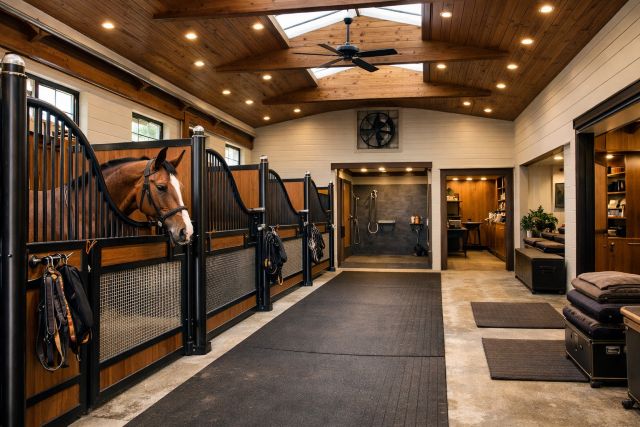

Designing a horse stable today isn’t just about “where the stalls go.” The best modern barns are built around how horses breathe, move, rest, and interact — and how people work safely around 1,000+ pounds of instinct and power. A thoughtful layout reduces injuries, improves air quality, lowers fire risk, and makes daily chores smoother without cutting corners on horse welfare.
In this guide, you’ll learn what makes a modern horse stable layout safer and more comfortable, which design choices matter most, and how to adapt these ideas whether you manage a private barn, a boarding facility, or a training operation.
What “modern” means in horse stable design
A modern horse stable layout prioritizes three outcomes:
Safer movement patterns for horses and humans (fewer tight turns, better sight lines, less congestion).
Healthier air and surfaces (better ventilation paths, moisture control, less dust and ammonia).
Lower stress through comfort and social needs (light, visibility, predictable routines, quieter zones).
Good design also acknowledges a reality many barns ignore: a stable is a “workplace” for people and a “living environment” for horses. When layouts only serve one of those, you usually pay for it with time, repairs, vet bills, or avoidable accidents.
Horse stable layout goals that directly reduce injuries
Many stable injuries happen in the same situations: passing in narrow aisles, crowding at doors, backing out into traffic, spooking at sudden noise, or slipping on wet footing. A modern layout aims to eliminate those scenarios before they happen.
A strong layout plan includes:
Clear, straight travel lines so horses don’t need sharp pivots in tight spaces.
Low-conflict “handoff zones” where you can tack up, wash, or wait without blocking flow.
Separate “clean” and “dirty” routes (feed and hay traffic separated from manure and trash when possible).
Visibility so horses can see what’s coming (and people can see horses).
The British Horse Society emphasizes safe passageways for leading horses past others and recommends stall sizing that allows horses to turn, lie down, and rise comfortably. It also highlights door width and safe lighting/wiring placement — details that directly affect daily safety.
Central-aisle vs. shed-row vs. courtyard: which modern layout works best?
Central-aisle barns (classic “barn aisle” layout)
A central-aisle layout places stalls on one or both sides of an indoor aisle. It can be excellent—if you manage airflow, fire risk, and congestion.
Best for: cold climates, high handling frequency (training barns), predictable routines
Key modern upgrades: wider aisle planning, high roofline, ridge/eave ventilation, dedicated zones (tack/feed) that don’t pinch the aisle
Air quality is where many central-aisle barns fail. University extension guidance emphasizes that barns need consistent air exchange to remove moisture and contaminants (including dust and ammonia).
Shed-row barns (stalls open to outside)
Shed-row layouts put stall fronts facing outdoors (often under a roof overhang). These can be fantastic for ventilation and horse comfort in the right climate.
Best for: mild climates, private barns, operations prioritizing natural airflow
Key modern upgrades: shade control, rain/wind protection, non-slip walkways, safe traffic lanes for handling and vehicles
Courtyard layouts (U- or O-shaped)
Courtyard barns create a protected inner yard that can function like a “buffer zone.” They can feel calm and organized when done right.
Best for: larger properties, mixed-use barns, facilities that want separate wings (training, rehab, broodmares)
Key modern upgrades: designated quiet wing, separate service entry, and a plan to prevent the courtyard becoming a congestion trap
Stall sizing and placement for comfort and safer handling
A modern horse stable layout starts with stall decisions because stall size affects everything: turning radius, bedding depth, airflow, and how safely staff can enter/exit.
The British Horse Society’s minimum recommendations commonly referenced in planning include 12ft x 12ft for horses, larger for big horses and foaling.
Here’s what “modern” designers do beyond minimums:
Place higher-need horses closer (rehab, seniors, mares with foals) to reduce travel and risk.
Avoid dead-end stall rows where horses must back out into traffic.
Use stress-reducing visibility (grills, safe windows, or stall-front designs that allow sight lines without encouraging fighting). BHS notes that stable designs vary and encourages considering safe social interaction and visibility.
Ventilation-first planning: the biggest comfort upgrade you can make
If you change only one thing in a horse stable layout, make it airflow.
Poor ventilation concentrates dust, moisture, and ammonia at the exact height where horses breathe—especially when lying down. Purdue’s guidance on dust management notes that ammonia levels tend to be higher closer to the floor, which can increase exposure for ponies and foals and for horses lying down.
Modern ventilation layout principles
A layout that supports ventilation usually includes:
High roof volume and clear vent paths
Ridge and eave openings (or engineered mechanical exchange where needed)
No “sealed-up” barn mindset — extension guidance warns that residential-style tight buildings are not ideal for horses and highlights the importance of designing for continuous fresh air.
If you’re using mechanical ventilation, the University of Minnesota provides practical airflow targets by season. For example, it notes 25 cfm per 1,000 lb of horse as a cold-weather ventilation rate guideline, scaling up substantially for warmer conditions.
Real-world scenario:
A 12-stall training barn with a beautiful enclosed aisle starts seeing repeated coughs and “heaves-like” flare-ups each winter. Staff closes everything to “keep it warm.” The fix isn’t a supplement—it’s a layout/airflow correction: adding controlled inlets/outlets, keeping air moving without drafts at horse level, and separating dusty storage away from the breathing zone.
Fire-safe layout zoning: design the barn like a series of safer compartments
Barn fires spread fast because barns combine ignition sources (wiring, heaters), fuel (hay, bedding), and oxygen. Rutgers’ Equine Science Center notes NFPA estimates of 326 deadly barn fires (2013–2017), with significant annual property damage, and also highlights that about half of barn structure fires involve the entire building — a sobering argument for layout choices that slow fire spread.
Modern fire-smart layout choices
Store hay and bedding separately from the main stable whenever possible. Rutgers specifically advises avoiding storing hay/straw/bedding in the same building as livestock housing when feasible.
Create “clean electrical corridors”: plan wiring runs away from stall fronts, protect fixtures, and keep dust/cobweb accumulation easy to clean.
Add wide, direct egress paths so horses can exit without passing tight corners or dead ends.
BHS also emphasizes safe lighting installation (protected fittings and wiring out of reach), which is both safety and fire-prevention minded.
The “workflow triangle”: feed, water, manure — without chaos
Modern stable layouts reduce daily risk by making routine tasks smoother. Most handling accidents happen during “normal” moments: feeding, turnout, leading past other horses, or maneuvering equipment.
A practical layout improvement is building around a workflow triangle:
Feed room close enough to reduce carrying distance, but positioned so feed traffic doesn’t bottleneck the aisle.
Water access that’s convenient and easy to monitor (BHS discusses considerations for buckets vs. automatic drinkers and the importance of constant clean water).
Manure route that stays out of the main horse traffic line as much as possible.
If you’re redesigning an existing barn, even small moves — like relocating a muck heap access point or flipping a door swing — can remove the worst “conflict points.”
Flooring and drainage choices that support comfort and fewer slips
Comfort isn’t only stall size. It’s also what horses stand on and how moisture moves.
BHS recommends stable flooring that’s even, non-slip, and designed to drain urine away, and also notes that bedding/matting should cover the whole floor to reduce strain from hard surfaces.
Modern layout tip: plan drains and slopes on paper before building, especially in wash bays and grooming areas. Slippery transitions — like leaving a wash bay onto a smooth aisle — are classic injury triggers.
Lighting, noise, and “calm design” for better behavior
Good behavior is often good design.
BHS stresses the need for adequate stable-area lighting for safe care, with safe placement and protected fittings/wiring.
Modern comfort upgrades include:
Even, glare-reduced lighting in aisles and grooming bays
Quiet zones (keep loud equipment and clanging storage away from the main horse line)
Predictable sight lines so horses aren’t startled by sudden “appearances” at corners
Featured snippet: quick definition
A modern horse stable layout is a barn plan that improves safety and comfort by optimizing horse flow, stall sizing, ventilation paths, fire-safe zoning, and daily work areas (feed, water, grooming, manure) to reduce stress and prevent accidents.
FAQ: Modern horse stable layouts
What is the safest horse stable layout?
The safest layout is the one that prevents congestion and reduces sharp turns: straight travel lines, wide and clear passageways, good lighting, and stall doors placed so horses don’t back into traffic. Separating hay storage from the main stable also reduces major fire risk.
What stall size is recommended for an average horse?
Minimum recommendations commonly used in planning include 12ft x 12ft for horses, with larger sizes for bigger horses and foaling boxes. Individual needs vary, so larger can be appropriate depending on horse size, temperament, and time spent stabled.
How do modern layouts improve stable air quality?
They plan for air exchange first: ridge/eave openings or engineered ventilation, high roof volume, and reduced dust/ammonia buildup. Mechanical ventilation guidelines can be sized to seasonal needs, and designs avoid sealing barns “tight like a house.”
Where should hay be stored in a modern barn plan?
Ideally in a separate structure from horse housing. If that’s not possible, use fire-resistant separation, keep ignition sources away, and maintain strict housekeeping because hay and bedding are high-risk fuels.
Conclusion: a safer, calmer horse stable starts with the layout
A well-designed horse stable layout is one of the most cost-effective “health and safety upgrades” you can make. When stalls are sized correctly, movement is predictable, ventilation is built into the structure, and fire risk is reduced through smart zoning, you don’t just get a nicer barn — you get fewer injuries, better respiratory comfort, and a daily routine that feels smoother for both horses and humans. Use modern layout thinking to design for airflow, workflow, and calm handling, and your stable will perform better for years.
















Leave a comment