
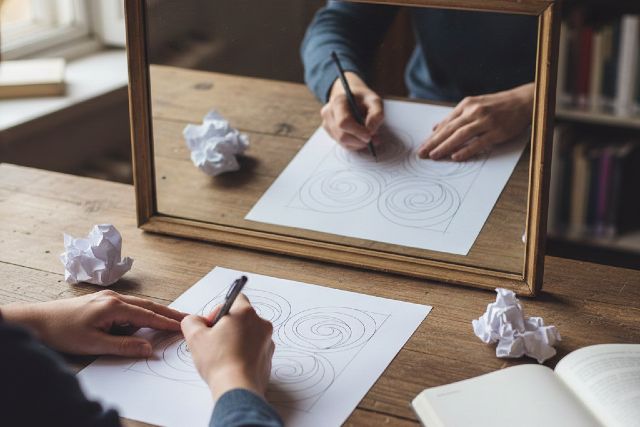

If you’re looking for a quick, low-cost way to challenge your mind, mirror drawing is one of those oddly satisfying exercises that feels like a game but behaves like real training. You’re doing a simple task — drawing a line, a shape, or a word — while only watching your hand in a mirror (or on a mirrored screen). Suddenly, your brain has to “re-map” left and right, slow down impulses, and build a new control strategy.
That mild frustration you feel in the first minutes? That’s the point. Mirror drawing creates a clean little storm of visuomotor coordination, sensorimotor adaptation, and procedural learning — the kind researchers use to study how the brain acquires skills.
What is mirror drawing?
Mirror drawing is a motor-learning task where you draw (often tracing a shape like a star) while viewing your hand and the drawing surface indirectly through a mirror, rather than looking directly at your hand. The mirror reverses visual feedback, so your usual hand-eye coordination rules don’t work — and your brain has to learn new ones.
In labs, it’s often called the mirror-drawing task or mirror tracing, and it’s been used for decades to measure improvement in speed and accuracy over repeated trials — classic signs of skill learning.
Why mirror drawing feels so hard (and why that’s good)
Mirror drawing is difficult for the same reason driving in a new country can feel mentally exhausting: your brain’s “autopilot” is tuned for one set of mappings, and now it’s wrong.
When you move your hand right, the mirror makes it look like it moved left. Your brain detects a mismatch between what you intended and what you see, then gradually recalibrates. That recalibration process is a core feature of motor learning, the same broad category researchers use to study how we acquire new movement skills.
It also tends to recruit procedural learning systems (skill memory), which are associated with circuits including the cerebellum and basal ganglia in many lines of research.
Mirror drawing benefits: what it can (and can’t) do
Let’s be honest: no single brain exercise turns you into a genius overnight. Most “brain training” claims fall apart when you demand broad, real-world transfer (like doing one game and suddenly improving at everything). Research on cognitive training often finds mixed results on transfer beyond the trained task.
So where does mirror drawing fit?
What mirror drawing is genuinely good for
Mirror drawing is especially strong for task-specific improvements such as:
Better hand-eye coordination under unusual visual conditions
Improved movement accuracy and steadier control with practice
Stronger attention and error-monitoring (you can’t zone out and succeed)
These are realistic, observable outcomes because the task forces your nervous system to build a new mapping.
What mirror drawing probably won’t do by itself
“Fix” memory, ADHD, anxiety, or cognition in a medical sense
Replace clinical rehab or therapy if you’re recovering from injury
Automatically improve unrelated skills (like math) without broader training habits
If you treat it like a focused skill drill — similar to learning a new instrument pattern — it shines.
How to do mirror drawing at home (simple setup)
You can do mirror drawing with almost no equipment.
Option A: The classic mirror method (best for the real effect)
You’ll need:
A small mirror (tabletop or standing)
Paper and a pen/pencil
A simple shape to trace (star, spiral, maze, block letters)
Steps
Place the paper flat on the table.
Put the mirror upright so you can see the paper in the reflection.
Position your hand so you cannot see it directly—only in the mirror.
Trace the shape slowly while only watching the reflection.
Repeat for multiple short trials, aiming for fewer errors.
Option B: The “phone mirror” version (works in a pinch)
Use your phone’s selfie camera and flip it horizontally (many camera apps have a “mirror” setting). Watch the screen while you draw on paper.
Best shapes to start with (and why)
Your first shape matters because it controls frustration levels and learning speed.
A good progression:
Straight lines and corners (quick wins)
Simple spirals (smooth control)
Star tracing (classic research shape)
Letters/your name (higher cognitive load)
Complex mazes (advanced control + planning)
In research contexts, star shapes are popular because they produce measurable changes in time and errors across trials.
Mirror drawing practice plan (10 minutes a day)
If you want visible progress without burning out, use short, repeatable sessions.
Day 1–2: Calibration
Do 6–8 trials of 30–60 seconds each. Go slow. Your goal is to learn the “rules” of the mirror.
Day 3–5: Smoothness
Keep the same shape. Try to reduce jerky corrections. Aim for one clean continuous line, even if it’s slow.
Day 6–7: Transfer
Try a new shape or write a short word. Your brain will complain again—this is normal.
Many studies track learning by measuring reduced errors and faster completion times over repeated trials.
The science of mirror drawing: what’s happening in your brain?
Mirror drawing is a neat demonstration of how flexible your brain is when feedback changes.
1) Sensory conflict → adaptation
Your visual system says one thing; your motor system expects another. The brain resolves the conflict by adjusting predictions and control.
2) Procedural learning kicks in
Over repeated attempts, the skill becomes less effortful. In clinical and research contexts, mirror drawing is widely used as a procedural learning task.
3) Sleep and consolidation (a big reason practice feels “sticky”)
Mirror drawing is even used in experiments exploring how practice effects consolidate across time (including sleep-related designs).
Mirror drawing tips that speed up progress
Here are the moves that make the biggest difference fast:
Slow is not “worse”—it’s the training signal
Early on, speed makes errors explode. Accuracy teaches your brain the mapping.
Use a “micro-correction” strategy
Instead of big swings, make tiny corrections. This reduces oversteering (the #1 beginner problem).
Fix your posture and anchor your wrist
If your arm is floating, the task becomes a shaky endurance test, not a learning task.
Track one metric only
Choose either:
Time to complete, or
Number of boundary hits/errors
Obsessing over everything increases stress and worsens performance.
Common mistakes
Mistake: Switching shapes every session
Your brain needs repetition to stabilize the mapping. Keep the same shape for a few days first.
Mistake: Trying to “outsmart” the mirror
Don’t overthink left/right. Let your hand learn by feedback.
Mistake: Doing one long session
Short, spaced practice tends to be more sustainable and keeps attention high.
Who should try mirror drawing?
Mirror drawing is great for:
Students who want a quick focus drill
Adults who enjoy skill-based “brain games”
Artists and designers who like coordination challenges
Anyone working on patience and attention control
If you have hand pain, a tremor, or you’re recovering from a neurological injury, keep it gentle and consider professional guidance for rehab protocols. For clinical rehabilitation, approaches like mirror therapy are a separate (medical) category with its own evidence base, especially in stroke contexts.
Mirror drawing vs. mirror therapy: don’t mix these up
They sound similar but they’re used differently.
Mirror drawing: a skill task for motor learning and coordination (training/experiment style).
Mirror therapy: a rehab method using mirror visual feedback to improve movement or pain outcomes (clinical use), including post-stroke motor recovery research.
Mirror drawing can feel therapeutic, but it’s not a medical treatment by default.
FAQs about mirror drawing
Does mirror drawing actually train your brain?
Yes—mirror drawing reliably trains a specific skill: controlling movement under reversed visual feedback. It’s used in motor-learning research because people typically improve over repeated trials in speed and accuracy.
How long does it take to get better at mirror drawing?
Most people notice improvement within a few short sessions (often within a week) if they repeat the same shape and track errors or time. Research designs commonly use repeated trials to detect learning over time.
What’s the best mirror drawing shape for beginners?
Start with straight lines and corners, then move to spirals, then a star. Star tracing is common in studies because it gives clear accuracy and timing signals.
Can mirror drawing help with memory?
Mirror drawing is more strongly tied to procedural learning (skill memory) than to memorizing facts. It can support attention and control habits, but it’s not a direct “memory booster” for everyone.
Is mirror drawing good for kids?
It can be, as long as sessions are short and fun. Research has examined how mirror-drawing learning differs across development and practice.
Conclusion: why mirror drawing is worth trying today
Mirror drawing is one of the simplest ways to feel your brain learning in real time. It’s low-tech, fast to set up, and surprisingly effective at training coordination, attention, and motor control under a new set of rules. Keep sessions short, repeat one shape for a few days, and measure either time or errors — then watch how quickly the “impossible” starts to feel normal.
If you want a brain-training habit you’ll actually stick with, mirror drawing is a great place to start — because it’s not just theory. You can see the progress on paper.














Leave a comment