
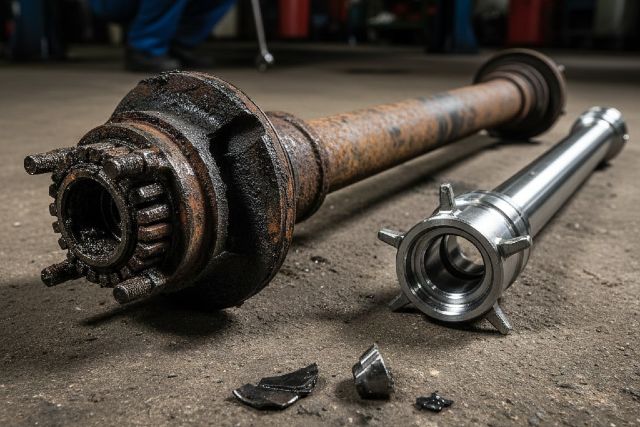

If you’re wondering how long an axle shaft lasts, you’re really asking two questions at once: how long the metal shaft itself can survive, and how long the joints and protective parts around it can keep doing their job. In most modern cars, the axle shaft is part of a CV axle assembly (constant-velocity joints plus shaft), and the “lifespan” usually depends less on the steel and more on whether the grease stays clean and sealed inside the CV boots.
The good news is that many factory axle shafts can run for years without attention. The bad news is that a small rubber boot tear can turn a long-life component into an expensive replacement surprisingly fast, because grease escapes and grit gets in. That seal-and-grease story is the key to understanding wear, symptoms, and prevention.
An axle shaft transfers torque from the transmission/differential to the wheel. On many front-wheel-drive and all-wheel-drive vehicles, the axle shaft includes inner and outer CV joints so the wheel can steer and move with suspension travel while still receiving power.
That’s why axle problems often show up as clicking during turns or vibration under acceleration: the joints are doing complex work under load. The steel shaft can be extremely durable, but the joints are precision parts that rely on lubrication and protection from contamination.
How long does an axle shaft last in miles and years?
Under normal driving, many vehicles see axle shaft/CV axle service life around the 100,000-mile neighborhood, with a wide real-world range. Some sources commonly cite practical ranges from roughly 50,000 miles on the low end to 150,000+ miles on the high end, depending on boot condition, environment, and driving style.
In ideal conditions, an OEM CV axle can last well past 150,000 miles and sometimes for the “service life” of the vehicle, especially if the boots remain intact and grease stays sealed.
If you want a simple expectation that’s usually safe for planning, think of it this way: the axle shaft can be a long-life component, but the axle assembly becomes a wear item the moment a boot starts leaking or a joint begins running dry and dirty.
The biggest factors that shorten axle shaft lifespan
CV boot damage and grease loss (the #1 accelerator)
CV boots exist to keep grease in and keep dirt and water out. SKF describes this contamination-control role directly: boots retain grease and protect CV joints from dirt and water ingress that can cause damage or erosion over time.
Once a boot splits, grease can leak out and contaminants can enter, which accelerates joint wear. Haynes explains this cause-and-effect plainly and recommends checking boot health before the joint is ruined.
Cars.com makes the same point from a consumer-maintenance angle: grease escape plus contamination can cause CV joint failure, and periodic inspections (often easiest during oil-change lift time) help prevent it.
Age-related wear plus high operating stress
Even without a torn boot, the axle assembly is constantly under high stress. A GKN workshop document notes that CV joints transfer torque and face extremely high stresses during operation, with age-related wear being common, and defective boots and inferior grease also being leading contributors.
Driving conditions and habits
City driving with frequent tight turns, hard acceleration, potholes, rough roads, and lifted/modified suspension geometry can increase joint angles and loading. Those conditions don’t automatically “kill” an axle, but they can reduce the margin for error once a boot starts failing.
Installation and parts quality (especially with replacements)
One underappreciated reason some people replace axles more than once is that not all replacement assemblies are equal, and improper handling during installation can damage boots or joints. GKN specifically flags improper handling during installation/removal as a contributor to failures.
What wear looks like: common axle shaft and CV joint symptoms
When people say “bad axle shaft,” they often mean the CV joint is worn, not that the steel shaft snapped. Here are the most common real-world signals.
Clicking or popping while turning is the classic outer CV joint symptom. It’s often most noticeable during low-speed, tight turns (parking lots are the giveaway).
Grease splatter near the wheel well or on suspension components is a strong sign the boot has torn or a clamp has loosened. Cars.com notes that grease on the outside of the boot or nearby surfaces commonly accompanies boot issues.
Vibration at highway speeds or shudder under acceleration can point to inner joint wear, axle imbalance, or related drivetrain issues. This symptom overlaps with wheel balance and tire problems, so it’s a “diagnose carefully” clue rather than a slam dunk.
A clunk when shifting from reverse to drive or when accelerating can also appear if there’s excessive play in the joint or in other driveline components.
Is it safe to drive with a worn axle shaft or CV joint?
A minor seep or early boot crack might not feel dangerous today, but the direction of travel is usually bad: less grease, more contamination, more wear. Cars.com warns that boot failure can lead to CV joint failure, and the practical risk is losing smooth power delivery and getting stranded if the joint fails badly.
If you hear persistent clicking on turns or feel strong vibration under load, treat it as a near-term safety and reliability issue rather than a “someday” repair, because the joint is telling you it’s already wearing.
Axle shaft wear prevention: what actually works
Inspect boots regularly (and do it at the right times)
The highest-ROI prevention step is simply spotting boot damage early. Cars.com specifically recommends periodic drive-axle boot inspection, often during routine service when the car is lifted.
If you only remember one schedule, align it with oil-change intervals or tire rotations. You’re not trying to become a full-time inspector; you’re just trying to catch a small crack before it becomes a dirt-and-grease disaster.
Fix a torn boot early, before noise begins
Haynes explains the key threshold: when a boot splits, grease leaks out and dirt gets in, causing the joint to wear. In practical terms, once clicking starts, the joint is often already damaged enough that a boot-only fix may not restore long-term reliability.
So the “prevention” move is speed. If you catch a tear early, you may be able to repair the boot and preserve the joint.
Avoid the habits that spike joint load
This isn’t about babying your car; it’s about avoiding the worst stress combinations. Hard acceleration while the wheel is cranked to full lock, frequent curb strikes, and blasting through potholes increase joint strain. If you drive on rough roads often, inspections matter even more.
Use quality parts and good installation practices
If replacement is needed, quality matters. GKN highlights that inferior grease and improper handling during installation/removal can contribute to damage. That’s a reminder to pick reputable parts and ensure boots aren’t twisted, nicked, or clamped poorly.
A realistic scenario: how a “small boot tear” becomes a full axle replacement
Imagine you’re doing an oil change and notice grease on the inside of the wheel. The car still drives fine, and you don’t hear clicking yet. If you replace the boot quickly, you may save the joint.
Now imagine you ignore it for a few months through rain, dust, and heat cycles. The boot leaks more, dirt enters, and the joint begins clicking on turns. At that stage, a boot replacement may stop further contamination, but it can’t undo the wear that already happened inside the joint. This is exactly why so many mechanics treat early detection as the difference between a smaller repair and a full axle shaft replacement.
When should you replace an axle shaft?
Replace the axle shaft (or full CV axle assembly) when you have confirmed joint wear, persistent clicking, significant vibration under load traced to the axle, or physical damage like a torn boot with contamination and noise.
Some manufacturers and service networks publish technical service bulletins related to axle or boot issues, and NHTSA hosts recall and TSB documentation that can be useful if you suspect a known defect pattern for your vehicle.
If you want a step that can save you money, check whether your vehicle has an applicable TSB or recall before paying out of pocket.
Frequently asked questions about axle shaft lifespan
How long does an axle shaft last if the boot never tears?
It can last a very long time, often well beyond 100,000 miles and sometimes past 150,000 miles, because the joint stays lubricated and uncontaminated. The main enemy is grease loss and dirt/water ingress, which boots are designed to prevent.
What’s the earliest warning sign of axle shaft trouble?
Grease around the boot area or inside the wheel well is one of the earliest visible signs, because it suggests the boot seal is compromised. Clicking on turns is a later, more definitive symptom that often indicates internal joint wear has started.
Can a CV boot be replaced without replacing the whole axle shaft?
Sometimes, yes, especially if you catch the tear early before clicking or vibration begins. If noise is present, many shops recommend replacing the whole axle assembly because internal wear may already be significant.
Do aftermarket axles last as long as OEM?
It depends heavily on parts quality and installation. Some aftermarket axles perform well, but improper installation handling and differences in grease/boot quality can affect lifespan, which is why reputable brands and correct fitment matter.
Conclusion: the real answer to “how long does an axle shaft last?”
A well-built axle shaft can last a long time, often around 100,000 miles or more, and sometimes well beyond 150,000 miles under good conditions. The deciding factor is rarely the steel shaft itself. It’s the protection system around it: intact CV boots, clean grease, and low contamination. When the boot fails, the clock speeds up fast because grease escapes and grit gets in, driving wear and eventual joint failure.











Leave a comment