
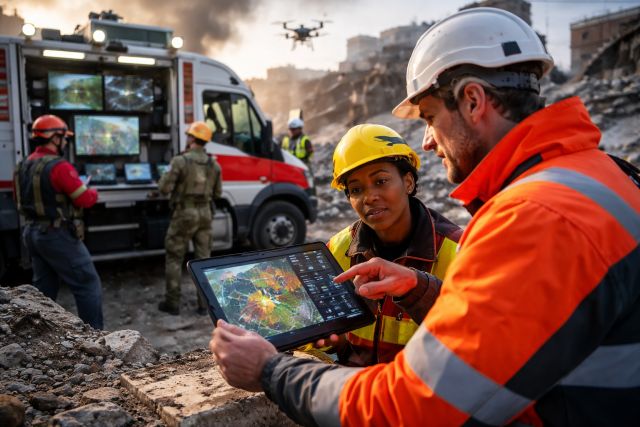

How can we empower the disaster management crew in a way that actually changes outcomes on the ground—faster rescues, clearer coordination, fewer preventable losses? The short answer is this: combine people-centered workflows with modern disaster response systems that improve situational awareness, communication, and command decisions in real time. When the crew can see what’s happening, talk to the right people, and move resources quickly, they stop fighting the disaster “blindfolded” and start running a controlled operation.
That matters more than ever. The World Meteorological Organization notes that early warnings issued within 24 hours can reduce damage by 30%, and that only about half of countries have multi-hazard early warning system coverage — at a time when the number of disasters has increased significantly over the last decades. So empowerment isn’t a buzzword; it’s a measurable capability gap we can close.
What “empowerment” really means in disaster response
In disaster operations, empowerment is not about giving people more tasks. It’s about giving them:
-
Clarity: a shared, verified operational picture (who needs help, where, and what’s blocked).
-
Authority with guardrails: clear roles, escalation paths, and approval limits that reduce bottlenecks.
-
Speed: faster information flow, dispatch, and resource tracking — without losing accountability.
-
Resilience: tools that still work when power, networks, and normal processes fail.
Modern disaster response systems are most powerful when they reinforce these four outcomes, rather than adding dashboards no one trusts.
H2: How can we empower the disaster management crew with a modern response “stack”?
A practical way to think about modernization is as a stack — layers that must work together under stress:
1) Command and coordination layer (ICS/NIMS-aligned)
Disasters aren’t solved by heroic individuals; they’re solved by coordinated teams. If your structure is fuzzy, technology amplifies the chaos. That’s why many agencies standardize around frameworks like NIMS/ICS, which FEMA describes as guidance that helps government, NGOs, and the private sector work together across the full emergency lifecycle.
What to modernize here:
-
Digital incident action plans, objectives, and tasking (so everyone works from the same priorities).
-
Standardized resource typing, requests, and mutual-aid workflows.
-
A single operational rhythm: briefings, updates, and handoffs that fit the tools (not the other way around).
Empowerment outcome: responders spend less time “finding the plan” and more time executing it.
2) Situational awareness layer (GIS + live field data)
If you want the crew to move confidently, they need a map that behaves like a living, shared truth.
Modern situational awareness typically combines:
-
GIS base maps (roads, critical infrastructure, hazard zones)
-
Live feeds (calls for service, sensor data, weather warnings)
-
Field reporting (photos, forms, check-ins, assessments)
A key tie-in: the Early Warnings for All push aims to protect everyone on Earth from hazardous events through life-saving early warning systems by 2027, emphasizing end-to-end systems that lead to action — not just forecasts.
Empowerment outcome: crews don’t waste hours validating rumors; they operate from validated, shareable ground truth.
3) Communications layer (interoperable, redundant, and logged)
When networks go down, response often collapses into fragmented radio chatter and phone calls. “Modern” here doesn’t mean fancy — it means redundancy and interoperability:
-
Radio + LTE/5G + satellite options (as available)
-
Push-to-talk interoperability bridges (so agencies can talk)
-
Message logging and acknowledgement (so critical updates don’t vanish)
Empowerment outcome: the right person gets the right message at the right time — consistently.
4) Resource and logistics layer (tracking what you have, where it is, and when it arrives)
In almost every large incident, the hidden enemy is logistics uncertainty:
-
Where are the boats?
-
How many trauma kits are left?
-
Which shelter has capacity tonight?
A modern resource system gives near-real-time answers through barcode/QR scans, check-in/out, staging area status, and simple “last known location” updates.
Empowerment outcome: fewer delays caused by “we thought someone else had it.”
5) Health and humanitarian operations layer (standards + coordination)
In medical and humanitarian response, quality and coordination can be life-or-death. The WHO Emergency Medical Teams (EMT) initiative focuses on improving timeliness and quality of health services and strengthening national capacity to lead activation and coordination after disasters and emergencies.
Empowerment outcome: responders integrate better with health systems and avoid duplication or unsafe deployments.
The business case: why modern systems pay off
Modern systems aren’t just “nice to have.” They reduce losses.
-
The World Bank has estimated that investments in early warning systems can achieve benefit-cost ratios ranging from 4 to 36, depending on context and assumptions.
-
WMO highlights that 24-hour warnings can reduce damage by 30%, which translates into real savings when scaled across frequent hazards.
-
UN and partners frame early warning and anticipatory action as among the most cost-effective disaster risk reduction measures.
If leadership needs a clear argument: modernization is often cheaper than repeated recovery.
What modern disaster response systems look like in the real world
Here’s what “modern” often includes in practice (and why crews actually like it when implemented well):
Computer-aided dispatch (CAD) connected to the incident picture
When dispatch data automatically feeds the operational map, you eliminate manual copying and reduce dispatch errors.
Mobile field apps that work offline
The field team can capture:
-
rapid damage assessments
-
photos and GPS points
-
victim counts and needs
-
road blockage reports
Then sync when connectivity returns.
Decision dashboards that answer operational questions (not vanity metrics)
Useful dashboards answer:
-
“Where are the highest-priority unmet needs right now?”
-
“Which routes are still passable to reach them?”
-
“What resources are en route and when will they arrive?”
Not: “How many total clicks did we get?”
Public alerting that drives action
If your warnings don’t produce protective action, they’re noise. People-centered warning means:
-
clear, short messages
-
location-specific guidance
-
consistent channels
-
feedback loops (did the message reach people?)
This aligns with the “end-to-end” emphasis of EW4All and multi-hazard early warning thinking.
A scenario: flood response before vs. after modernization
Imagine a sudden river flood impacting multiple neighborhoods.
Before modernization:
Field teams report via voice calls. Dispatch writes notes. The EOC has a static map. Two rescue teams get sent to the same street. Another street is missed for hours. Supplies arrive at a shelter that’s already full.
After modernization:
The crew uses a shared map where flood extents and road closures are updated continuously. Field reports drop pins with photos. Dispatch assigns tasks directly from the map. Logistics sees shelter occupancy live and reroutes supplies. Public alerts target only the at-risk zones with clear evacuation routes.
Same people. Same hazard. Completely different outcomes — because the system reduces friction.
The biggest barriers
Barrier 1: “We already have tools, but nobody uses them”
This usually means the system doesn’t match the crew’s reality.
Fix: design around the incident rhythm:
-
one update format
-
one map view everyone trusts
-
one place for tasking and status
Barrier 2: Data is fragmented across agencies
Modern response requires data sharing agreements, minimum data standards, and a trusted hub.
Fix: start with a thin slice of shared data:
-
road closures
-
shelter status
-
resource requests
-
incident objectives
Then expand.
Barrier 3: Connectivity fails when you need it most
Fix: prioritize offline-first and redundancy:
-
offline forms + delayed sync
-
backup power for key nodes
-
alternate comms pathways
Barrier 4: Training happens once a year, then is forgotten
FEMA emphasizes implementation and training as part of operational readiness for NIMS adoption.
Fix: train in small, frequent loops:
-
15-minute tool drills
-
monthly scenario exercises
-
quick refreshers before high-risk seasons
Actionable implementation roadmap
If you’re modernizing, don’t start by buying everything. Start by building a reliable minimum system and expanding.
Step 1: Define your “golden workflow”
Document the simplest version of:
-
alert → assessment → tasking → resource request → execution → reporting → handoff
If you can’t describe it clearly, software won’t fix it.
Step 2: Establish a shared operational picture
Pick one map view and one data standard for core fields (time, location, status, owner).
Step 3: Add anticipatory action triggers
Anticipatory action (acting before disaster impacts peak) is increasingly formalized across humanitarian systems. The IFRC describes “early warning and early action” (anticipatory action/forecast-based action) as steps taken to protect people before a disaster strikes, based on warnings and forecasts.
Also, OCHA has emphasized evidence that anticipatory action can be cost-effective and that coordination improves resource allocation and reduces duplication.
Step 4: Make accountability effortless
Use simple status updates, timestamps, and audit trails — so teams don’t feel like they’re doing paperwork “for headquarters.”
Step 5: Measure what matters
Track:
-
time from alert to first assessment
-
time from request to delivery
-
duplication rate (two teams sent to same task)
-
unmet needs over time
These are empowerment metrics.
FAQs
How can we empower the disaster management crew quickly?
Empower the crew quickly by standardizing command workflows (ICS/NIMS-aligned), providing a shared operational map, enabling redundant communications, and digitizing resource requests so decisions and deliveries happen faster and with fewer bottlenecks.
What is a modern disaster response system?
A modern disaster response system is an integrated set of tools and workflows that connects command, communications, situational awareness, logistics, and public warning — so teams can coordinate in real time, even under degraded conditions.
Do early warning systems really reduce damage?
Yes. WMO notes that early warnings issued within 24 hours of a hazard can reduce the damage of that event by 30%.
Are modern disaster systems cost-effective?
Often, yes. World Bank analysis has estimated benefit-cost ratios for early warning system investments between 4 and 36, reflecting potentially large returns relative to cost.
Conclusion: how can we empower the disaster management crew in 2026 and beyond?
How can we empower the disaster management crew in a lasting way? By combining clear command structures with modern disaster response systems that make information trustworthy, communication resilient, and logistics visible. The best technology doesn’t replace judgment — it amplifies it, helping responders act earlier, coordinate better, and deliver help faster.
If you focus on an ICS-aligned operating rhythm, a shared real-time map, redundant communications, and anticipatory action tied to early warnings, you’re not just “modernizing.” You’re building a response capability that can keep working when everything else fails — exactly what communities need as hazards intensify.













Leave a comment