
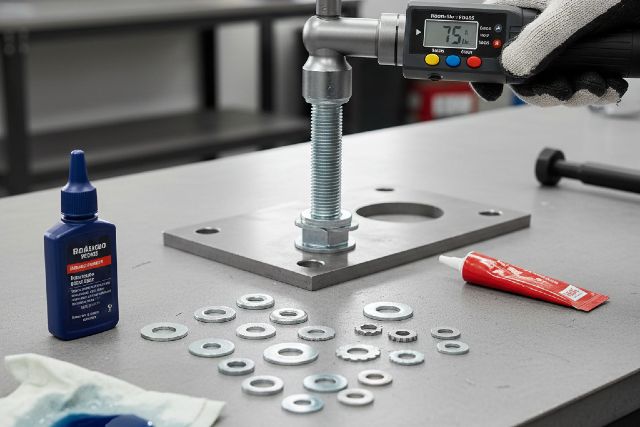

A hex bolt looks simple, but installation details decide whether the joint stays tight for years or slowly loosens after heat cycles and vibration. In real shops and real field repairs, most “bolt problems” are not mysterious material defects. They’re usually predictable outcomes from mismatched torque assumptions, inconsistent friction, the wrong washer choice for the surface and load, or a thread locking method that doesn’t match the environment.
This article focuses on what actually matters in everyday hex bolt work: how torque relates to clamp load, why washers can either protect preload or quietly destroy it, and how to choose thread locking that fits your service conditions. It’s written for people who assemble and maintain equipment, vehicles, structures, and machines, and it aims to reduce rework, loosening, leaks, and fatigue failures.
How a Hex Bolt Holds a Joint Together
A hex bolt doesn’t “hold” parts together in the way most people picture it. In a properly designed bolted joint, the bolt is tightened to stretch slightly, which creates preload (also called clamp load). That clamp load compresses the joint members and generates friction between the clamped surfaces. When the joint is loaded in service, that friction and compression resist movement. If the joint slips, the fastener is far more likely to loosen and fatigue.
NASA’s Fastener Design Manual treats torque, preload, friction, washers, locking methods, fatigue, and joint design as a connected system rather than separate topics, because reliability depends on how these elements work together.
Torque Isn’t Clamp Load, and That’s Where Most Trouble Starts
Torque is the most common tightening method because it’s convenient and fast. The problem is that torque is an indirect proxy for tension. A large portion of the torque you apply is consumed by friction in the threads and under the head or nut. That means two “identical” hex bolts torqued to the same number can end up with significantly different clamp loads if friction changes even slightly.
NASA technical guidance on preloaded joints explicitly discusses preload uncertainty and notes it depends on factors such as the torquing device, lubrication, measurement method, and friction variability from one bolt to another. The practical consequence is simple: if you treat torque as a guarantee instead of a controlled estimate, you’ll see unpredictable results over time.
If you ever wondered why one bolt in a pattern loosens while the others seem fine, friction scatter is a common culprit. One fastener had slightly more oil on the threads, or a washer with a different finish, or minor debris under the head. Your torque wrench delivered the same torque, but the joint didn’t get the same clamp load.
What Improves Torque Consistency in the Real World
You don’t need a lab to improve results. You need consistency in the things that dominate friction and settling.
Clean and repeatable thread condition matters more than people expect. Dirt, corrosion, burrs, damaged threads, and plating differences all change the torque-tension relationship. Even when you “clean” a bolt, the feel can still vary if the under-head bearing surface is rough or if the washer face is inconsistent.
Lubrication is a big decision, not a minor detail. If a torque spec was developed for dry installation and you add oil, you can easily push clamp load higher than intended at the same torque. If a spec assumes lubrication and you assemble dry, you risk low preload and self-loosening. NASA’s preload work highlights lubrication and friction variability as major contributors to preload uncertainty.
Tool condition matters too. A torque wrench that is out of calibration doesn’t just “miss by a little,” it can systematically over- or under-tighten every fastener you touch. Calibration and proper technique help, but even perfect tools can’t overcome inconsistent friction.
On multi-bolt joints, uniformity matters as much as the final number. If a cover, flange, or bracket is pulled down unevenly, early bolts in the sequence may relax as the joint seats. That relaxation shows up later as “mysterious loosening” even though you swear you hit spec.
Hex Bolt Strength Classes and Why “Stronger” Isn’t Always Better
Bolt property class determines strength and how much preload a fastener can safely carry. ISO 898-1 is the key reference for mechanical properties of carbon and alloy steel bolts, screws, and studs by property class.
In practice, higher strength can be helpful, but it’s not automatically safer. If you’re clamping soft materials like aluminum, plastics, or thin sheet metal, the joint may crush or embed long before the bolt benefits from its higher capacity. If you’re tightening into a tapped hole, the internal threads may be the weak link. The “strong bolt” doesn’t matter if the threads in the part strip first.
Washers: The Quiet Factor That Can Save or Ruin Clamp Load
Washers are often treated like optional accessories, but they have a real mechanical role. They affect the bearing surface under the head or nut, protect the joint surface, and influence how much embedment and settling occurs. NASA’s Fastener Design Manual covers washers and locking approaches as part of the broader reliability picture for joints.
A flat washer can be a smart move when the joint material is soft, when the hole is oversized or slotted, or when you want to reduce surface damage and achieve more consistent under-head friction. The key is quality and hardness. A soft, cheap washer can deform under load. That deformation becomes settlement, and settlement reduces preload. Over time, reduced preload increases the likelihood of slip, vibration loosening, and fatigue.
Lock washers are commonly used, but it’s risky to assume they will prevent loosening in high-vibration, high-slip environments. In many real assemblies, self-loosening is driven by transverse movement and joint slip, not simply “rotation wanting to happen.” That’s why the industry talks so much about transverse vibration testing.
The Junker vibration test, described in DIN 65151, is widely referenced as a method to compare how well bolted joints and locking solutions maintain clamp load under transverse dynamic loading. Even if you never run this test yourself, the concept is valuable: if the joint experiences transverse vibration and slip, many locking methods will lose preload. The best “fix” often starts with better preload and better joint design to prevent slip, rather than relying solely on a washer to do the job.
For applications where vibration loosening is a recurring problem, wedge-locking washer systems are designed specifically to resist loosening under dynamic loads by using a cam principle. Junker-style testing is often used to demonstrate differences between locking approaches in these conditions.
Thread Locking: When Threadlocker Helps, and When It’s the Wrong Tool
Thread locking is about maintaining clamp load by resisting rotation loosening. It can also reduce leakage paths in some assemblies. The right choice depends on vibration, temperature, serviceability, and cleanliness.
Anaerobic threadlockers are popular because they’re simple and clean. LOCTITE 243, for example, is described by Henkel as a medium-strength, general-purpose threadlocker that works on many metals and can cure through many “as-received” fasteners with minor oil contamination. That oil tolerance is helpful in maintenance environments, but it’s not a license to ignore surface prep entirely. If the fastener is heavily contaminated or the surfaces are inconsistent, results will still vary.
Threadlocker is a strong option when vibration is present, when you can allow cure time, and when you want a locking method that doesn’t require special nuts, washers, or drilling for safety wire. It is less ideal when the joint is disassembled frequently, when temperatures exceed the product’s capability, or when chemical exposure may degrade the adhesive. Technical data sheets exist for a reason, and they’re worth checking before you standardize a threadlocker in a harsh environment.
Mechanical locking methods still have an important place. Prevailing torque nuts, all-metal lock nuts, and other mechanical approaches can be better when you need immediate resistance without cure time or when heat makes nylon inserts unsuitable. Transverse vibration testing discussions are often framed around comparing these approaches under DIN 65151 style conditions.
A Practical Hex Bolt Installation Workflow That Reduces Comebacks
A reliable installation starts before you pick up the wrench. Confirm that the hex bolt length and thread engagement make sense for the joint. If you’re threading into a tapped hole, make sure engagement is sufficient and that the internal threads are in good condition. If you’re using a nut, ensure the nut runs freely by hand for several turns. If it binds early, you may be cross-threading or dealing with damage that will distort the torque result.
Next, look at the seating surfaces under the head and nut. If paint, powder coat, or gasket material is in the bearing area, expect settlement. Settlement means preload loss. Some joints are designed with that in mind, but many field repairs are not. If you can’t avoid compressible layers, consider a tightening approach that accounts for seating and relaxation, such as staged tightening and a controlled recheck after initial seating, while recognizing that re-torquing changes friction conditions and can change the resulting preload. NASA guidance on preloaded joints discusses uncertainty factors and why the applied torque does not map perfectly to preload.
When washers are used, choose them intentionally. If the joint material is soft or easily damaged, a hardened flat washer can reduce embedment and provide a stable bearing surface. If the joint has a slotted hole or oversized clearance, a washer can help distribute the load more evenly and reduce localized deformation. If the application has repeated vibration loosening, consider whether the joint is slipping under load, because locking methods are fighting a losing battle when slip is uncontrolled. DIN 65151-style discussions highlight clamp load loss under transverse vibration as a key loosening mechanism.
If you use threadlocker, apply it consistently. Uneven application creates uneven friction and inconsistent torque feel. Follow the product instructions for amount, location on the threads, and cure expectations. Henkel’s LOCTITE 243 information emphasizes its general-purpose nature and oil tolerance, but the technical documentation still matters for best results.
When tightening, staged torque is one of the easiest improvements you can make on multi-bolt joints. Bringing fasteners up gradually helps the joint seat evenly and reduces the chance that early bolts lose preload as the assembly settles. If you’re working on something leak-sensitive like a cover or flange, this approach often makes the difference between “it seeps again next week” and “it stays dry.”
Finally, verification practices reduce surprises. In critical work, simple witness marking can help you identify rotation later. In production or high-risk maintenance, more advanced methods like tension-indicating bolts, direct tension indicators, or other measurement approaches can reduce uncertainty, as NASA notes that instrumented or load-sensing approaches can lower preload uncertainty compared with basic hand torque.
Common Questions About Hex Bolt Torque, Washers, and Thread Locking
What is a hex bolt, in practical terms? A hex bolt is a threaded fastener with a hexagonal head tightened by a wrench or socket to generate clamp load. Its primary function in most joints is to create preload so the joint surfaces stay compressed and resist movement through friction.
Is torque the same as bolt tension? No. Torque is only a proxy for tension because friction consumes much of the input torque in the threads and under the bearing surface. That is why preload uncertainty depends heavily on lubrication, tools, and friction variation.
Do washers increase clamping force? A washer doesn’t automatically increase clamp load. What it can do is help you achieve and maintain the intended preload by providing a stable bearing surface, reducing embedment in softer materials, and improving consistency under the head or nut. Washers are treated as part of the joint system in fastener design guidance, not as decoration.
What helps most with vibration loosening? The biggest lever is maintaining adequate preload and preventing joint slip, because transverse motion is a major driver of self-loosening. The Junker vibration test described in DIN 65151 is widely used to compare how well fasteners and locking solutions maintain clamp load under transverse dynamic loading, which mirrors the mechanism that loosens bolts in many real machines.
Can I use LOCTITE 243 on slightly oily fasteners? Henkel describes LOCTITE 243 as able to cure through many “as-received” fasteners with minor oil contamination and as suitable for a wide range of metals, including passive substrates. For best results, follow the product’s technical data guidance regarding application and curing conditions.
Conclusion: A Better Hex Bolt Installation Is Mostly About Consistency
A hex bolt becomes reliable when preload is predictable, and preload becomes predictable when friction, seating, washers, and locking choices are controlled instead of improvised. Torque is useful, but it is not clamp load, and authoritative fastener guidance highlights how preload uncertainty is influenced by tools, lubrication, and friction variability. Washers are not a formality; they can stabilize bearing surfaces and reduce embedment, or they can deform and quietly bleed away preload. Thread locking can be extremely effective when chosen appropriately, with products like LOCTITE 243 positioned as a general-purpose medium-strength option, but cure conditions and consistency still matter.
If you want a tailored recommendation, tell me the bolt size and property class, whether you’re using a nut or tapped hole, what the clamped materials are, and whether the joint sees vibration, heat, or frequent disassembly. I’ll suggest a practical torque approach, washer strategy, and thread locking plan for that exact scenario, and I’ll map it to the failure modes you’re most likely trying to avoid.















Leave a comment