
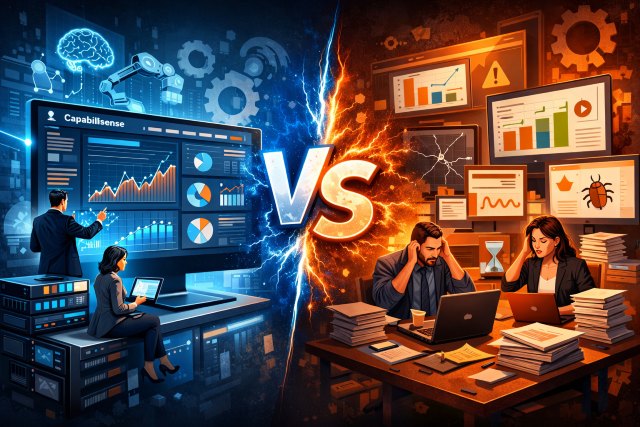

In today’s fast-evolving digital ecosystem, businesses are constantly searching for platforms that can streamline operations, improve data visibility, and enhance decision-making. The Capabilisense Platform has emerged as a strong contender in this space, offering advanced capabilities in analytics, automation, and intelligent insights. But how does it compare to its competitors?
This in-depth guide explores the Capabilisense Platform vs competitors debate, analyzing features, performance, pricing, scalability, and real-world usability to determine which solution truly stands out.
What is the Capabilisense Platform?
The Capabilisense Platform is an intelligent data-driven solution designed to help organizations harness insights, automate workflows, and optimize performance. It combines analytics, AI-driven decision-making, and operational intelligence into a single unified system.
At its core, the platform focuses on enabling businesses to:
Monitor real-time data
Automate processes
Improve operational efficiency
Scale with minimal friction
Many modern enterprises are shifting toward such platforms due to the explosion of data. According to a report by Statista, global data creation is expected to exceed 180 zettabytes by 2025, making intelligent platforms essential for survival.
Key Features of the Capabilisense Platform
Advanced Data Analytics
The Capabilisense Platform provides deep analytics capabilities, allowing businesses to extract meaningful insights from complex datasets.
AI-Powered Automation
Automation is one of its strongest selling points. The platform uses machine learning to automate repetitive tasks, reducing manual intervention and human error.
Real-Time Monitoring
Businesses can track performance metrics in real time, enabling faster decision-making and improved responsiveness.
Scalability
Whether you’re a startup or an enterprise, the platform scales efficiently with your needs.
User-Friendly Interface
Unlike many complex enterprise tools, Capabilisense offers a relatively intuitive interface, reducing the learning curve.
Who Are the Main Competitors?
To understand how the Capabilisense Platform performs, it’s essential to compare it with leading alternatives in the market. Common competitors include:
Business intelligence tools like Tableau and Power BI
Automation platforms like UiPath
Data analytics platforms like SAS and Looker
Integrated enterprise solutions like SAP Analytics Cloud
Each of these platforms has its strengths, but none offer the exact combination of features found in Capabilisense.
Capabilisense Platform vs Competitors: Feature Comparison
1. Analytics Capabilities
The Capabilisense Platform excels in combining predictive analytics with real-time insights. Competitors like Power BI and Tableau are strong in visualization but often require additional tools for predictive modeling.
For example, Microsoft Power BI is widely known for dashboards, but Capabilisense goes further by embedding decision intelligence directly into workflows.
Winner: Capabilisense Platform (for integrated analytics + actionability)
2. Automation & AI Integration
Automation is where Capabilisense truly differentiates itself.
While platforms like UiPath specialize in robotic process automation (RPA), Capabilisense integrates automation with analytics, allowing decisions to trigger actions automatically.
This aligns with research from McKinsey, which states that automation can increase productivity by up to 30% in certain industries.
Winner: Capabilisense Platform (for unified automation + intelligence)
3. Ease of Use
Many enterprise tools suffer from complexity. SAP Analytics Cloud, for example, can be powerful but overwhelming for new users.
Capabilisense focuses on usability, offering:
Simplified dashboards
Guided workflows
Minimal technical setup
Winner: Capabilisense Platform (for user experience)
4. Integration Capabilities
Competitors like Tableau and Looker offer strong integrations with data sources.
However, Capabilisense goes further by enabling:
Cross-platform automation
API-driven integrations
Seamless data syncing across systems
Winner: Tie (depends on use case)
5. Scalability
Enterprise platforms like SAS are known for scalability but often come with high costs and complexity.
Capabilisense provides scalable architecture without requiring heavy infrastructure investments.
Winner: Capabilisense Platform (for flexible scalability)
6. Pricing & Value
Pricing is often where competitors try to win.
Power BI offers a low entry cost
Tableau sits in the mid-to-high range
SAP and SAS are premium solutions
Capabilisense typically positions itself as a value-driven platform, offering multiple features under one umbrella, reducing the need for multiple subscriptions.
Winner: Capabilisense Platform (for overall value)
Real-World Use Case: Capabilisense in Action
Imagine a logistics company struggling with delayed shipments and inefficient route planning.
Using the Capabilisense Platform, they can:
Analyze historical delivery data
Predict delays using AI models
Automatically adjust routes in real time
This reduces operational costs and improves customer satisfaction.
In contrast, using separate tools (like Tableau + UiPath) would require integration efforts, increasing complexity and cost.
Pros and Cons of Capabilisense Platform
Advantages
All-in-one analytics and automation
Real-time decision-making capabilities
Scalable for businesses of all sizes
User-friendly interface
Limitations
May have a smaller ecosystem compared to giants like Microsoft
Limited brand recognition compared to established tools
Learning curve for advanced features
When Should You Choose Capabilisense Platform?
The Capabilisense Platform is ideal if:
You want a unified solution instead of multiple tools
Your business relies heavily on real-time data
You need automation integrated with analytics
You’re scaling and need flexibility
When Competitors Might Be Better
Competitors may be more suitable if:
You only need basic dashboards (Power BI)
You require specialized RPA tools (UiPath)
You are already deeply integrated into a specific ecosystem (SAP, Microsoft)
Expert Insights: Why Integrated Platforms Are the Future
According to Gartner, by 2026, over 65% of organizations will adopt integrated analytics and automation platforms instead of standalone tools.
This trend strongly favors platforms like Capabilisense, which combine multiple capabilities into a single ecosystem.
FAQ: Capabilisense Platform vs Competitors
What makes the Capabilisense Platform different?
The Capabilisense Platform stands out because it combines analytics, automation, and AI-driven decision-making in one unified system.
Is Capabilisense better than Power BI?
It depends on your needs. Power BI is great for visualization, but Capabilisense offers broader functionality including automation and predictive analytics.
Is the Capabilisense Platform suitable for small businesses?
Yes, its scalable architecture makes it suitable for both startups and enterprises.
Does Capabilisense replace multiple tools?
In many cases, yes. It can replace separate analytics, automation, and monitoring tools.
Conclusion: Does the Capabilisense Platform Win?
After comparing the Capabilisense Platform vs competitors, it’s clear that Capabilisense offers a compelling advantage in today’s data-driven world. Its ability to combine analytics, automation, and real-time insights into a single platform makes it a powerful choice for modern businesses.
While competitors excel in specific areas, they often lack the unified approach that Capabilisense provides. For organizations looking to simplify operations, reduce costs, and gain actionable insights, the Capabilisense Platform emerges as a strong winner.
Ultimately, the right choice depends on your business needs — but if you value integration, scalability, and intelligent automation, Capabilisense is hard to beat.












Leave a comment