
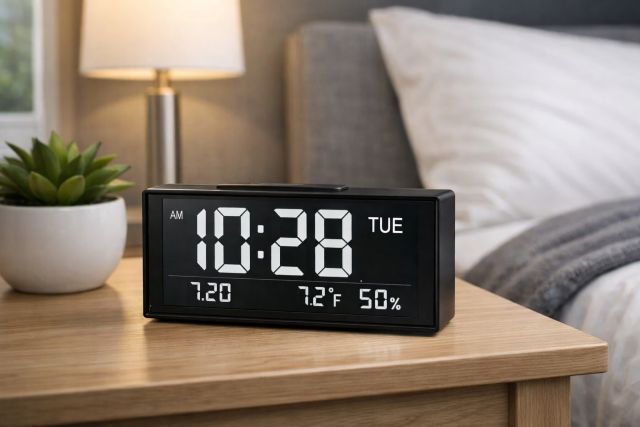

If you’ve ever woken up at 3:07 a.m. and squinted at a blurry clock face—or worse, realized your bedside clock is a few minutes fast—you already understand why a radio controlled clock is such a bedroom upgrade. These clocks synchronize to an official time broadcast linked to atomic standards, which means the time stays accurate without constant adjustments. For bedroom use, that “set it and forget it” reliability matters even more, because nobody wants to reset a clock after a power flicker or wonder whether the displayed time is drifting.
A bedroom clock also has to respect sleep. It needs to be quiet, readable at a glance, and dim enough to avoid lighting up the room. The best options combine dependable radio synchronization with thoughtful bedside features like brightness control, simple alarm buttons, and stable time-zone and daylight-saving handling.
What is a radio controlled clock?
A radio controlled clock is a clock that receives a low-frequency radio time signal from an official transmitter and uses it to set and correct its time automatically. In the United States, most consumer models sync to NIST’s WWVB station near Fort Collins, Colorado, broadcasting at 60 kHz. The clock’s internal receiver listens for that signal, usually during nighttime hours, and updates the displayed time so it remains accurate without manual corrections.
This is why you’ll often see these products called “atomic clocks.” They are not miniature atomic clocks inside your bedroom, but they reference time that originates from atomic-based national standards through the broadcast signal.
Why a bedroom clock needs to be quiet and dim
Bedrooms amplify small annoyances. A faint tick, a buzzing transformer, or an overly bright screen can become the only thing you notice at night. Health guidance on sleep environments commonly recommends keeping continuous bedroom noise low, with many references pointing to around 30 dB as a helpful target for undisturbed sleep. Even when a noise isn’t loud, repetitive sounds can feel intrusive when your room is otherwise silent.
Light matters, too. A clock can be perfectly accurate and still be a bad choice if it glows like a nightlight. The best radio controlled clocks for bedrooms either offer multiple brightness levels that get genuinely dim, or they avoid a glowing display entirely through an analog design with a silent sweep movement.
How radio controlled accuracy works in real bedrooms
Radio-controlled syncing is simple in principle and occasionally finicky in practice. The time broadcast is strong enough for many households, but walls, electronics, and building materials can interfere. NIST describes WWVB as a station designed specifically so consumer devices like radio-controlled clocks can receive time information. When your clock receives a clean signal, it corrects itself. When it doesn’t, it keeps time internally until the next successful sync attempt.
This is why two people can buy the same model and have different experiences. One bedroom might be near a window with low interference; another might be in an apartment with reinforced concrete and multiple electronic devices nearby. The “always accurate” promise is real when synchronization happens regularly, but it’s still important to choose a clock that is easy to place and easy to configure.
Best radio controlled clock for bedrooms: what matters most
When you’re shopping for the best bedroom option, the most important feature isn’t a long list of extras. It’s the combination of readability, low light impact, and low annoyance. A clear display should show time prominently and avoid clutter. Brightness control should include a truly low setting, not just “less bright than daytime.” Buttons should be usable half-asleep, especially alarm controls and snooze. Power design should fit your home, whether you prefer battery-only simplicity or AC power with battery backup so a brief outage doesn’t erase your settings.
Finally, the radio receiver should be reliable. Many clocks attempt to synchronize overnight, so placement and interference matter. Models that provide a signal indicator can be helpful because you can tell whether the clock is actually syncing or simply running on its internal timekeeping.
Best brand lines for bedroom-friendly radio controlled clocks
Because bedroom needs are consistent across households, a few established brands tend to dominate the “quiet, clear, always accurate” niche.
La Crosse Technology atomic alarm clocks for bedside use
La Crosse Technology offers a broad range of atomic alarm clocks designed for home use, including bedroom-friendly formats. Many of their models emphasize big digits and brightness control, and some add indoor comfort information like temperature and humidity.
A representative model often cited in their lineup is the La Crosse 617-1485B style, which highlights large time digits and brightness control and includes indicators tied to WWVB syncing. For bedroom buyers, the practical advantage is that you get a legible time display, the ability to dial down brightness, and a clear sense of whether the clock is receiving the time signal.
This type of design tends to work well in master bedrooms, guest rooms, and anywhere you want a straightforward bedside clock that is easy to read without turning your room into a glow box.
Sharp atomic clocks for simple, readable bedroom setups
Sharp’s atomic clock line is commonly chosen by people who want the “just works” approach, focusing on clear display and straightforward use. Sharp describes its atomic syncing as relying on WWVB and regular updates to maintain accuracy. If your priority is a clean bedside clock that doesn’t require constant attention, this is the type of product family that often fits.
For many bedrooms, simplicity is a feature. The fewer modes you have to cycle through at night, the better your clock will feel in daily life.
Oregon Scientific for projection-style bedroom clocks
If you regularly check the time at night and dislike rolling over to read a display, projection clocks can be a great bedroom solution. Oregon Scientific is known for atomic clock categories that include projection-style models and designs that aim to set themselves automatically.
Projection is especially helpful for people with glasses, people who wake frequently, and anyone who wants time visibility with minimal movement. The key is to choose a projection brightness that stays comfortable in a dark room and doesn’t create distracting light scatter.
Radio controlled analog clocks for “no glow” bedrooms
Some sleepers want darkness, not dimness. In that case, an atomic analog clock can be the best compromise, provided it uses a silent sweep mechanism rather than a traditional tick. La Crosse includes atomic analog models in its offerings. Analog works well for light-sensitive sleepers because there is no bright LED or LCD glow. The tradeoff is that you must be more careful about choosing a truly silent movement, because analog ticking is the most common reason people abandon a bedside clock.
How to improve radio signal reception in your bedroom
If your clock struggles to synchronize, it doesn’t always mean the clock is defective. It often means your bedroom is a hard environment for low-frequency signal reception. Many manufacturers and practical guides recommend placing the clock near a window, especially during the first few nights, to improve the chances of a successful sync.
It also helps to move the clock away from common sources of interference. Chargers and power bricks, routers, monitors, and even some LED lighting can add noise. Even a small shift in placement can change reception, so it’s worth trying a different nightstand position or moving it a few feet for a couple of nights.
If the clock still won’t synchronize, pick a model that remains easy to use manually. A good bedroom clock should still function well even if it misses an occasional overnight update, and then it should self-correct once reception improves.
Common questions people ask before buying
Do radio controlled clocks work everywhere?
They work best where the time signal is strong and the environment is friendly to reception. In the U.S., many consumer devices rely on WWVB at 60 kHz. Thick walls, metal structures, and electrical interference can reduce reliability. If you live far from the transmitter or in a signal-challenging building, placement becomes more important.
Are they really “atomic clock accurate”?
They are accurate when they synchronize regularly, because the time source is tied to national standards and broadcast for consumer receivers. If they can’t receive the signal for long periods, they will rely on internal quartz timekeeping like a normal clock, and may drift slightly until the next successful update.
Do they handle daylight saving time automatically?
Many models are designed to handle DST changes automatically after your time zone and DST setting are configured, but behavior can vary by region and model. It’s a good idea to confirm the model’s DST handling if you live in an area with DST changes or unique rules.
Conclusion
Choosing the best radio controlled clock for bedrooms comes down to three things: quiet operation, a clear display that can get genuinely dim, and reliable self-setting accuracy. When you select a model from established lines like La Crosse, Sharp, or Oregon Scientific, you’re usually buying into designs built around everyday home use, with features that matter at the bedside.
To get the “always accurate” experience, placement matters. Start by giving your clock its best chance to synchronize overnight, ideally near a window and away from heavy electronic interference. Once it’s syncing consistently, you’ll get the main benefit that makes these clocks so popular: you stop thinking about the time being right, because it simply is.












Leave a comment