
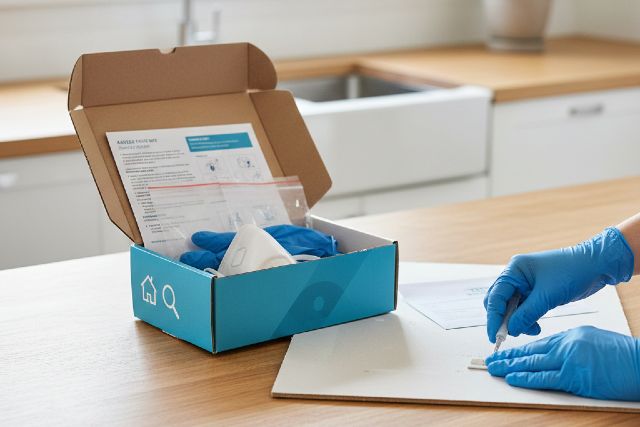

If your home was built decades ago, there’s a good chance you’ve seen at least one “mystery material” that makes you pause before renovating. Maybe it’s popcorn texture on the ceiling, old vinyl flooring that’s starting to curl, or a chalky patch on a wall that’s been repainted a dozen times. In situations like these, an asbestos testing kit can help you make a smart decision before you drill, sand, scrape, or demo.
The most important thing to understand upfront is that you can’t reliably identify asbestos by sight. The U.S. EPA says the only way to be sure a material contains asbestos is to have it tested by a qualified laboratory. That’s why the “best” kit for homeowners is less about fancy packaging and more about whether it gets your sample to the right lab, in the right way, with clear results you can act on.
What an asbestos testing kit actually is
Most homeowner kits are not instant detectors. In practice, an asbestos testing kit is usually a sampling-and-shipping package. You collect a small sample from a suspect material, seal it, label it, and send it to a lab that performs asbestos analysis. If a kit promises a quick “dip strip” style test at home, treat that claim cautiously and verify whether an actual accredited lab is involved.
EPA guidance emphasizes that testing is best handled through qualified laboratory analysis, and it specifically recommends testing suspect materials when they are damaged or when a renovation would disturb them. That renovation detail matters a lot. Even if you’ve lived with a ceiling texture for years, the risk changes when you plan to cut holes for lighting or scrape it down.
Why the lab matters more than the kit brand
When people search for the best asbestos testing kit, they often compare what’s inside the box: gloves, bags, labels, maybe a mask. Those items help, but the lab is the engine. If the lab isn’t credible, the results aren’t useful.
A strong sign you’re doing this the right way is lab accreditation. In the U.S., the Consumer Product Safety Commission advises homeowners to send samples to an asbestos analysis laboratory accredited by NVLAP at NIST. NIST also maintains formal program requirements for NVLAP bulk asbestos fiber analysis, which is exactly what many building material samples fall under. EPA also points to NIST’s listing of accredited asbestos laboratories under NVLAP in its discussion of asbestos professionals and lab accreditation.
In plain English, this means the safest “best kit” is the one that clearly identifies the lab, shows you how that lab is accredited, and provides a report that you can rely on when deciding whether to stop work, switch plans, encapsulate, or hire a professional.
Asbestos health risk: why “just a little dust” is not a casual gamble
A homeowner’s biggest risk is often accidental disturbance. Asbestos isn’t dangerous because it exists behind paint or under a floor; it becomes dangerous when tiny fibers are released into the air and inhaled.
ATSDR, a U.S. public health agency, notes that disturbing asbestos-containing materials can release tiny fibers into the air, too small to see. The same agency explains that health effects depend on dose, duration, and how exposure happens, which is one reason experts focus so hard on limiting disturbance and controlling dust. For cancer risk context, the U.S. National Cancer Institute’s asbestos fact sheet discusses asbestos as a hazard linked with diseases including mesothelioma and lung cancer.
This is also why choosing a kit that encourages minimal disturbance and conservative sampling practices is a safety choice, not a convenience feature.
How to choose an asbestos testing kit safely
The phrase “best asbestos testing kit” really means “best process for a homeowner.” Here’s what that process should look like, without hype.
Look for an accredited lab that is named upfront
If a kit doesn’t tell you which lab will analyze your sample, it’s hard to verify anything. The best kits are transparent. They name the lab, state the testing method used for bulk samples, and provide paperwork that looks like something a serious lab would issue rather than a generic email.
As a homeowner, you don’t need to memorize accreditation codes, but you do want to see clear mention of NVLAP at NIST for asbestos analysis, because that’s what U.S. consumer safety guidance points you toward.
Favor kits that treat labeling and documentation as a priority
You can collect a perfectly good sample and still create confusion if you don’t document what it is. A reliable kit will give you an identification system and ask you to record where and when each sample was taken.
CPSC guidance specifically advises labeling the container with an identification number and clearly stating when and where the sample was taken. That might sound administrative, but it becomes crucial when you test more than one area, or when you need to show results to a contractor.
Make sure the kit matches your renovation reality, not just your curiosity
If you’re only trying to answer one question, a single-sample kit can be enough. But if you’re renovating, it’s common to need more than one sample because different layers can be different materials. Old flooring is a classic example. The surface layer might be one product, the adhesive beneath can be another, and the underlayment can be a third.
EPA’s guidance about testing specifically ties it to renovation that would disturb suspect materials, which implies you should test the materials you are actually about to cut, sand, scrape, or remove — not just the ones that look suspicious from a distance.
Trust instructions that emphasize “minimal disturbance” and know when to stop
A good kit reads like it was written by someone who wants you to be safe, not someone who wants you to ship more samples. If the instructions encourage aggressive scraping, dry sanding, or breaking brittle material, that’s a red flag.
Public health guidance stresses that disturbing asbestos-containing materials can release fibers into the air. If you begin sampling and the material crumbles easily, or you can’t access it without creating dust, it’s often safer to stop and consider professional help rather than forcing a DIY approach.
What materials homeowners commonly test
Many homeowners first consider an asbestos testing kit when a project touches older finishes or insulation. Popcorn and other textured ceiling coatings are common, especially if you plan to install can lights, repair cracks, or remove the texture entirely. Vinyl tiles and sheet flooring also come up frequently, particularly in kitchens, basements, and laundry rooms. Drywall joint compound and patching materials can be a hidden variable, especially around older repairs.
EPA emphasizes that testing is recommended when materials are damaged or when renovation would disturb them, which is why these common “disturbance zones” show up again and again in real-life projects.
DIY kit vs professional inspection: when a kit is the wrong tool
A homeowner kit can be reasonable for a small, accessible material sample that you can collect with minimal disturbance. It becomes a poor choice when the material is friable, meaning it crumbles easily, or when it’s already damaged and shedding. It also becomes a poor choice when the area is large, when the material is wrapped around pipes or heating equipment, or when access requires drilling, grinding, or sanding.
How the lab tests your sample, in plain language
Most homeowner building material samples are analyzed as bulk materials, and a common approach is polarized light microscopy for bulk asbestos fiber analysis. The lab will determine whether asbestos is present in the material you sent, and many reports will include the approximate percentage, depending on the method and sample type.
What matters for you is that the report is clear. You want it to state whether asbestos was detected, what method was used, and whether there were limitations. When you’re deciding whether to proceed with renovation, a clean report is more valuable than a fast report.
Understanding results: positive, negative, and what “it depends” really means
A positive result means asbestos was detected in that sampled material. Your next decision is usually about whether the material can remain in place safely or whether your renovation will disturb it. In many real-life homeowner scenarios, leaving intact material alone is safer than removing it, because removal can create exposure if it’s not done correctly. EPA’s guidance repeatedly circles back to disturbance as the key risk driver, which is why management-in-place is often considered when materials are not damaged and won’t be disturbed.
A negative result means asbestos was not detected in that specific sample, which can be reassuring. But it doesn’t automatically clear every similar-looking material in the house. Materials change across rooms, and even within one room, especially if previous owners made repairs or partial replacements.
Sometimes you’ll see results that feel less satisfying than a simple yes or no. A report can include limitations if the sample is non-homogeneous, if layers are mixed, or if the lab notes that a different method might be needed for greater sensitivity. In that situation, the best next step is often to talk to the lab directly and ask what they recommend based on the material type and what you’re planning to do.
A real homeowner scenario that explains why “one sample” can be misleading
Picture a 1970s bathroom renovation. You test one corner of the flooring and it comes back negative. You start removing the floor confidently, only to discover that the adhesive beneath is different in another area, or that an underlayment layer appears where you didn’t expect it. Now the project pauses mid-demo, and the cost of stopping, cleaning, and re-testing is higher than it would have been to plan a few targeted samples upfront.
This is why the best asbestos testing kit is often the one that makes multi-sample testing easy, because homes rarely behave like a single-sample problem.
Frequently asked questions about asbestos testing kits
What is an asbestos testing kit?
An asbestos testing kit is typically a sampling and shipping package that helps you collect a small piece of suspect material and send it to a laboratory for analysis. EPA explains that the only way to be sure a material contains asbestos is to have it tested by a qualified lab, which is why the lab component is essential.
Can I identify asbestos just by looking at my ceiling or flooring?
Not reliably. Many asbestos-containing materials look similar to non-asbestos materials, and EPA’s guidance emphasizes laboratory testing as the way to be sure.
Is asbestos exposure always dangerous?
Risk depends on factors such as how much asbestos you’re exposed to, how long the exposure lasts, and how you’re exposed. ATSDR highlights dose and duration as key determinants, and it warns that disturbing asbestos-containing material can release tiny fibers into the air.
Should I remove asbestos if my results are positive?
Not always. The practical decision is based on condition and whether your project will disturb the material. EPA’s renovation-focused guidance is a helpful lens, because the major risk driver is disturbance that releases fibers. If removal is needed, professional handling is often the safer path.
What lab should my kit use?
U.S. consumer safety guidance from CPSC tells homeowners to send samples to an asbestos analysis lab accredited by NVLAP at NIST. NIST also publishes the requirements for NVLAP bulk asbestos fiber analysis accreditation, reinforcing that NVLAP is a serious standard rather than a marketing label.
Conclusion: the safest way to pick the best asbestos testing kit
The “best” asbestos testing kit for homeowners is the one that leads to credible lab analysis and keeps you focused on safety. Prioritize transparency about the lab, look for NVLAP-at-NIST accreditation cues, and choose a kit that treats documentation and minimal disturbance as central — not optional. EPA’s guidance makes it clear that testing is most relevant when materials are damaged or when renovation will disturb them, and ATSDR’s warnings underline why disturbance control matters so much.














Leave a comment