
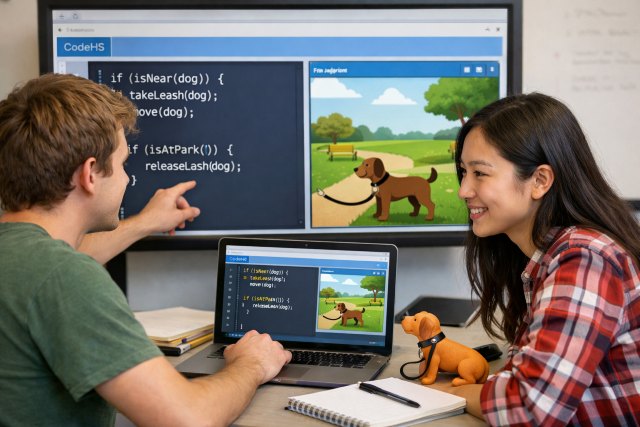

If you’re searching for 9.7.4 Leash CodeHS Answers, you’re likely working on a programming assignment in CodeHS that involves controlling objects using code logic. Many students find this task confusing at first because it combines programming syntax, logical thinking, and sometimes graphical movement.
This guide explains the 9.7.4 Leash CodeHS Answers step-by-step so you can understand how the solution works rather than just copying code. We’ll cover the concept behind the assignment, explain how the leash behavior works in programming, and provide an example solution that you can adapt to your own CodeHS environment.
What Is the 9.7.4 Leash Assignment in CodeHS?
The 9.7.4 Leash assignment in CodeHS usually appears in programming courses that teach JavaScript graphics or similar object-movement concepts.
The main goal of the task is to simulate a situation where one object follows another like a leash. Think of it like a dog walking behind its owner or a balloon tied to a string.
In programming terms, this involves:
Tracking the position of a moving object
Updating another object’s position based on it
Creating smooth movement using functions or event listeners
This teaches students important programming concepts such as:
Event-driven programming
Object positioning
Coordinates and movement
Logical conditions
These skills are foundational for game development, animations, and interactive applications.
Understanding the Core Concept Behind the Leash Program
Before jumping into the 9.7.4 Leash CodeHS Answers, it’s important to understand the logic behind the assignment.
Imagine two objects:
Leader object (usually controlled by the mouse or movement)
Follower object (the one attached to the leash)
The follower should always move toward the leader but remain slightly behind.
Basic Logic
The program typically follows this pattern:
Detect the leader’s position
Calculate distance or direction
Move the follower toward that position
Repeat continuously
This creates the illusion of a leash.
Example Solution for 9.7.4 Leash CodeHS Answers
Below is a simplified version of how the program might work.
var follower;
leader = new Circle(20);
leader.setPosition(200,200);
leader.setColor(Color.blue);
add(leader);
follower = new Circle(15);
follower.setPosition(100,100);
follower.setColor(Color.red);
add(follower);
mouseMoveMethod(moveLeader);
setTimer(moveFollower, 40);
}
leader.setPosition(e.getX(), e.getY());
}
function moveFollower(){
var x = follower.getX();
var y = follower.getY();
var targetX = leader.getX();
var targetY = leader.getY();
var newX = x + (targetX – x) * 0.1;
var newY = y + (targetY – y) * 0.1;
follower.setPosition(newX, newY);
}
How This Code Works
The leader object follows the mouse cursor. The follower calculates the distance between itself and the leader.
Instead of jumping directly to the leader’s position, the follower moves 10% closer each frame. This creates a smooth leash-like motion.
Why Students Struggle With the 9.7.4 Leash Assignment
Many beginners search for 9.7.4 Leash CodeHS Answers because the assignment introduces multiple new ideas at once.
Common difficulties include:
1. Understanding Coordinates
Programming graphics use an X and Y coordinate system.
Students must track positions using functions like:
getX()getY()setPosition()
If you’re unfamiliar with coordinate systems, it can feel confusing initially.
2. Movement Calculations
The leash effect requires simple math:
This ensures smooth movement rather than teleporting objects.
According to MIT’s introduction to computer graphics, gradual movement calculations are commonly used in animation systems.
3. Event Handling
The program relies on event functions like:
mouseMoveMethod()setTimer()
These functions allow programs to respond to user actions and run repeated updates.
Understanding events is essential for interactive applications.
Step-by-Step Explanation of the Solution
Let’s break down the 9.7.4 Leash CodeHS Answers more clearly.
Step 1: Create the Objects
First, create the two circles.
One represents the leader, the other represents the follower.
Example:
follower = new Circle(15);
Step 2: Set Initial Positions
Next, place them on the screen.
follower.setPosition(100,100);
This makes them visible and separated.
Step 3: Track Mouse Movement
The leader usually follows the mouse.
Every time the mouse moves, the leader updates its position.
Step 4: Move the Follower Gradually
The follower moves toward the leader using a timer.
The timer runs the movement function every 40 milliseconds.
Step 5: Calculate Smooth Movement
The key leash logic happens here.
var newY = y + (targetY – y) * 0.1;
This calculation ensures smooth trailing movement.
Real-World Applications of the Leash Programming Concept
Although this assignment is simple, the concept behind 9.7.4 Leash CodeHS Answers is widely used in real applications.
Examples include:
Game Development
Characters often follow players using similar logic.
Examples:
Enemy AI tracking players
Companion characters
Camera following a character
Game engines like Unity use comparable algorithms.
Animation Systems
Animation systems use interpolation to move objects smoothly.
The leash concept is essentially a basic form of linear interpolation (lerp).
Robotics
Robots sometimes follow targets using position tracking algorithms.
This basic concept evolves into advanced systems like PID control.
Tips to Solve CodeHS Assignments Faster
Instead of memorizing 9.7.4 Leash CodeHS Answers, focus on understanding the patterns.
Here are practical tips.
Understand the Problem First
Before coding, ask:
What object moves?
What object follows?
How often should updates happen?
Writing logic first saves time.
Use Debugging
If the program behaves strangely, print values.
Example:
Debugging helps locate errors quickly.
Break Problems Into Small Steps
Large assignments feel overwhelming.
Solve them in stages:
Create objects
Move leader
Add follower logic
Smooth movement
This approach improves coding efficiency.
FAQ: 9.7.4 Leash CodeHS Answers
What does the leash assignment teach?
It teaches how to make one object follow another using position tracking and animation logic.
Is copying CodeHS answers a good idea?
Copying without understanding can hurt learning. It’s better to study how the code works so you can apply the logic later.
What programming language does CodeHS use?
Most CodeHS graphics exercises use JavaScript with a graphics library.
Why does the follower move slowly?
The code moves the follower only a small percentage toward the target each frame, creating smooth animation.
Conclusion
Understanding 9.7.4 Leash CodeHS Answers becomes much easier once you grasp the core idea: making one object follow another using coordinates and smooth movement calculations.
Instead of simply copying a solution, focus on learning how the code works. This assignment introduces essential programming skills used in game development, animations, and interactive software.
With the step-by-step explanation, example code, and practical tips provided in this guide, you should now be able to complete the assignment quickly and confidently.
If you keep practicing these concepts, more advanced programming challenges will become much easier to solve.
















Leave a comment