
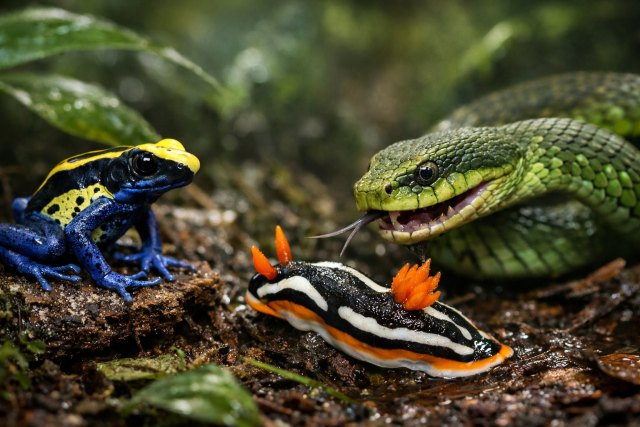

Kleptotoxicity is one of nature’s cleverest survival hacks: instead of making toxins themselves, some animals acquire (“steal”) chemical weapons from what they eat or absorb, then repurpose those compounds for protection. In the first moments of a predator encounter, that shortcut can be the difference between becoming lunch and living long enough to reproduce.
If you’ve ever wondered how a tiny frog can be dangerously poisonous, or how a snake can deploy heart-stopping steroids without manufacturing them, kleptotoxicity is often the missing piece. In chemical ecology, this strategy overlaps with terms like toxin sequestration, diet-derived chemical defense, and acquired defenses — all describing the same big idea: defensive chemistry can move through food webs, not just evolve from scratch inside one body.
What Is Kleptotoxicity?
Kleptotoxicity describes a defensive strategy where an organism acquires toxic chemicals from another organism — often through diet — and then stores, concentrates, or redeploys those chemicals for its own defense.
Scientists more commonly use the language of chemical sequestration or diet-derived defenses in research papers, especially when discussing mechanisms and evolution across animals. A classic, well-supported example is toxin sequestration in the Asian snake Rhabdophis tigrinus, which stores bufadienolide steroids that originate from toads it eats. Feeding experiments and population comparisons show these snakes don’t synthesize the toxins; they obtain them from prey.
Why “klepto”? Because from an evolutionary perspective, it’s chemical “theft”: the defender co-opts a weapon that originally evolved in another species.
How Kleptotoxicity Works in the Body
Kleptotoxicity isn’t just “eat toxic thing, become toxic.” The animal has to solve multiple physiological problems that would kill most predators.
First, it must resist the toxin. If a compound is strong enough to deter predators, it’s strong enough to harm the organism carrying it unless there’s resistance at the target site, detoxification pathways, or safe transport mechanisms.
Next, it must uptake and transport the compound. That means moving toxins across gut or skin barriers into the body without triggering damage.
Then, it must store the toxin safely, often in specialized tissues or glands, keeping it away from vulnerable organs. In Rhabdophis, defensive nuchal glands are a famous storage solution.
Finally, it must deploy the toxin at the right time — through skin secretions, gland exudates, mucus, or even defensive behaviors that expose toxin-rich tissues.
This is why kleptotoxicity is such a big evolutionary deal: it’s not one adaptation, but a whole integrated system.
Kleptotoxicity in Action: The Most Convincing Animal Examples
1) The “Toad-Toxin” Snake: Rhabdophis and Bufadienolides
If kleptotoxicity had a poster child, it might be the Asian keelback snake Rhabdophis tigrinus. These snakes have defensive glands on the neck (nuchal glands) that contain bufadienolide steroids — cardiotoxic compounds also found in toad skin.
What makes this example especially strong is the evidence chain:
Researchers have shown through chemical work and feeding experiments that the toxins in the snake’s defensive glands come from toads in the snake’s diet, not from snake biosynthesis.
Even more convincing, snakes on a toad-free island were found to lack these compounds in their nuchal glands — exactly what you’d expect if the toxin source is dietary.
Population-level chemical differences also track local prey availability and diet, strengthening the case for true diet-derived defense.
The snake’s “chemical armor” depends on what the ecosystem provides. That’s kleptotoxicity as an ecological relationship, not just an individual trait.
2) Poison Dart Frogs: Diet-Derived Alkaloids and Aposematism
Poison dart frogs (family Dendrobatidae) are widely cited as a hallmark case of diet-derived chemical defense. Rather than producing many of their skin alkaloids, they acquire them from arthropod prey and store them in skin glands — paired with bright warning coloration (aposematism).
A key observation supporting kleptotoxicity-like sequestration is that captive-bred frogs often become alkaloid-free when their diet lacks the right wild prey sources, while wild diets restore defensive chemistry.
Research also suggests toxin sequestration has evolved multiple times across dendrobatids, emphasizing that acquiring chemical defenses can be a repeatable evolutionary solution.
And current work continues to explore the molecular uptake mechanisms — because transporting alkaloids safely is one of the hardest parts of the strategy.
This is an important nuance: many frogs aren’t “born toxic.” Their toxicity is often built from diet, which means habitat changes that alter prey communities can indirectly weaken frog defenses.
3) Nudibranchs: Marine Masters of Stolen Chemical Defenses
In the ocean, kleptotoxicity gets even weirder (and more common). Many nudibranchs (shell-less sea slugs) are conspicuous, slow, and seemingly defenseless — yet predators often learn to avoid them quickly.
Classic chemical ecology work shows nudibranchs frequently carry secondary metabolites localized in their body wall and other tissues, and these compounds are largely of dietary origin.
That means a nudibranch’s toxicity can depend heavily on what it’s been eating — often sponges, hydroids, or other chemically defended prey.
In practical terms, nudibranch kleptotoxicity can look like this: a slug grazes on a toxic sponge, selectively retains or concentrates the sponge’s defensive compounds, then becomes unpalatable to fish that try to bite it later. Field and lab studies have repeatedly connected nudibranch chemical defenses to diet-derived metabolites, while also noting that some species may modify or complement acquired compounds with their own chemistry.
Kleptotoxicity vs. Venom vs. Poison vs. Sequestration
People often mix these up, so here’s the clean distinction.
Venom is typically injected via a delivery structure (fang, stinger). Poison harms when touched or eaten. Kleptotoxicity is about the source of the toxic chemical — acquired from another organism — rather than the delivery method.
Sequestration is the core biological mechanism behind kleptotoxicity: uptake and storage of defensive compounds. In research contexts, you’ll often see “sequestration” used instead of “kleptotoxicity,” particularly in technical papers.
Why Kleptotoxicity Evolves: The Benefits (and the Trade-Offs)
The obvious advantage is speed. Evolving a brand-new toxin pathway from scratch is hard. “Borrowing” a pre-made chemical defense can be faster, especially if the toxin already exists in the ecosystem and is effective against local predators.
But kleptotoxicity isn’t a free lunch.
It can force dietary specialization. If your defense depends on one prey type, losing that prey can leave you vulnerable. The Rhabdophis example makes this vivid: remove toads from the environment, and the snake’s defensive chemistry can disappear.
There’s also an energetic and physiological cost to resistance, transport, and storage. Many animals must evolve target-site changes, detox enzymes, binding proteins, or specialized glands — complex adaptations that can come with trade-offs in growth, reproduction, or ecological flexibility.
This is why kleptotoxicity is best seen as a whole strategy, not a gimmick.
Actionable Takeaways: What Kleptotoxicity Teaches Us About Nature (and Us)
If you’re a student, educator, or science communicator, kleptotoxicity is a powerful way to explain how ecosystems work as chemical networks. It’s not just “who eats whom,” but “who moves which molecules.”
If you’re in conservation, the key insight is that protecting a toxic species may require protecting its toxin supply chain — the prey and habitat that enable diet-derived defense. Poison frog conservation, for example, can be undermined if prey communities shift due to pesticide use or deforestation, even when frogs themselves still have forest cover.
If you’re in biotech or pharmacology, these systems hint at how organisms safely traffic dangerous compounds — mechanisms that can inspire drug delivery, antidotes, or bioengineering approaches.
FAQs
What is kleptotoxicity in simple terms?
Kleptotoxicity is when an animal becomes toxic by acquiring defensive chemicals from another organism — usually through diet — then storing and using those toxins to deter predators.
Do animals that use kleptotoxicity make their own toxins?
Often, no. Many rely heavily on diet-derived chemicals. For instance, toxin profiles in Rhabdophis tigrinus reflect whether toads are available as prey, supporting a diet-based source rather than internal synthesis.
What’s a strong real-world example of kleptotoxicity?
The Asian keelback snake Rhabdophis tigrinus sequesters cardiotoxic bufadienolide steroids from toads and stores them in specialized nuchal glands for defense.
Are poison dart frogs poisonous because of their diet?
Many poison dart frogs acquire skin alkaloids from their prey and can lose those chemicals in captivity when the diet lacks the right toxin-bearing arthropods.
Why is kleptotoxicity important for ecology?
Because it links an animal’s defense to its environment and food web. Changes in prey availability can change predator-prey dynamics and even survival rates, as seen in systems where toxins are diet-derived.
Conclusion: Kleptotoxicity as Nature’s Chemical Shortcut
Kleptotoxicity shows that evolution doesn’t always “invent” from scratch — it often repurposes what’s already available. By stealing toxins through diet-derived chemical defense and sequestration, animals like Rhabdophis snakes, poison dart frogs, and nudibranchs turn prey chemistry into personal protection. The result is a fascinating, ecosystem-wide flow of defensive molecules, where survival can depend as much on what you eat as on what you are.
If you want to explore this topic further on your site, the next natural cluster topics are toxin sequestration, aposematism, chemical ecology, and venom vs. poison — all tightly connected to kleptotoxicity and highly search-relevant.















Leave a comment