
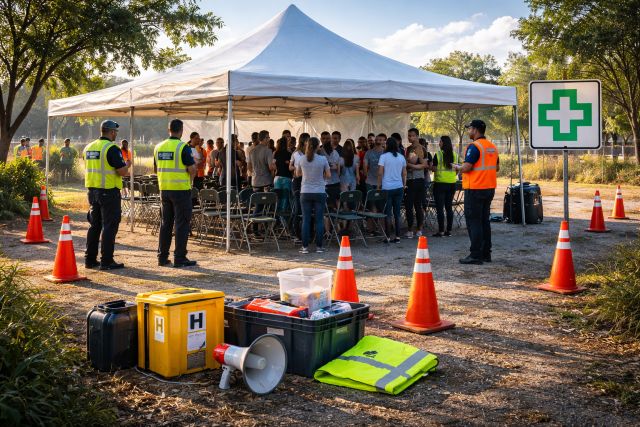

When an alarm sounds or an incident unfolds, people instinctively move — sometimes fast, sometimes confused, and often in the same direction. That’s exactly why a temporary place of assembly matters: it turns “everyone out of the building” into “everyone safe, accounted for, and ready for next instructions.” In workplaces, schools, events, and public facilities, a well-planned temporary gathering point reduces chaos, supports headcounts, and speeds communication with responders — without creating new hazards.
This guide walks you through practical, real-world best practices for choosing, setting up, and running temporary assembly areas that work under pressure — whether you’re planning for fire, earthquake, chemical release, severe weather, or an unexpected security incident.
What Is a Temporary Place of Assembly?
A temporary place of assembly is a designated (or rapidly designated) location where people gather after evacuating or relocating during an emergency so leaders can account for everyone, share instructions, and coordinate with emergency responders.
It’s “temporary” because:
It may only be used for the duration of the incident.
It can change based on the hazard (for example, smoke downwind, debris risk, or a security perimeter).
In larger incidents, it may evolve into multiple muster points or a staged relocation area.
In occupational settings, emergency planning guidance commonly emphasizes identifying assembly areas and having a method for accounting for all employees.
Why a Temporary Place of Assembly Is a Safety Multiplier
Even a flawless evacuation can fail at the “after” part. People scatter, re-enter to look for friends, or stand near entrances where responders need access. A temporary assembly point solves a set of predictable problems:
Accountability and faster rescue decisions
Emergency guidance strongly prioritizes accountability — if someone is missing, the response changes immediately. Confusion at assembly areas can delay rescuing trapped people or trigger unnecessary, risky search operations.
Communication under stress
Once people are gathered, you can deliver short, consistent instructions: whether to stay, move again, shelter, or dismiss. That reduces rumor-driven movement.
Traffic control for responders
Keeping evacuees away from doors, fire lanes, and staging areas helps responders do their jobs faster and safer.
Temporary Place of Assembly vs. Muster Point vs. Refuge Area
These terms get mixed up. Here’s the clean distinction:
Temporary place of assembly / muster point: Outside (or in a safer zone) where people gather for headcount and instructions.
Area of refuge: A protected location (often inside) for those who cannot immediately evacuate, typically used in specific building designs and plans.
Family reunification point: Often used in schools/events to hand off people safely to approved guardians.
Incident staging area: For responders and equipment — not for evacuees.
Treat your assembly areas as part of a broader incident-management approach: clear roles, communication, and resource coordination are widely recognized as core incident management components.
How to Choose a Safe Temporary Place of Assembly
A “good” assembly point isn’t just far from the building. It’s far from the hazards your incident will create.
Distance: far enough, but not so far people ignore it
If it’s too close, you’re in smoke, falling glass, or collapse zones. Too far, people drift away or head to their cars. A practical rule is: choose a point far enough to keep access routes open and avoid secondary hazards, while still reachable for everyone—including mobility-limited evacuees.
Wind and plume awareness (chemical releases, smoke)
For chemical spills or smoke, upwind and crosswind placement is critical. A point that’s “safe” for fire might be dangerous for fumes depending on wind direction.
Avoid “secondary hazard magnets”
Don’t place assembly areas near:
Loading docks and fuel storage
Generator exhausts
Glass façades or tall masonry walls (falling debris risk)
Vehicle choke points where people stand in traffic lanes
Multiple hazards require multiple assembly options
Your plan should include more than one possible gathering point, because the “best” location depends on the event type. OSHA-style emergency action planning checklists often call for identifying one or more assembly areas “as necessary for different types of emergencies.”
Best Practices for Setting Up a Temporary Place of Assembly
1) Make it obvious in the moment
In a real incident, people follow the crowd. Use clear markers:
Tall, high-contrast signage
Flags or portable cones
Lighting if you operate at night
A designated marshal wearing a visible vest
2) Design for headcounts, not just standing around
The single biggest operational failure is a “blob” of people where no one can verify attendance.
Set up:
A check-in side and a “completed” side
Department/team lanes for larger organizations
A quiet spot for first-aid triage or stress support
A controlled communication position for the lead warden
Accounting for all personnel after evacuation is repeatedly emphasized because it drives rescue and response decisions.
3) Keep it out of responder pathways
If evacuees cluster at doors or gates, they block access. Your temporary assembly point should be positioned so responders can stage, move equipment, and control perimeters.
4) Plan for accessibility and inclusion
A “safe” point isn’t safe if people can’t reach it. Consider:
Step-free routes
Extra time for mobility aids
Communication methods for multilingual teams and people with hearing impairments
Emergency planning guidance often explicitly highlights procedures for assisting people during evacuations, including those with disabilities or language barriers.
Temporary Place of Assembly in Different Scenarios
Fire evacuation
Fire introduces smoke, heat, and responder access needs. Your assembly point should avoid:
Smoke drift paths
Fire lanes and hydrant access
Areas where people can re-enter unnoticed
Assembly points support organized headcounts and communication during drills and real fire events.
Earthquake
Earthquakes shift your hazard model:
Falling glass and façade collapse become major risks.
Aftershocks mean you may need to move again.
Choose open areas away from tall structures and overhead lines.
Severe weather
For lightning, high winds, or tornado conditions, an outdoor assembly point may be unsafe. Your “temporary place of assembly” may need to be an interior relocation zone until the hazard passes.
Security incidents
If the threat is human-caused, “gather everyone in one spot” can be the wrong move. You may need:
Multiple small rally points
A reunification area away from public visibility
Controlled communications and identity verification
Roles and Responsibilities: Who Runs the Assembly Area?
A temporary place of assembly works best when it’s “managed,” not just named.
Evacuation wardens / marshals
Many emergency action planning approaches designate wardens to help move people to safe areas and organize accountability.
What good wardens do at the assembly point:
Direct people to the correct group lane
Prevent re-entry
Report hazards or injuries
Confirm headcount status quickly
Incident lead / coordinator
This person:
Confirms the hazard type (fire vs. chemical vs. security)
Decides whether the assembly point remains valid
Coordinates with emergency services
Issues the “all clear” or relocation order
Headcount That Actually Works (Without Slowing Everything Down)
The goal is speed plus confidence — not perfection in a spreadsheet while the situation evolves.
Use layered accountability
Visual sweep: “Is anyone still arriving from exits?”
Team roll call: supervisors confirm their people.
Exception reporting: only report missing/unaccounted and last-known location.
Why this matters: if people are unaccounted for, responders may initiate searches—high-risk decisions that must be based on reliable information.
Expect human behavior under stress
Evacuation research consistently highlights how perception, response time, and congestion influence outcomes — people don’t react uniformly, and delays happen.
That means your headcount process must tolerate late arrivals, confusion, and imperfect initial data.
Common Mistakes to Avoid at a Temporary Place of Assembly
Picking a “convenient” spot instead of a safe one
If your assembly area is next to the main entrance, you’ll block responders and tempt re-entry.
Only having one assembly area
Emergencies vary. One location cannot be optimal for every hazard.
No plan for visitors and contractors
If you only count employees, you’ll miss the people most likely to be unaccounted for. Add a simple check-in method for guests.
Letting people leave before accountability is complete
People driving off creates “ghost missing persons” and wastes responder time.
Examples and Mini Case Studies
Example 1: Office building with two assembly options
A mid-size office uses:
Primary assembly point: open parking section 80 meters from exits.
Secondary assembly point: a covered structure on the opposite side for heavy rain.
During a small electrical fire, the primary area works. During a chemical odor incident (possible refrigerant leak), the team switches to the secondary area because wind is pushing fumes toward the primary zone. The key win: the decision is fast because the alternative is pre-communicated and signed.
Example 2: Temporary assembly area at a festival
A festival adds:
3 muster zones (north/south/east) to prevent a single dense crowd
Staff marshals with flags and radios
A reunification point for separated groups
This mirrors crowd-management principles used in assembly occupancies where large groups gather and movement dynamics can become risky if unmanaged.
Recommended Signage and Communication Tips
Use language that works in a crisis:
“Go to Assembly Area A”
“Stay with your supervisor”
“Do not re-enter”
“Await instructions”
For mobile readiness, post short instructions near exits and on internal pages like:
/emergency-action-plan
/evacuation-routes
/fire-drill-procedures
/incident-communication
FAQ: Temporary Place of Assembly
What is the purpose of a temporary place of assembly?
A temporary place of assembly provides a safe, organized location to gather after evacuation so leaders can account for everyone, communicate next steps, and coordinate with emergency responders.
How many assembly points should a site have?
Most sites benefit from at least two: a primary and an alternative, because wind direction, debris risk, or security perimeters can make one location unsafe during a specific incident.
What should happen at the assembly point after evacuation?
People should check in with their supervisor/warden, a headcount should be completed quickly, injuries or missing persons should be reported, and everyone should wait for instructions without re-entering the building.
Is a muster point the same as a temporary place of assembly?
In most workplace usage, yes. “Muster point” is a common term for the temporary gathering location used for accountability after evacuation.
What if the emergency makes outdoor assembly unsafe?
For severe weather or certain security situations, the temporary place of assembly may be an interior relocation area or an offsite reunification point, depending on the hazard and official guidance.
Conclusion: Make Your Temporary Place of Assembly Work When It Matters
A temporary place of assembly is not a sign on a wall — it’s an operational system that helps people move from danger to safety, and from confusion to accountability. When you choose locations based on real hazards, provide clear markings, assign roles (like wardens), and run headcounts that are fast and reliable, you reduce delays, prevent risky re-entry, and support responders with trustworthy information. Guidance for emergency action planning commonly emphasizes identifying assembly areas and methods to account for everyone, because accountability shapes life-saving decisions.
If you want the biggest upgrade with the least effort: create two assembly options, practice switching between them, and make your headcount process simple enough to work on the worst day — not just during drills.
















Leave a comment