
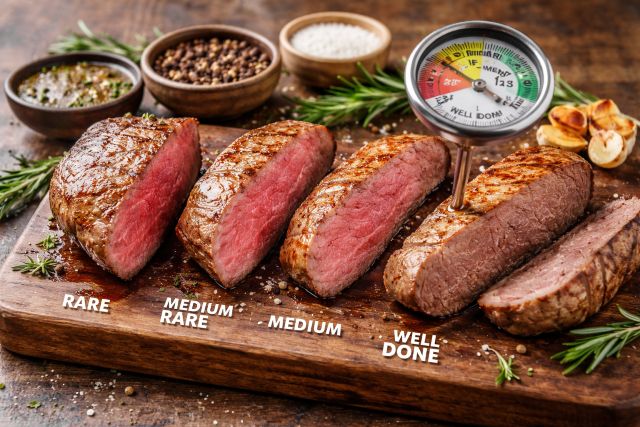

If you’ve ever pulled a lamb rump from the oven or grill and thought, “I hope that’s medium-rare,” this guide is for you. Lamb rump is naturally tender and flavorful, but it’s also one of those cuts that can go from juicy to dry faster than you expect — especially if you rely on timing alone.
The good news: you don’t need guesswork. You need a thermometer, a clear target temperature, and a simple plan for carryover cooking (the temperature rise that happens while the meat rests). Let’s make your next lamb rump confidently perfect — every single time.
Why lamb rump temperature matters more than “minutes per side”
Lamb rump is a compact, meaty cut from the hindquarter with a light fat cover that brings big flavor. Because it’s relatively thick and dense, the outside can look beautifully browned while the center is still under (or over) your intended doneness.
Also, lamb keeps cooking after you remove it from heat. That’s the main reason people overshoot: they hit the “right” temperature in the pan, then it climbs another 5–15°F while resting. Serious Eats’ recent deep dive on resting meat highlights how underestimated carryover can be and why temperature control — not superstition — is the real value of resting.
Lamb rump temperature chart (the numbers you actually need)
The safest baseline (USDA)
For whole cuts like lamb rump (steaks/roasts), the USDA’s safe minimum internal temperature is 145°F (62.8°C) with a 3-minute rest.
Doneness targets (chef-friendly)
These are practical “pull temps” and “final temps” that account for carryover cooking.
| Doneness | Pull temp (remove from heat) | Final temp after rest | Texture & color |
|---|---|---|---|
| Rare | 120–125°F (49–52°C) | 125–130°F (52–54°C) | Very red, very soft |
| Medium-rare (most popular) | 125–130°F (52–54°C) | 130–135°F (54–57°C) | Warm red center, juicy |
| Medium | 135–140°F (57–60°C) | 140–145°F (60–63°C) | Pink center, firmer |
| Medium-well | 145–150°F (63–66°C) | 150–155°F (66–68°C) | Slight pink, drier |
| Well done | 155–160°F (68–71°C) | 160°F+ (71°C+) | Little/no pink, driest |
Important note: If you want to stay aligned with USDA guidance, aim for 145°F final temperature and rest at least 3 minutes.
Where to place the thermometer in lamb rump (this is where most people slip)
To get a reading that matches what you’ll eat:
Insert the probe into the thickest part of the lamb rump.
Aim for the center of the muscle, not touching pan/grill, not in fat pockets.
If it’s a rump roast tied into a neat shape, test the center from the side, so your probe tip sits in the middle.
If you’re using an instant-read thermometer, start checking early and often. Lamb rump cooks quickly compared with larger roasts.
Carryover cooking: the “hidden heat” that changes everything
Carryover cooking is simply heat moving from the hotter exterior into the cooler center after you remove meat from the heat source. The rise depends on cut size and cooking method, but a 5–10°F increase is common for smaller cuts—and bigger roasts can climb more.
A real-world lamb rump scenario
You’re aiming for medium-rare (final 130–135°F). If you cook until the center hits 135°F in the pan, it may rest up to 140–145°F, landing closer to medium.
That’s why “pull temperature” is your best friend.
The best lamb rump temperature for tenderness and flavor
Most cooks and many temperature guides place lamb’s sweet spot at medium-rare to medium—enough heat to render some fat and soften connective tissue, but not so much that it dries out. ThermoWorks, for example, commonly frames lamb as being enjoyed in the 130–135°F zone for medium-rare.
If you’re cooking lamb rump for guests with mixed preferences, a smart compromise is medium: pull around 135–140°F, rest to 140–145°F.
How to cook lamb rump to temperature (pan, oven, grill)
Pan-seared lamb rump (fast and restaurant-style)
This method is ideal for individual lamb rump portions.
Pat dry and season (salt ahead of time helps).
Sear on medium-high heat until you build a deep crust.
Lower heat or finish briefly in the oven if needed.
Pull at your target temperature, then rest.
Tip: If you’re chasing medium-rare, start checking around 120–125°F. Lamb rump can jump quickly in the final minutes.
Oven-roasted lamb rump (most forgiving)
Roasting gives more even doneness edge-to-center.
Use a moderate oven temp.
Consider searing first for color, then roasting to target.
Pull earlier than you think; the oven continues heating the outer layers intensely.
FoodSafety.gov and USDA both emphasize temperature + rest time for whole cuts like lamb (including lamb roasts).
Grilled lamb rump (smoke + char + precision)
Grilling is where thermometers matter most, because heat can be uneven.
Sear first, then move to indirect heat to finish.
Keep the lid closed to stabilize temp.
Probe in the center and pull at your planned pull temp.
Food safety: what “safe” means for lamb rump
For whole cuts of lamb (steaks, chops, roasts), the USDA’s benchmark is:
145°F (63°C) minimum internal temperature + 3-minute rest
For ground lamb, the safe minimum is typically 160°F (71°C) (different rules because bacteria can be mixed throughout).
And yes — this matters. The CDC estimates 48 million people get sick from foodborne illness each year in the U.S., with 128,000 hospitalizations and 3,000 deaths.
How long to rest lamb rump (and why it helps)
Resting isn’t just tradition. It’s temperature management.
A practical rest window:
Individual lamb rump pieces: 5–10 minutes
Rump roast: 10–15 minutes
During rest, the temperature climbs to its final number (carryover), and the meat relaxes so it slices more cleanly. Recent testing discussions emphasize that resting’s most reliable benefit is controlling final temperature — not magically “locking in juices.”
Common lamb rump temperature mistakes (and quick fixes)
Mistake: Cooking by time alone
Fix: Time is a rough estimate; temperature is truth. Use the thermometer as the finish line.
Mistake: Measuring too close to the surface
Fix: Probe the true center of the thickest part.
Mistake: Pulling at the final temp instead of the pull temp
Fix: Pull 5–10°F early, then rest.
Mistake: Slicing immediately
Fix: Rest, especially if you cooked hot and fast.
Featured snippet: quick definition
Lamb rump “done” temperature is the internal temperature at the thickest point that matches your desired doneness (rare to well done), measured with a food thermometer and adjusted for carryover cooking during resting.
FAQs
What temperature should lamb rump be cooked to?
For safety, cook lamb rump (a whole cut) to 145°F (63°C) minimum and rest for 3 minutes, per USDA guidance.
For doneness preference, many people choose medium-rare (130–135°F final) or medium (140–145°F final).
What is the best temperature for medium-rare lamb rump?
Medium-rare lamb rump is best at 130–135°F (54–57°C) final temperature. To land there, pull the meat from heat around 125–130°F and rest.
Can lamb rump be pink?
Yes. Lamb is commonly enjoyed pink (medium-rare to medium). Just keep food safety in mind and use a thermometer; USDA’s baseline for whole cuts is 145°F + 3-minute rest.
How do I know where to put the thermometer?
Insert into the thickest center of the lamb rump. Avoid touching bone (if present) or sitting in a fat seam, which can skew readings.
How much does lamb rump temperature rise while resting?
Often 5–10°F for smaller cuts, sometimes more depending on thickness and cooking intensity—carryover cooking is frequently underestimated.
Conclusion: nail lamb rump every time
Getting lamb rump right isn’t about luck — it’s about temperature control. Use a thermometer, choose a doneness target you love, pull the lamb a few degrees early, and let carryover cooking finish the job during a proper rest. If you want to follow the most widely recognized safety benchmark, remember the USDA baseline: 145°F (63°C) minimum internal temperature + a 3-minute rest.
If you want, tell me how you usually cook lamb rump (pan, oven, grill) and what doneness you like, and I’ll give you a tight “pull temp + rest time” game plan for that exact setup.














Leave a comment