
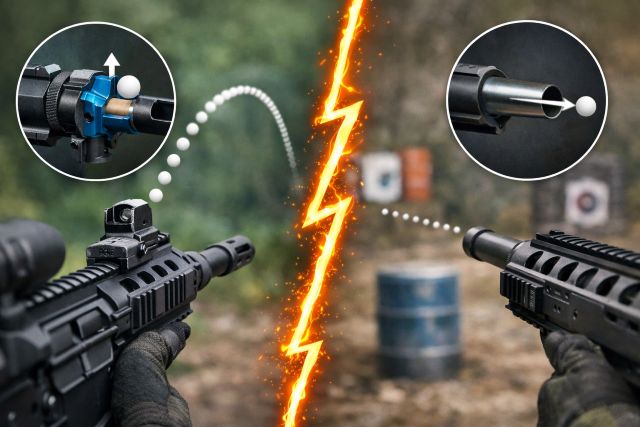

If your shots drop early, float upward, or curve off target, hop up is usually the first system to blame—and most of the time, that’s fair. Hop up is the part of an airsoft gun that gives BBs backspin, which helps them fly flatter and farther. That single job makes hop up fundamentally different from every other upgrade people talk about, because it doesn’t just “improve parts.” It changes the physics of the shot.
In the first few minutes of tuning, hop up can transform your effective range more than a stronger spring or a tighter barrel. But hop up also exposes weaknesses elsewhere. If your air seal is inconsistent or your ammo is poor quality, your hop won’t behave the same from shot to shot.
What Is Hop Up and Why It Matters So Much?
Hop up is a mechanism that presses a rubber contact surface against the BB as it moves through the hop chamber and into the barrel. That contact creates backspin. Backspin changes airflow around the BB and produces lift through the Magnus effect, which is a well-documented aerodynamic phenomenon involving spinning objects moving through air. Britannica explains the Magnus effect as a force acting on spinning bodies traveling through a fluid, which can alter their path. NASA’s aerodynamics education materials also describe how spin can generate lift and influence trajectory behavior.
In airsoft terms, hop up is commonly described as the feature that increases range and flattens trajectory by applying backspin to the BB.
What makes hop up different from “everything else” is that it directly controls whether your BB flight is usable at all. Many upgrades improve consistency around the edges, but hop up determines the basic shape of the trajectory. Without correct hop up, even high FPS setups can look impressive on a chrono and disappointing in actual games.
Hop Up vs. Barrel Upgrades: Which Changes Accuracy More?
A better barrel can improve shot-to-shot consistency by reducing imperfections that cause random flyers. It can also help groupings when your stock barrel has poor finish or inconsistent dimensions. That said, a barrel does not create lift and it cannot compensate for incorrect or inconsistent hop.
Hop up is usually the bigger performance lever because it decides how much spin is applied and how evenly it’s applied. If hop pressure is uneven, you’ll see curved shots. If it’s inconsistent, you’ll see random height changes. If it’s simply wrong for your BB weight, you’ll see early drops or late climbs.
In practical terms, if your accuracy problem looks like “my shots don’t fly the same twice,” hop up and alignment are the first place to fix. If your accuracy problem looks like “my shots are consistent but not tight,” a barrel upgrade becomes more meaningful.
Hop Up vs. BB Weight: Why These Two Are a Package Deal
BB weight and hop up tuning are tied together. Changing BB weight changes how your hop behaves, and changing hop changes which BB weights feel “stable.”
Heavier BBs are often more stable outdoors because they handle wind better and tend to carry energy more reliably downrange. But heavier BBs also require a hop setup that can apply consistent backspin without over-pressuring the BB or creating uneven contact.
The Airsoft Trajectory Project, which models airsoft BB flight behavior, discusses how BB mass and spin interact, including how heavier BBs may require higher hop input to reach suitable spin rates and stable flight. Practical tuning guides also emphasize adjusting hop for different BB weights rather than expecting a single hop setting to work universally.
If you want your setup to “work best,” focus on matching BB weight to the distance and wind conditions you actually play in, then tune hop up to produce a flat flight path that finishes with a gentle drop rather than a dramatic fall or a sudden climb.
Hop Up vs. FPS and Power: Why More Energy Doesn’t Automatically Mean More Range
FPS upgrades increase muzzle velocity, but that doesn’t automatically translate to more hit probability at range. Airsoft BBs lose speed quickly because they are light, and drag matters a lot. Hop up is what keeps the BB flying flatter long enough to be useful.
The Airsoft Trajectory Project highlights how velocity, drag, and spin ratios influence the shape of the trajectory and can produce very different outcomes depending on hop settings and BB behavior. This is why two guns at the same FPS can have wildly different effective ranges. The gun with the better hop setup often wins in real games because it places shots more predictably.
If you’re chasing performance, power should usually come after consistency. A strong spring on an inconsistent hop setup often produces impressive-looking arcs and frustrating shot placement.
Hop Up vs. Flat Hop vs. R-Hop: What’s Actually Different?
Flat hop and R-hop are not alternatives to hop up. They are alternative ways of creating hop contact. The goal is to apply backspin more evenly and more consistently, especially when using heavier BBs or trying to push distance.
Flat hop typically increases the size and consistency of the contact patch compared to a standard nub setup. R-hop uses a more specialized patch approach that many players associate with high consistency at longer ranges, especially with heavier ammo. Comparisons often describe R-hop as higher potential but more sensitive to installation quality and tuning.
If you want “best results” without turning your build into a long tuning project, many players treat flat hop as a strong balance between effort and performance. If you want maximum range consistency and you’re comfortable testing, adjusting, and re-testing, R-hop can be worth it when installed correctly.
What Works Best in Real Games?
What works best is the setup that produces repeatable flight under your actual field conditions. Hop up is the core of that, but it performs best when the rest of your system supports consistency.
In CQB environments, extreme range matters less than fast, predictable shots. Hop up still matters, but the “best” hop setup here is usually one that avoids over-hop, keeps flight straight, and stays stable across rapid fire.
Outdoors, hop up becomes the primary driver of usable range. The best outcome is a flat trajectory that holds line until the last portion of flight, then drops predictably. This is where BB weight, hop consistency, and clean alignment matter most.
For long-range-focused builds, the best results usually come from pairing heavier BBs with a hop contact method that stays stable, along with careful alignment and consistency. Hop settings in this category tend to be more sensitive, so reliability comes from careful tuning rather than chasing maximum lift.
Common Hop Up Problems and Why They Happen
If your BBs curve left or right, the most common cause is uneven hop contact creating side spin. That often happens when the bucking is not seated perfectly, the nub is misaligned, or the hop unit is not centered with the barrel. This is one of the biggest reasons “my barrel is bad” gets blamed when the real issue is hop alignment.
If your BBs climb at the end of the trajectory, you are typically over-hopping. In that case, you want to reduce hop until the BB flies flatter and finishes with a controlled drop.
If your BBs drop early even with hop applied, the issue can be under-hopping, a hop arm that can’t apply enough pressure, or a bucking hardness that doesn’t match your energy and BB weight. It can also be inconsistent compression or air seal that changes how the BB leaves the system from shot to shot, which makes hop behavior feel random.
Tuning guides generally recommend making very small hop adjustments and testing at consistent distances so you can see true changes rather than chasing noise.
FAQ
What does hop up do in airsoft?
Hop up applies backspin to the BB to create lift, which helps BBs fly flatter and farther instead of dropping quickly.
Is hop up more important than a tightbore barrel?
For most players, hop up tuning and consistency produce bigger gains than a barrel upgrade because hop controls lift and flight stability, while the barrel mainly refines consistency once hop is stable.
Does higher FPS mean better range if hop up is bad?
Not reliably. Higher FPS increases speed, but without consistent hop up, BBs still drop early, curve, or behave unpredictably — especially outdoors where drag and wind matter.
What BB weight works best with hop up?
The best BB weight is the one your hop up can lift consistently while staying stable in your field conditions. Outdoors often favors heavier BBs, while CQB can work well with lighter weights if consistency is good.
Conclusion: Hop Up Is the Core, Not an Optional Upgrade
If you want the biggest improvement in real gameplay performance, hop up is the upgrade and tuning category that most directly affects range, consistency, and hit probability. Barrels, FPS increases, and other internal upgrades can matter, but they work best when hop up is already stable and correctly matched to your BB weight.
The simplest “what works best” answer is this: get your hop up consistent first, choose BBs that match your field, then upgrade supporting parts only after you’ve verified repeatability. When hop up is dialed in, you don’t just shoot farther—you shoot more predictably, and that’s what wins exchanges.














Leave a comment