
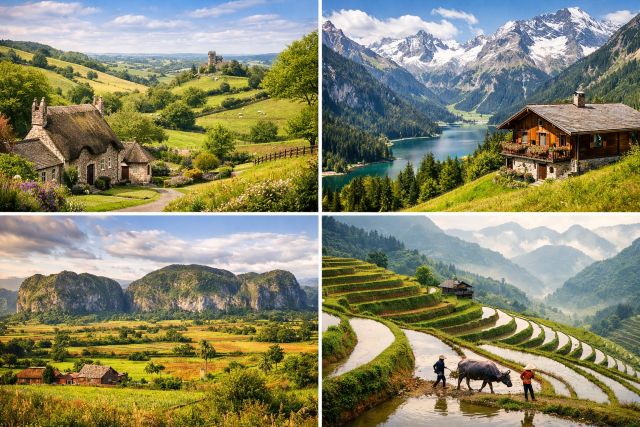

If you’ve ever looked at a photo of rolling hills, patchwork fields, or a dramatic valley and wondered where it was taken, you’ll enjoy a countryside quiz. This format turns travel curiosity into a game: you study a rural scene and match it to the correct country using visual clues such as terrain, vegetation, architecture, and farming patterns. A well-designed countryside quiz isn’t just entertaining; it teaches you how landscapes reveal climate, culture, and history.
In the first moments of any countryside quiz, most people rely on instinct. The trick is learning a repeatable way to read the land. Landscapes are shaped by processes like tectonics, erosion, and human land use, and those forces leave consistent patterns you can learn to spot. National Geographic describes a landscape as a portion of Earth’s surface you can view from one place, made up of features that characterize an area. Those features include landforms such as mountains, plains, plateaus, and valleys, which are found worldwide but take on different signatures depending on regional geology and climate.
What a countryside quiz is and why it’s so addictive
A countryside quiz is a challenge that asks you to match a rural landscape to a country based on a photo, a short description, or both. Some quizzes focus on iconic rural regions, while others deliberately choose “look-alike” scenes to test whether you can separate similar climates and land uses. The most valuable quizzes provide explanations, because the explanation is where you actually learn.
The appeal is simple. Landscapes feel familiar, but they also contain hidden complexity. A green hillside can belong to multiple countries, yet the type of fence, the roof pitch of a farmhouse, or the shape of fields can narrow it down quickly. Over time, a countryside quiz trains your brain to shift from guessing to pattern recognition, the same way people improve at identifying birds or cars.
Interactive formats tend to keep readers engaged because they require active participation. That’s one reason quizzes have become a popular content format across many industries. Demand Gen Report has published findings showing interactive content can outperform static content for education and engagement in marketing contexts. The underlying learning idea still applies to a countryside quiz: when you actively try, fail, and correct, you remember.
Why matching rural landscapes to countries is challenging
Landforms repeat across the planet. Mountains are not exclusive to one nation, and valleys appear on every continent. National Geographic’s landform overview emphasizes how common landform categories are worldwide, which is why “it’s mountainous” rarely narrows it enough. A valley can be a river valley, a glacial valley, a rift valley, or something else, and each type can exist in many countries.
Another complication is that “rural” is defined differently depending on the organization and country. The OECD notes that rural and urban classifications vary and provides frameworks for comparing territories, which highlights how slippery the term can be across borders. In one country, rural might imply dense villages surrounded by small farms. In another, rural might mean vast open rangeland with very few buildings.
A final challenge is photography bias. The same landscape can look dramatically different based on season, time of day, and lens choice. A wide-angle lens makes hills feel grander and valleys deeper. A winter shot hides crops and makes architecture carry more of the identification load. That’s why the best way to win a countryside quiz is to stack multiple clues instead of relying on one.
How to read a landscape like a pro in a countryside quiz
A reliable countryside quiz strategy is to move from broad clues to specific clues. You start by identifying what kind of environment you’re in, then you narrow to a region, then you consider country-level tells such as building style and farming patterns. Each step removes wrong answers.
Start with landforms and terrain
Landforms are your first filter. National Geographic’s definition of landforms includes features like mountains, hills, plateaus, and plains, shaped by long-term Earth processes. In a countryside quiz, you can often decide within seconds whether you’re looking at a lowland agricultural plain, a rugged mountain region, a coastal cliff landscape, or a high plateau.
If the peaks are jagged and sharp, you may be looking at younger mountain ranges or heavily glaciated terrain. If the hills are rounded and smooth, erosion has likely softened the landscape over time. When a scene includes a valley, look for its shape. Broad U-shaped valleys are often associated with glacial carving, while narrow V-shaped valleys commonly reflect river erosion. National Geographic’s overview of valleys explains how valleys form and vary, which helps you interpret what you’re seeing.
Terrain also influences how humans build. In steep regions, you’ll often see terracing, winding roads, and clustered settlements. In flat plains, you may see straight roads, larger field blocks, and more dispersed farm structures.
Read vegetation as a climate shortcut
Vegetation is one of the fastest ways to estimate climate. Dense, bright greens and thick tree cover suggest abundant moisture. Dry scrub, pale grasses, and bare soils suggest aridity or a pronounced dry season. Evergreen forests point toward cooler or wetter zones, while sparse trees and scrub often appear in semi-arid countryside.
This is where many countryside quiz answers become clearer. Countries sharing similar terrain can still have very different vegetation profiles based on rainfall patterns, elevation, and seasonal temperature ranges. Even when two places are equally green, the type of green matters. Broadleaf forests look different from conifer-dominated landscapes. Pastures look different from crop fields.
Seasonality is also a clue. If you see golden stubble fields, it might indicate a post-harvest period. If the fields are intensely green while trees are bare, you may be seeing a cool-season crop cycle in a temperate climate.
Use agriculture as a fingerprint
Farming is geography plus culture. The way land is divided, planted, and maintained carries strong regional signals.
Field shape is one of the most underrated countryside quiz clues. Large rectangular fields often appear where mechanized agriculture dominates and where land consolidation is common. Smaller patchwork fields may suggest older land division patterns, hilly terrain, or mixed farming. Boundaries matter too. Hedges, stone walls, tree lines, and fencing styles can all hint at a particular region.
Crop type can narrow the options quickly, though you have to be careful. Vineyards appear in many countries, for example, but the slope, trellising style, and nearby architecture can help differentiate. Olive groves often suggest Mediterranean climates. Rice terraces suggest humid climates with intensive hillside farming, though terracing itself isn’t exclusive to one continent.
The presence of livestock is another clue. A landscape dominated by grazing animals and open pasture can point to a different rural economy than one dominated by orchards or row crops.
Notice buildings and infrastructure
If the countryside quiz includes buildings, treat them like a passport stamp. Roof pitch often reflects climate. Steeper roofs shed snow and rain more easily, while flatter roofs are more common where heavy snow load is not a concern. Building materials can be even more revealing. Stone, timber, brick, and earth-toned materials each cluster in different traditions depending on geology, forests, and historical practices.
Settlement pattern matters as well. Compact villages on hills can signal defensive history and older settlement patterns. Scattered farmhouses can signal different land ownership systems and agricultural organization.
Road style and signage, if visible, can be decisive. Even when text isn’t legible, the design of road markings and guardrails often differs regionally.
Pay attention to water and coastlines
Rivers, lakes, wetlands, and coastal features change what’s possible in the countryside. A lush river valley in an otherwise dry region can create a green ribbon effect. Coastal scenes may show windswept vegetation, rugged cliffs, or dunes.
If the landscape looks like a long narrow inlet with steep sides, you might be looking at a fjord-like formation shaped by glaciers. That still doesn’t identify a country by itself, but it strongly narrows the set of plausible locations.
Use “light” and atmosphere as subtle confirmation
Light is not a primary clue, but it’s a strong confirmation clue. High-altitude air can look crisp with sharp shadows. Humid coastal air can appear hazy and soften distant ridges. Some volcanic regions have distinctive soil colors that affect the overall palette of the image.
If your best guess is a cool, wet maritime country, and the scene has soft contrast with frequent low cloud, that alignment increases confidence. If the colors and shadows don’t match your climate assumption, reconsider.
Common countryside quiz “look-alikes” and how to separate them
A good countryside quiz often uses landscapes that resemble each other to test deeper observation. Here are a few frequent confusion patterns and what typically breaks the tie.
Green rolling hills can appear in multiple temperate countries. The differentiator is often the field boundaries, the style of farm buildings, and the way villages cluster. If the scene includes thick hedgerows and irregular field shapes, that suggests older boundary systems, whereas large uniform fields suggest newer consolidation.
Mediterranean hillsides can also be tricky because several countries share warm light, stone villages, and cypress or similar vertical trees. In those cases, look closely at roof tiles, wall color, and agricultural patterns like olive groves versus vineyards.
Mountain valleys can confuse people because mountain ranges exist almost everywhere. The deciding factor is often the treeline and the type of settlement. Extremely high valleys with sparse trees and grazing may differ from lower alpine valleys with dense forest and chalet-style buildings.
Terraced agriculture is a classic trap. Terraces exist in Asia, Europe, Africa, and the Americas. The difference usually comes from vegetation density, humidity cues, and architectural style. A misty, intensely green terrace scene points toward humid climates, while terraces in drier climates may show more exposed soil and different crops.
How to design a countryside quiz that ranks and retains readers
If you’re publishing a countryside quiz on a site and want it to perform well in search results, you need it to be both useful and engaging. Search engines increasingly reward pages that satisfy intent, and a quiz page satisfies intent best when it includes explanations and supporting content, not just images and answer keys.
Start by making your quiz theme clear in the title and introduction. People searching “countryside quiz” want exactly what it sounds like: a game that matches landscapes to countries. They also want quick feedback and a sense that they learned something new.
Then, include short but meaningful explanations for each answer. The explanation should reference specific cues in the image, like “terraced rice paddies indicate intensive hillside farming in humid regions” or “stone walls and hedgerows suggest long-established field boundaries.” Those explanations also naturally introduce related keywords such as rural landscape quiz, geography quiz, travel trivia, and scenic countryside.
Add supporting sections that help the reader improve, like the clue stack you saw above. This expands content depth, increases time on page, and can help you rank for informational queries like “how to identify countries from landscapes.”
Countryside quiz FAQs
What is the goal of a countryside quiz?
The goal of a countryside quiz is to match a rural landscape to the correct country using clues such as terrain, vegetation, agriculture, and architecture. The best quizzes also teach you why the correct answer fits.
How can I quickly identify a country from a landscape photo?
Start with landforms to narrow the region, then confirm with vegetation and farming patterns, and finally use buildings, roads, and settlement style as the deciding evidence. Landforms and valleys are globally common, so stacking clues is essential.
Why do some countryside landscapes look similar across different countries?
Many countries share similar climates and landforms, and landform types like mountains, plains, and valleys occur worldwide. Similar land use practices can also produce similar-looking fields, even in different nations.
Are countryside quizzes accurate for learning geography?
They can be, especially when each question includes an explanation based on visible geographic and cultural cues. Without explanations, you’re mostly practicing guessing rather than learning.
What clues matter most: nature or human features?
Both. Natural features like landforms and vegetation narrow the possibilities, while human features like architecture, field boundaries, and settlement patterns often provide the final country-level clue.
Conclusion: become sharper at every countryside quiz
A countryside quiz is one of the most enjoyable ways to build real-world geography intuition. Each round teaches you to read the land through layers: landforms first, then climate and vegetation, then agriculture, then the built environment. Over time, you stop seeing “pretty hills” and start seeing a story about geology, weather patterns, and human choices that shape rural life.
If you want to improve fast, treat every countryside quiz answer like a mini-lesson. When you get one wrong, don’t just move on. Ask what clue you missed, then look for that same clue in the next image. Do that consistently, and you’ll be surprised how quickly you can match landscapes to the right country with confidence.

















Leave a comment