
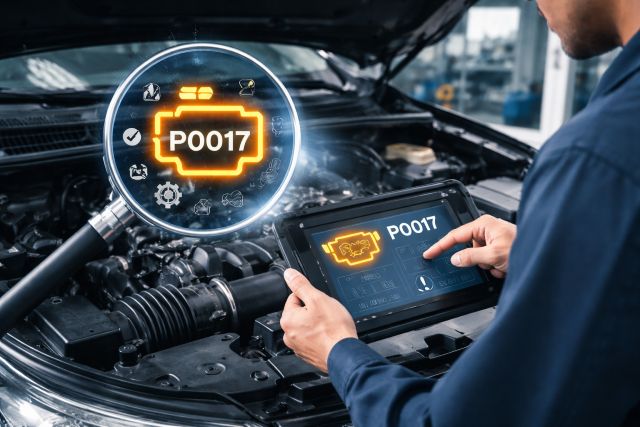

If your scanner shows p0017, your engine computer is detecting a timing correlation issue between the crankshaft and camshaft. In most vehicles, p0017 maps to “Crankshaft Position–Camshaft Position Correlation (Bank 1, Sensor B),” which usually refers to the exhaust cam on the bank that contains cylinder 1. In simple terms, the ECU expects the crank and cam signals to line up in a specific pattern, and it’s seeing a mismatch.
Because modern engines use variable valve timing that depends heavily on clean oil and accurate sensor readings, p0017 troubleshooting can be quick if you follow the right order. Some cases are as simple as correcting low or degraded oil that’s causing VVT control problems. Others point to worn timing components, which should be handled promptly.
What p0017 means and why it happens
The engine relies on the crankshaft position sensor and camshaft position sensor(s) to synchronize ignition timing and fuel delivery. When the ECU sees that the crank and cam signals are not correlated as expected, it sets p0017. This mismatch can be caused by mechanical timing drift, a VVT system that isn’t moving the cam the way it should, or sensor signal problems.
Mechanical timing drift is often tied to timing chain stretch, tensioner weakness, or a chain that has jumped a tooth. VVT-related causes often involve dirty oil, incorrect oil viscosity, clogged VVT solenoid screens, or a failing cam phaser. Sensor and wiring causes include contaminated connectors, damaged harness routing, or a sensor that intermittently drops signal.
Common symptoms of p0017
Many drivers first notice the check engine light and a change in how the engine feels. Rough idle, hesitation during acceleration, reduced power, and poor fuel economy are common. Hard starting can happen, especially when the correlation is far off or the system struggles to control cam timing during startup. Some engines develop a rattling noise near the timing cover area, particularly on cold starts, which can be a clue pointing toward timing chain tension issues.
If the car is stalling, cranking for a long time, or making loud metallic rattling sounds, it’s smarter to avoid driving and get it inspected quickly. Correlation codes can escalate if the underlying problem is mechanical.
The fastest p0017 troubleshooting sequence
Step 1: Confirm the exact code definition and capture freeze-frame data
Start by scanning for stored, pending, and history codes and saving freeze-frame data. The freeze-frame tells you the conditions when the ECU decided the issue was real, such as engine temperature, RPM, speed, and load. If you also see correlation neighbors like p0016, p0018, or p0019, that often changes the diagnostic direction and suggests a broader timing or VVT control issue.
A fast win here is simply avoiding guesswork. Freeze-frame and related codes keep you from replacing parts that are not responsible.
Step 2: Check oil level, oil condition, and correct oil viscosity
This is the quickest and most overlooked step, and it matters because variable valve timing systems use oil pressure and controlled oil flow to move cam phasers. Low oil, heavily degraded oil, or the wrong viscosity can slow or prevent proper VVT operation, leading to correlation faults like p0017.
Check the dipstick level on flat ground and look at the oil’s condition. If the oil is thick, sludgy, or smells burned, an oil and filter change can be the fastest legitimate repair attempt. If the oil level is low, correct it and inspect for leaks or consumption. If the code clears and stays away after a few drive cycles, you likely caught a VVT control problem early.
Step 3: Inspect cam and crank sensor connectors and harness routing
If oil checks out, the next fastest step is a careful connector and wiring inspection. Correlation depends on clean signals, so a loose connector, oil-soaked plug, corrosion, or a harness rubbing through its insulation can create an intermittent mismatch. This is especially common near hot exhaust routing or where wiring is clipped to brackets.
Unplug the connectors, inspect for oil intrusion or corrosion, make sure pins are not bent, and confirm the connectors lock firmly. If you find oil inside a connector, that can indicate a leaking sensor seal or oil wicking through harness sheathing in some designs.
Step 4: Clear codes and replicate freeze-frame conditions
After you address oil and obvious signal issues, clear the code and drive the vehicle under conditions similar to the freeze-frame. If p0017 returns immediately on startup, that often points to either a persistent sensor signal problem or a mechanical/VVT position problem that’s present at all times. If it only returns under specific load or RPM ranges, VVT control issues become more likely.
When p0017 points to VVT problems
If the engine has variable valve timing, a sticking oil control solenoid or a worn cam phaser can cause the cam to lag behind commanded position, which the ECU interprets as a correlation error. Dirty oil and sludge are frequent contributors because small control passages and solenoid screens can clog.
A fast professional confirmation is comparing commanded cam angle to actual cam angle on a scan tool that supports live VVT PIDs. If the ECU commands a cam advance and the cam response is slow or inconsistent, VVT hardware or oil pressure/flow is suspect. Another fast check is verifying oil pressure if symptoms suggest low pressure, because insufficient pressure can prevent phasers from holding position.
When p0017 points to timing chain or mechanical timing issues
If the timing chain has stretched or a tensioner has weakened, the cam timing can drift enough that the ECU sees correlation as incorrect. A chain that has jumped a tooth is more severe and can cause major drivability issues, misfires, and in some engines risk internal damage. Rattling at cold start, persistent immediate-return correlation codes, and broad loss of power are classic clues.
Mechanical confirmation typically requires checking timing alignment marks or measuring chain stretch indirectly through scan tool cam/crank correlation data if supported. On many vehicles, timing chain service is labor-intensive, and published cost ranges often land in the roughly two-thousand-dollar neighborhood depending on engine layout and access.
The sensor question: should you replace the cam or crank sensor first?
People often replace sensors first because it’s easy, but correlation codes do not automatically mean a bad sensor. Sensors should be suspected when you have intermittent cut-outs, unstable RPM signals, or obvious connector and wiring issues. If the engine is mechanically noisy, consistently low on power, or the code returns immediately after clearing with clean connectors and correct oil, mechanical timing or VVT control becomes more likely than a sensor alone.
If you do replace a sensor, use a reputable part, confirm the connector seal is good, and avoid “parts cannon” behavior. A shop with scope testing can confirm if the cam/crank waveform relationship is drifting or if one signal is dropping out.
Real-world scenarios that resolve p0017 fast
A common “fast fix” case is a vehicle that throws p0017 after extended oil changes. The owner changes oil and filter with the correct spec, clears the code, and the code stays away because the VVT solenoid and phaser can move freely again.
Another common case is wiring damage. A harness near the valve cover or front timing cover rubs through, causing intermittent cam signal noise. Repairing the wiring and securing the harness eliminates the mismatch.
A more serious scenario is a cold-start rattle followed by persistent p0017. Inspection finds timing chain stretch and a weak tensioner. Replacing chain, guides, and tensioner restores correlation and prevents the problem from worsening.
FAQ-style answers for featured snippets
What is p0017?
p0017 is an OBD-II code indicating the engine computer sees the crankshaft and camshaft positions out of sync on Bank 1, Sensor B, often related to exhaust cam timing correlation.
Can low oil cause p0017?
Yes. Low oil, dirty oil, or incorrect viscosity can impair variable valve timing operation and trigger correlation codes like p0017.
Is p0017 serious?
It can be. Mild cases can be oil- or signal-related, but persistent correlation faults can also indicate timing chain stretch or mechanical timing problems that should be handled quickly.
How do you fix p0017 the fastest?
The fastest legitimate path is verifying oil level and condition, confirming correct oil viscosity, inspecting cam/crank sensor connectors and wiring, then validating VVT and timing integrity if the code returns.
Conclusion: the smartest way to clear p0017 without wasting money
p0017 troubleshooting is fastest when you start with what affects VVT and sensor accuracy first. Verify oil level, quality, and correct spec because VVT systems are oil-dependent and oil problems are common. Next, inspect cam and crank sensor connectors and wiring because correlation codes rely on clean signals. If the code persists or returns immediately, shift your focus to VVT solenoids, cam phasers, oil pressure, and finally mechanical timing components like the timing chain, guides, and tensioner.














Leave a comment