
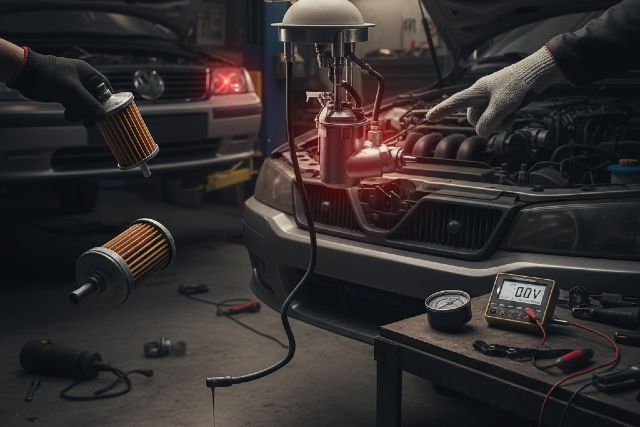

Bad fuel pump symptoms often start small, then escalate fast. You might notice a slightly longer crank in the morning, a brief stumble when you accelerate, or a vague loss of power that comes and goes. Because the fuel pump sits quietly in the background doing one important job—delivering fuel at the right pressure and volume—when it weakens, the engine’s behavior can change in ways that feel inconsistent. The truth is, the pattern is usually very consistent once you know what to look for.
If you’re here because your car is hesitating, stalling, or struggling to start, you’re not alone. Fuel delivery problems are common, and they can mimic other issues like ignition problems or vacuum leaks. In this guide, you’ll learn the most reliable signs of a failing fuel pump, quick ways to narrow it down, and what to do next so you don’t get stranded or end up with an unsafe stall.
What the fuel pump does and why failure feels “random”
In most modern vehicles, the fuel pump is electric and mounted inside the fuel tank. It pushes fuel through the lines and filter toward the engine, where pressure is controlled by a regulator or by the engine computer depending on the system design. When everything is healthy, pressure and fuel volume stay stable across different driving conditions—idling, accelerating, cruising, and climbing hills.
When a pump starts failing, it often can’t keep up when demand rises. That’s why a car might idle fine in a parking lot but hesitate badly during a highway merge. This isn’t your imagination; it’s a classic way a weak pump reveals itself. Safety recall documents for low-pressure fuel pump issues also note that failure can lead to engine stall while driving, which increases crash risk.
Bad fuel pump symptoms that show up first
Hard starting and longer cranking
One of the earliest bad fuel pump symptoms is extended cranking. The engine turns over normally, but it takes longer to catch and run. This can happen after the car sits overnight because fuel pressure bleeds down, or after a short stop when heat in the engine bay changes fuel behavior. If you notice the engine starts better when you cycle the key to the ON position before cranking, that’s a meaningful clue. Key cycling primes the pump briefly, so improvement suggests a fuel pressure build or hold problem, which can be related to the pump, a check valve, a regulator, or leaking injectors.
Hesitation, sputtering, or stumbling under acceleration
A weak pump may supply enough fuel for idle and gentle driving but struggle under load. That leads to hesitation, sputtering, or a sensation that the car is “starving” when you press the pedal. This symptom becomes especially noticeable when climbing a hill, passing another vehicle, or merging onto a freeway. HowStuffWorks highlights sputtering and loss of power under heavy load as common indicators of fuel pump trouble.
Loss of power at higher speeds
If your vehicle feels decent around town but loses power at highway speeds, fuel volume delivery becomes a prime suspect. At higher speeds, injectors demand more fuel, and the engine needs stable pressure to maintain correct air-fuel ratios. If pressure drops, the engine can go lean, power falls off, and you may feel surging or flat acceleration. In recall documentation related to low-pressure fuel pumps, reduced engine power and poor performance are listed as warning signs that can occur before a pump fails.
Rough running and misfires that feel “lean”
Fuel pump issues can create a lean condition, which can trigger misfires. Instead of the sharp “single-cylinder miss” people associate with spark plug failure, lean misfires often feel like a soft but persistent stumble, especially when accelerating. You may also notice a rough idle that comes and goes, or a shaky sensation at steady cruising speeds when the engine is trying to correct the mixture.
Check engine light related to lean operation
A failing fuel pump can trigger a check engine light, often with lean codes like P0171 or P0174. These codes mean the engine computer has detected a lean condition and has been trying to compensate. It’s important to know that these codes do not automatically mean the fuel pump is bad because vacuum leaks, MAF sensor issues, and exhaust leaks can also cause them. Still, when you combine lean codes with hesitation under load and reduced power, fuel delivery climbs higher on the suspect list. AutoZone explains that these lean codes relate to a lean condition detected by upstream oxygen sensors.
Stalling at idle or while driving
Stalling is one of the most serious bad fuel pump symptoms, and it should change how you treat the problem immediately. If the pump can’t maintain pressure, the engine may stall when you come to a stop, when you turn on accessories, or even while you’re moving. This isn’t just inconvenient; it’s a safety issue. NHTSA recall reports related to fuel pump failures emphasize that an engine stall while driving increases the risk of a crash.
Unusual whining or loud humming from the tank
Many fuel pumps make a quiet hum, especially with the key in the ON position. What matters is a noticeable change. If your car develops a louder-than-usual whining from the rear of the vehicle, particularly when paired with starting issues or acceleration hesitation, it can indicate pump wear, restriction, or cavitation. Noise alone isn’t proof, but it’s an important supporting clue.
Crank-no-start that appears suddenly
The end-stage failure is often a crank-no-start condition where the engine turns over but never fires. At this stage, the pump may not be running at all, or it may be running but producing insufficient pressure. Electrical issues like a blown fuse, failing relay, wiring corrosion, or a ground problem can mimic a dead pump, so this is the situation where diagnostics matter most.
Why symptoms worsen in hot weather or with low fuel
Heat and low fuel are two conditions that commonly expose a weak pump. Fuel inside the tank helps cool an in-tank electric pump. When the tank is low, the pump may run hotter, and hot fuel can behave differently, increasing the chance of vapor-related delivery problems. In safety documentation for low-pressure fuel pumps, risk factors and warning signs are sometimes associated with low fuel levels and warm fuel conditions, along with rough running, reduced power, and check engine warnings.
If you notice the car runs worse on hot days, during long drives, or when the fuel gauge is below a quarter tank, don’t brush it off. That pattern is a useful diagnostic clue.
How to tell if the fuel pump is actually failing fast
The key-prime clue
A quick at-home clue is whether the vehicle starts better after you turn the key to ON, wait a couple seconds, then crank. If this helps consistently, it points toward pressure build-up or pressure hold issues. That does not always mean the pump itself is the only culprit, but it strongly suggests the problem lives in the fuel delivery system rather than purely ignition.
Fuel pressure testing is the most direct confirmation
A fuel pressure test is the fastest way to move from symptoms to proof. Many port fuel injection systems commonly run somewhere around the 40–60 psi range, but the correct spec varies by vehicle and engine design, so you should verify the exact specification for your model.
If your vehicle uses gasoline direct injection, pressures can be far higher at the rail and require different tools and procedures, which is one reason professional testing is often the safest route.
Scan tool fuel trims can support the diagnosis
If you have an OBD2 scanner, look at fuel trims. When the engine is running lean, the computer often adds fuel, which shows up as positive fuel trim numbers. High positive trims at idle can suggest vacuum leaks, while trims that worsen under acceleration can suggest fuel delivery limitations. This isn’t a standalone test, but it can reinforce what your symptoms already suggest.
Don’t skip electrical supply checks
A fuel pump that’s mechanically fine can act weak if it’s not getting proper voltage. A failing relay, corroded connector, weak ground, or voltage drop under load can cause intermittent pump performance. If a shop diagnoses your pump, it’s reasonable to ask whether they checked voltage and current draw, not just pressure.
Fuel pump symptoms vs other common problems
Fuel pump failure has a recognizable “load sensitivity.” In simple terms, the harder you ask the engine to work, the more obvious the problem becomes. Ignition coil or spark plug issues can also worsen under load, so the difference often comes down to what data and tests say. If pressure drops when you accelerate, that’s a strong sign of pump or supply issues. If pressure stays stable but misfires count climbs on specific cylinders, ignition becomes more likely.
Lean codes can be especially misleading. A vacuum leak often causes a rough idle that improves when you rev the engine slightly, while a weak pump often causes the opposite: it feels okay at idle and becomes worse under acceleration. Real-world behavior matters, and it’s why describing when the symptom occurs is more helpful than describing how it feels.
A real-world scenario of a pump failing quickly
A very common timeline looks like this. You notice a small hesitation during a highway merge that you can’t reproduce in city driving. A day or two later, the hesitation becomes more frequent on hills. Then the car takes longer to start, especially after it’s warm. Finally, the vehicle stalls once at a stop or feels like it’s about to die when you slow down.
This “failing fast” progression happens because once a pump begins to lose capacity, the margin disappears quickly. Modern engines can compensate only within limits. Recall documents also emphasize warning signs like reduced power, poor performance, and rough running before a stall event.
Is it safe to drive with bad fuel pump symptoms?
If you’re only dealing with mild sluggishness, you might be able to drive short distances, but it’s still risky to ignore. Once stalling or sudden power loss appears, the risk rises sharply. Any symptom that could cause you to lose power while merging or crossing traffic should be treated as urgent.
Because engine stalls while driving are explicitly linked to fuel pump failure risk in safety documentation, the safer move is to limit driving and diagnose quickly if stalling has occurred or feels imminent.
Fuel pump replacement cost and why estimates vary
Fuel pump replacement costs vary widely because access varies widely. Some vehicles allow service through an access panel under the rear seat, while others require dropping the fuel tank, which increases labor. Parts pricing also varies, especially if your vehicle uses a complete fuel pump module that includes the sender and housing.
As a general reality check, price guides show broad ranges, with some estimates reaching over a thousand dollars depending on vehicle and labor. RepairPal’s average estimates for many vehicles can exceed $1,200 total, while other sources describe a wide “ballpark” depending on model and shop rates.
Practical prevention that actually helps
Fuel pumps live longer when they’re kept cool and not overworked. Keeping the tank above a quarter when possible can help, especially in hot climates and during long trips. If your vehicle has a serviceable fuel filter, replacing it on schedule helps reduce restriction and pump strain. It also helps to avoid consistently buying fuel from stations with questionable turnover, since contamination and debris can shorten pump life.
None of this is magic, but it reduces the conditions that make weak pumps fail sooner and makes it less likely you’ll face an avoidable roadside breakdown.
FAQ: short, snippet-ready answers in paragraph form
Many drivers ask, “What are the most common bad fuel pump symptoms?” The most common signs are hard starting, hesitation under acceleration, loss of power at higher speeds, sputtering, rough running, check engine warnings related to lean conditions, unusual whining from the tank area, and stalling.
Another common question is, “Can a bad fuel pump cause a check engine light?” Yes, it can. When fuel pressure drops, the engine can run lean or misfire, and the engine computer may trigger a warning light. Some recall documentation notes check engine light warnings, rough running, and reduced power as signs that may appear before pump failure becomes severe.
People also ask, “How do I know if it’s the fuel pump or the fuel filter?” The most reliable method is measuring fuel pressure and observing how it behaves under load. A clogged filter can reduce flow, and a weak pump can fail to maintain pressure during acceleration. If your filter is overdue and your vehicle has a serviceable filter, replacing it may be part of the fix, but testing is the best way to avoid replacing the wrong part.
A practical question is, “Will my car still run with a failing fuel pump?” Often it will, especially at idle and low speeds. Many pumps weaken gradually, and symptoms show up first during high demand situations like hills, highway speeds, and quick acceleration. This is why drivers often report that the problem feels inconsistent until it becomes frequent.
Finally, drivers want to know, “Is it dangerous to drive with these symptoms?” It can be, particularly when stalling or sudden power loss is involved. Safety documents related to fuel pump failures warn that engine stall while driving increases crash risk, so if you’ve experienced stalling or power loss during merges, it’s wise to treat it as urgent.
Conclusion
Bad fuel pump symptoms are easiest to deal with when you catch them early. Long cranking, hesitation under load, power loss at speed, lean codes, and rough running are all signs that fuel delivery may be slipping. Once stalling appears, the priority shifts from convenience to safety, because pump failure can cause an engine stall while driving.
If you want the fastest path to certainty, focus on confirmation, not guessing: fuel pressure testing, basic electrical supply checks, and scan tool data together can pinpoint whether the pump is failing or whether another issue is mimicking it. Acting sooner usually saves time, reduces the risk of getting stranded, and helps you avoid collateral damage from prolonged lean operation.













Leave a comment