
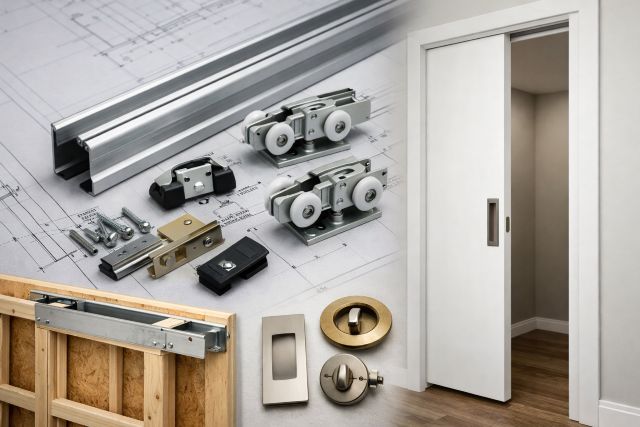

A pocket door kit is one of the most practical upgrades you can make when a swinging door steals valuable space. Instead of opening into the room, the door slides into a cavity inside the wall, which can completely change how a small bathroom, closet, pantry, laundry, or home office feels day to day. The catch is that pocket doors only feel “high-end” when the track, frame, and hardware are correctly matched to your door slab and your wall conditions. Choose a kit that’s under-rated for weight, too flimsy for drywall, or incompatible with your framing, and the door can drag, wobble, or become difficult to latch.
This guide breaks down how to pick the right track, frame, and hardware so your pocket door glides smoothly, closes cleanly, and stays serviceable for years, not weeks.
What a pocket door kit actually includes
At its core, a pocket door system is a moving door plus a hidden “runway” inside your wall. A typical pocket door kit combines the pocket frame (the structure that forms the cavity), the track and hangers (the moving parts that carry the door), and the guides (the parts that keep the door from swinging at the bottom). Some kits are sold as a full frame-and-hardware package, while others are sold as hardware-only, meaning you may be buying only the track and rollers without the pocket frame that creates the wall cavity.
If you’re converting an existing hinged doorway into a pocket door, most homeowners end up needing a frame kit (or a pre-assembled frame system) because the wall has to be rebuilt to create the pocket. If you already have a framed pocket cavity, a hardware-only replacement can make sense, but you still need to confirm compatibility with your door thickness, door weight, and existing track mounting.
Why the track and rollers matter more than people expect
When someone says a pocket door “feels cheap,” they’re usually describing the motion, the noise, or the last few inches of travel. That experience is dominated by the track and the roller/hanger design. High-quality systems call out details like ball-bearing hanger wheels and smooth travel as a core feature of better performance. For example, Johnson Hardware’s soft-close pocket frame system highlights smooth ball-bearing hanger wheels combined with soft-close operation as a premium installation feature.
The most important mindset shift is to stop thinking of the track as a simple metal strip and start treating it like load-bearing hardware. If the track flexes, if the rollers are under-rated, or if the hangers aren’t designed to stay stable under repeated daily use, you can end up with dragging, door sway, or a door that never “settles” into a consistent latch position.
Start with the door slab, because it determines everything
Before you compare brands or features, lock down your door slab details. Door weight, door thickness, and material drive the correct choice more than any other factor. Hollow-core interior slabs are lighter and easier on hardware. Solid-core doors are heavier and better for sound control, but they demand stronger rollers and a sturdier frame to avoid sag and long-term wear.
Manufacturers often publish weight limits and compatibility ranges, and those specs should be your baseline rather than a guess. As one example, Johnson Hardware’s 1500PF pocket door frame kit is described as standard-duty and designed to carry doors up to 125 lbs in standard 2×4 timber stud walls (or 4-inch steel stud walls with an adapter). If your solid-core slab approaches or exceeds that range, you should move up to a heavier-duty hardware line, or select a system designed for heavier panels and higher usage.
If you want a real-world rule that keeps you out of trouble, don’t buy a kit that “barely meets” your door weight. Choose a kit that comfortably exceeds it. The extra headroom tends to translate into quieter operation and less frequent adjustment.
Pocket door kit sizing: the wall and the rough opening are not afterthoughts
Pocket doors reclaim swing space, but they require the wall to do more work. You’re framing both the visible doorway and the hidden pocket cavity, which means the overall rough opening width typically increases compared to a hinged door opening. This is where planning pays off. Even excellent hardware can’t compensate for a rough opening that’s out of plumb, a header that isn’t properly supported, or a pocket cavity that ends up slightly twisted after drywall.
In load-bearing scenarios, header sizing is not optional and should follow code requirements for your spans and loads. The International Residential Code provides header provisions and span tables under the wall construction sections, including R602.7 Headers (with tables for exterior bearing walls and related header span guidance). If you’re unsure whether a wall is bearing, treat it as if it is until a qualified pro confirms otherwise. A pocket door kit isn’t a structural solution; it’s a door system that needs the structure done correctly.
Choosing a pocket door frame kit that stays straight after drywall
A pocket door frame isn’t just a way to “make a hollow space.” It has to resist bowing after drywall and trim are installed, and it has to remain stable even when people push the door sideways or pull it hard at the end of travel. That’s why many higher-quality systems emphasize reinforced uprights or split studs designed to prevent bowing. Hafele’s Slido pocket door frame set, for instance, describes steel-reinforced split studs intended to prevent bowing of the pocket walls, and also notes serviceability features like a track that can be removed without opening the drywall.
This matters more than it sounds. A pocket cavity that bows inward even slightly can create rubbing that shows up mid-travel, and those rub points are infamously hard to “fix with adjustment” because the cavity itself is no longer straight. If you plan tile near the opening, or if the door will be used constantly, frame rigidity becomes a major predictor of long-term satisfaction.
Wall thickness: why 2×4 vs 2×6 changes your kit choice
Most residential pocket door kits are designed around common stud walls, often 2×4 construction. If you’re working with a thicker wall, such as 2×6 framing, plumbing walls, or walls built out for sound insulation, you need to confirm that the kit is designed for that thickness or that the manufacturer provides compatible parts. Even when a kit “fits,” you still want to consider how finishing will work, because the final jamb depth and trim details will influence how cleanly the door closes and how well it latches.
Also consider what’s inside the wall. Pocket cavities and utilities don’t like each other. Electrical boxes, plumbing vents, and supply lines can compete with the space your door needs to retract. Planning this early prevents the classic moment where a door is installed and then won’t fully disappear because something inside the cavity is in the way.
Track choices: what separates “smooth” from “sticky”
Track design and roller quality determine how the door feels every time you touch it. If you’re optimizing for a premium glide, look for systems that emphasize smooth travel and durable hangers, and that provide reliable retention so the door can’t jump the track if it’s bumped.
It’s also worth thinking about serviceability. A pocket door can be a long-term feature, so you want a system that makes future maintenance possible without destroying finished walls. Hafele’s note that the track can be removed without opening drywall is exactly the kind of detail that can save major time and expense later.
Soft-close and soft-open: when it’s worth paying more
Soft-close is not a gimmick when the door is used many times a day. It changes the feel of the final inches of travel and helps reduce the slamming and bounce that can loosen hardware over time. Some systems go further and include soft-open as well, controlling motion at both ends.
Manufacturers describe soft-close and soft-open as mechanisms that brake the door smoothly and prevent slamming or pinched fingers. For example, Home Depot’s listing for a Cavity Sliders SofStop soft close/soft open kit describes smooth braking into the closed position and being pulled into the open position, specifically calling out slam prevention and finger safety. Johnson Hardware’s 1500SC pocket door frame is explicitly designed to soft-open and soft-close heavy solid-core doors up to a published weight rating, framing the combination of ball-bearing hangers and soft operation as a premium result.
If you’re choosing where to spend on upgrades, soft-close tends to rank high for bathrooms, laundry rooms, and any door that sees constant use. In a low-traffic closet, you may not care. In a busy hallway bath, you probably will.
Hardware that makes the door easy to live with
Pocket doors require flush, low-profile hardware so the door can disappear into the wall cavity. This is the area where “almost right” can become annoying. A pull that looks good but is uncomfortable to grip will irritate you every day. A latch that doesn’t align well with the jamb will make the door feel imprecise. In bathrooms or bedrooms, you’ll typically want a privacy function designed specifically for pocket doors, which usually means a flush pull paired with a privacy latch.
If accessibility is relevant, the clear width of the opening is a key factor. The ADA Standards include a minimum clear width requirement for door openings. Section 404.2.3 notes that door openings must provide 32 inches minimum clear width, and it also addresses deeper openings requiring more clearance. Pocket doors can be helpful for circulation because they remove swing conflicts, but compliance still depends on the finished opening dimensions and usable hardware.
Real-world room scenarios: matching the kit to daily use
In a small bathroom remodel, the biggest wins are often space and usability. A pocket door can prevent collisions with vanities and make the room easier to navigate. In that case, a solid-core door paired with a kit rated comfortably above the slab weight can improve privacy and sound, while soft-close makes the door feel calmer and more refined, especially in the morning-and-night rush.
In a pantry or laundry room, the door is often used with hands full. That’s where smooth glide and dependable guides matter because people tend to bump these doors, close them quickly, or pull them from an angle. Soft-open/soft-close helps here too because it reduces slamming and keeps motion controlled even when someone uses an elbow or hip to nudge the door.
In a home office or flex space, sound control becomes more important. A pocket door can work well, but you want the heavier slab and sturdy hardware combination, plus careful finishing at the jamb so the door closes with a decisive latch feel. A pocket door won’t seal like an exterior door, but a thoughtful slab choice and good trim execution can make it feel more private than most people expect.
Installation reality check: why pocket doors fail and how to avoid the common traps
Pocket doors usually earn a bad reputation when the wall is out of square, the frame bows after drywall, or the door weight exceeds the hardware rating. Once a pocket cavity is finished, fixing a fundamental framing issue is expensive, so prevention is the smart play.
The first trap is assuming pocket doors install like a normal prehung. They don’t. The rough opening must be straight, the header must be solid, and the pocket frame must stay aligned while it’s fastened. In load-bearing walls, the header must be appropriately sized per code and load conditions; that’s why the IRC’s header provisions exist. The second trap is underestimating door weight. If the slab is heavy and the kit is near its capacity, you’re more likely to see degraded glide and more frequent adjustment over time. Specs like Johnson’s 125-lb design guidance for a standard-duty frame are meant to keep the system operating within its intended performance window.
The third trap is crowding the cavity. Even small protrusions, like a misplaced fastener or a poorly planned electrical run, can catch a door edge and create scratches, noise, or incomplete retraction. Pocket doors need a clean runway.
FAQs
What is included in a pocket door kit?
A pocket door kit typically combines the pocket frame that forms the wall cavity with the track and hangers that carry the door, plus guides that stabilize the bottom edge. Some products are sold as hardware-only, so it’s important to confirm whether a listing includes the pocket frame or only the sliding components. A full frame system may also highlight long-term serviceability features, such as removable track access without opening the drywall.
What weight rating do I need for a solid-core door?
You should choose a kit whose published door weight capacity comfortably exceeds your slab’s weight. Standard-duty systems may be designed for doors up to a certain threshold, such as Johnson’s 1500PF frame described for doors up to 125 lbs. If you’re installing a heavier solid-core door or want soft-close operation with heavy use, consider systems designed for heavier slabs and controlled motion, such as Johnson’s 1500SC designed for soft-open and soft-close operation on heavy solid-core doors within its published rating.
Are pocket doors ADA compliant?
They can be, but compliance depends on the finished clear opening width and the usability of the hardware. ADA section 404.2.3 specifies that door openings must provide a clear width of 32 inches minimum. A pocket door can improve circulation by removing swing clearance conflicts, but you still need to design the opening to meet the required clear width.
Do pocket doors require a special header?
If the wall is load-bearing, the opening must be framed with an appropriate header sized for the span and load conditions. The International Residential Code addresses headers under wall construction provisions, including R602.7 Headers and related span tables. Even in non-bearing walls, a solid header is essential for keeping the track straight and the door travel smooth.
Is soft-close worth it?
Soft-close is often worth it in high-traffic areas because it changes the feel of daily use and reduces slamming. Product descriptions for soft-close/soft-open kits commonly emphasize smooth braking and slam prevention, which can make the door quieter and feel more refined in busy rooms.
Conclusion: pick a pocket door kit that matches real life, not just the opening
The right pocket door kit is the one that matches your door slab weight and thickness, your wall construction, and how often the door will be used. When you choose a track and hanger system with a comfortable weight rating, a frame that resists bowing after drywall, and hardware that fits your privacy and accessibility needs, a pocket door stops feeling like a compromise and starts feeling like an intentional upgrade. Use published specs for weight and wall compatibility as your guardrails, and remember that good framing and a straight rough opening are what allow premium hardware to perform like premium hardware.











Leave a comment