
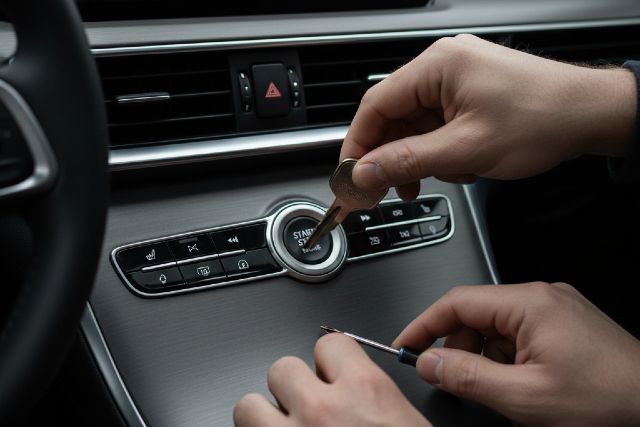

If you’re dealing with a key stuck in ignition, it can feel especially confusing when your car is push-start or “keyless.” You might be thinking, “Why is there even an ignition cylinder?” or “How can a modern car trap a key?”
Here’s what’s really happening. Many push-start vehicles still include a physical key or an emergency key slot, and most cars use safety interlocks that block key release unless certain conditions are met. That means your key isn’t “randomly stuck.” It’s usually being held by a park/shift interlock, steering lock pressure, low 12-volt power, or a worn ignition mechanism that can’t return cleanly to the release position.
What “Key Stuck in Ignition” Means in Push-Start and Keyless Cars
Even if you press a start/stop button, your car may still have a physical key system somewhere in the background. Some vehicles have a conventional ignition cylinder plus push-start features. Others have an emergency key slot or a hidden mechanical key inside the fob for doors and backup access. Toyota, for example, documents that when the Smart Key battery dies you can use the mechanical key to enter, then hold the Smart Key near the start button to start the engine.
So when the key won’t come out, it usually means the car believes it is not in the correct “safe state.” The most common blockers are that the vehicle doesn’t think it’s fully in Park, the steering lock is loaded with pressure, or the 12-volt battery voltage is too low to release the key-lock solenoid.
Why Your Key Gets Trapped: The Most Common Real Causes
The transmission isn’t fully recognized as Park
Many vehicles are designed so the ignition key cannot be removed unless the shifter is in Park. This is not just tradition — it’s a safety system built into shift interlock designs. Service documentation describing shift interlock operation explicitly notes that the ignition key cannot be removed until the gearshift lever is returned to Park.
In plain English, you might be “in Park,” but the sensor that tells the car you’re in Park might not be reading cleanly because of drivetrain load, a sticky shifter mechanism, or a failing switch.
Steering wheel lock pressure is binding the cylinder
If you parked with the steering wheel turned hard, the steering lock can clamp down. That pressure can bind the cylinder so the key can’t rotate to the exact release position.
Low 12-volt battery voltage prevents release
This is a big one people miss. Key release can be controlled by a key-lock solenoid or related mechanism. If the 12-volt system is weak, the car may not have the power needed to actuate a release properly, even though lights and accessories may still partly work. AAA frequently points to battery issues as a major reason drivers need assistance, and their maintenance guidance mentions batteries as one of the top call drivers.
A key-lock solenoid or interlock is malfunctioning
This isn’t guesswork—manufacturers and service bulletins describe diagnosing “cannot remove key from ignition” concerns by checking the key-lock solenoid output in body control data.
The ignition cylinder is worn or contaminated
If the key feels gritty or intermittently sticks, the internal wafers and springs can bind. This can worsen with heavy keychains and years of wear.
The Real Fix: Safe Steps That Actually Work (No Forcing)
Fix the Park signal problem first
Start by making the car absolutely sure it’s in Park. Put your foot firmly on the brake, then move the shifter out of Park and back into Park slowly and deliberately. If you parked on an incline, apply the parking brake first and let the vehicle settle slightly so drivetrain load isn’t fighting the parking mechanism.
This matters because shift interlock systems are designed around the idea that Park is the condition for key release, and service documentation describes that logic directly.
Relieve steering lock pressure the right way
If the steering wheel feels “stuck” against the lock, don’t muscle the key. Instead, gently try turning the key toward the release position while you turn the steering wheel slightly in the direction that has a bit of movement. Once the pressure is relieved, the cylinder often rotates easily and the key comes out.
A reputable automotive repair chain describes this as a common situation with a typically simple resolution — unlocking the wheel by relieving tension rather than forcing the key.
Make sure the car is truly OFF, not in accessory mode
On push-start vehicles, you can end up in accessory mode or ignition-on without realizing it. If the dash stays lit in a way that suggests the vehicle didn’t fully shut down, the system may not allow release. Cycle the start/stop button according to your model’s logic, and make sure the vehicle shows a true “off” state.
If your vehicle uses a removable emergency key in a slot or cylinder, it may still rely on the vehicle being in the correct electronic state before it allows release.
Restore 12-volt power if the battery is weak
If the car behaves strangely — dim interior lights, clicking, inconsistent electronics, or a refusal to fully power down — treat low 12-volt voltage as a serious suspect. Supplying stable power via a jump pack can restore proper interlock behavior.
AAA’s reporting and maintenance guidance repeatedly stress how often battery issues are behind breakdowns and service calls, which is consistent with real-world “interlocks don’t release” situations in modern vehicles.
If the key releases immediately after power is stabilized, you’ve learned something crucial: your key wasn’t “mechanically stuck” so much as “electronically held.”
If you’re using a key fob, handle a dead fob battery the smart way
A dying fob battery can create confusing symptoms in push-start systems. Some cars won’t recognize the fob reliably, which can prevent proper shutdown/authorization logic from completing.
Toyota’s official guidance is clear: if the Smart Key battery is dead, use the mechanical key to enter, then hold the Smart Key next to the start button while pressing it; Toyota also notes that if it still doesn’t work, the engine battery may be weak rather than the fob battery.
That single note is gold because it explains why two “battery problems” can look the same. If the fob battery is weak, recognition fails. If the 12-volt battery is weak, interlocks and modules can misbehave.
Address a binding cylinder with the right lubricant approach
If your vehicle has a real ignition cylinder and the key feels gritty, a dry lock lubricant is the safer approach than soaking it with oily spray that can attract dirt. If the problem is intermittent and getting worse, lubrication may buy time, but it’s often a sign of wear that will eventually require repair.
Reduce keychain weight as a preventative fix
If you have a conventional key-in-cylinder setup (even if the car also has push-start), a heavy keychain can increase wear and aggravate binding. It’s a small change that can noticeably reduce sticking over time, and it costs nothing.
When the “Real Fix” Is a Faulty Interlock or Solenoid
If Park is confirmed, steering tension is relieved, the car is truly off, and power is stable, but the key still won’t release, you may be in interlock/solenoid territory rather than user-error territory.
A manufacturer service bulletin on a “cannot remove key” concern outlines checking key lock solenoid output through body integrated unit data, which strongly suggests that on affected models the issue can be electrical or control-module related, not just “a stuck key.”
At this point, your smartest next move is often professional diagnosis, because repeated forcing can escalate a relatively straightforward repair into a broken key, damaged cylinder, or steering column trim replacement.
What Not to Do
When a key is stuck, the temptation is to yank harder. That’s how keys snap. A snapped key becomes a key extraction job, and if the cylinder is damaged in the process, it can become a steering column tear-down.
Also avoid prying aggressively at column trim or shifter trim. Modern interiors use clips that break easily, and misaligned trim can introduce new problems like shifter interference that mimics Park-sensor failures.
Real-World Scenarios That Match What Drivers Actually Experience
Imagine you park on a slope, put the shifter into Park, turn the wheel, and jump out quickly. The next time you try to remove the key, it won’t budge. In many cases, that’s not a “bad ignition.” It’s drivetrain load tugging against the parking mechanism plus steering lock pressure. Once you apply the parking brake, re-seat Park, and relieve steering tension, the key releases like nothing ever happened.
Another common situation is a weak 12-volt battery. You might still have enough power for lights, but not enough for reliable module behavior or solenoid actuation. AAA’s emphasis on batteries being among the most common roadside issues aligns with why drivers experience strange lock/interlock behaviors when voltage drops.
And then there’s the push-start confusion: the car is actually in accessory mode. The driver thinks it’s off because the engine isn’t running, but the vehicle logic doesn’t agree, so it doesn’t allow release.
FAQ: Quick Answers
Why is my key stuck in ignition if my car is push-start or keyless?
Because many push-start cars still use a physical key cylinder or emergency key slot, and the vehicle’s safety logic may block release unless it detects Park, full shutdown, and proper steering lock conditions. Shift interlock documentation explicitly ties key removal to being in Park.
Can a weak car battery cause a key to get stuck in the ignition?
Yes. If key release depends on a solenoid or electronic interlock, low 12-volt voltage can prevent the mechanism from releasing. AAA repeatedly identifies battery issues as a leading contributor to roadside events.
What’s the safest first thing to try?
Re-confirm Park carefully, especially on an incline, then relieve steering lock pressure while gently turning the key. Those two actions solve a large share of cases without tools and without force.
What if my key fob battery is dead—can that trap me in a weird state?
It can contribute to keyless recognition issues. Toyota’s official support guidance says you can often start the vehicle by holding the Smart Key next to the start button, and it also notes that if it still fails, the vehicle’s 12-volt battery may be the real issue.
When should I stop troubleshooting and call a pro?
If the key is twisting only with significant force, if it feels like it may snap, or if you’ve confirmed Park, relieved steering tension, and stabilized 12-volt power but the key still won’t release. A service bulletin approach to “cannot remove key” complaints includes checking key lock solenoid output, which is not something most drivers can verify roadside.
Conclusion: How to Fix a Key Stuck in Ignition Without Breaking Anything
A key stuck in ignition on a push-start or keyless car is usually an interlock condition, not a catastrophe. The most reliable fixes are the ones that satisfy the car’s safety logic: get a clean Park recognition, relieve steering lock pressure, ensure the vehicle is truly off, and restore stable 12-volt power when voltage is weak. AAA’s guidance reinforces that batteries and key-related problems remain among the most common reasons drivers need help, so this issue is far more normal than it feels in the moment.
If the problem persists after those steps, treat it as an interlock/solenoid or wear issue rather than “bad luck.” At that stage, professional diagnosis is often the fastest way to avoid snapping a key or damaging the cylinder, and service-bulletin style diagnostics show the issue can be electronic, not just mechanical.















Leave a comment