
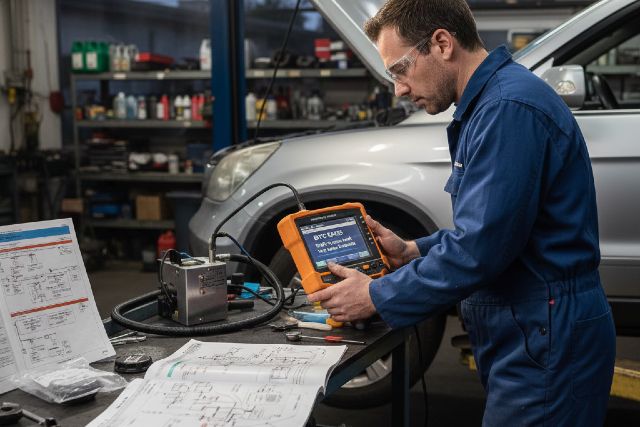

If you’re seeing the po455 code on a scan tool (often displayed as P0455), your vehicle is reporting that the evaporative emissions system can’t seal well enough to pass its self-test. In everyday terms, the car believes fuel vapors are escaping from a “closed” system because it detects what’s considered a large or gross leak. The upside is that this issue typically won’t leave you stranded. The downside is that it can keep the check engine light on, cause a fuel vapor smell, and prevent you from passing emissions inspection in many regions.
This guide explains what the po455 code means, what symptoms to expect, why it happens, and how to diagnose and repair it efficiently. You’ll also learn what technicians look for, when a smoke test becomes the smartest move, and how to confirm the repair so the code doesn’t come right back.
What does the po455 code mean?
The po455 code (P0455) is an OBD-II diagnostic trouble code that indicates the engine computer detected a large leak in the EVAP system. Most repair references define P0455 as “EVAP system leak detected (large/gross leak).”
The EVAP system is designed to capture gasoline vapors and route them to the engine to be burned instead of venting into the atmosphere. During an EVAP monitor test, the vehicle attempts to create and hold a specific amount of vacuum or pressure in the sealed system. If it can’t reach the target or can’t hold it, the computer interprets that as a leak. When it’s significant enough to be categorized as “gross,” you get P0455.
Why EVAP leaks matter in the real world
Even though an EVAP problem often feels “non-urgent,” evaporative emissions are a meaningful contributor to air pollution. Regulatory bodies treat evaporative emissions as a dedicated category because fuel vapors can contribute to smog-forming pollution. CARB maintains extensive evaporative emissions standards and compliance frameworks for on-road vehicles, reflecting how seriously these vapor losses are taken. The U.S. EPA also tracks evaporative emissions as part of its on-road emissions modeling and inventories.
From a driver’s perspective, that translates into a check engine light that won’t go away, an emissions test you may not pass, and the possibility of noticeable fuel odor if the leak is large enough or located where vapors collect.
Symptoms you may notice with po455 code
Most drivers first notice the check engine light. Many vehicles otherwise drive normally, because EVAP sealing is not the same as fuel delivery or ignition timing. Still, a few symptoms are common.
A fuel odor is one of the most frequent complaints, especially after refueling or when the vehicle is parked in an enclosed space. Some drivers notice the smell more on warm days, which makes sense because fuel vaporization increases with temperature.
In some cases, you may see inspection readiness problems. Even if the car runs fine, an EVAP code can prevent the EVAP monitor from completing properly, which can fail readiness-based inspections.
Occasionally, if the fault involves purge control, drivability symptoms can appear. Certain purge valve failures can create rough idle, hard starting after refueling, or stumble in specific conditions. Many diagnostic references explicitly include purge valve issues among common roots for EVAP leak codes because a valve that won’t seal can mimic a leak during the monitor test.
The most common causes of the po455 code
A large EVAP leak sounds dramatic, but very often the cause is simple. A loose, missing, incorrect, or worn gas cap is a classic trigger. Many reputable diagnostic summaries mention the gas cap as an early, high-probability check for P0455.
Cracked or disconnected EVAP hoses and vapor lines are another frequent culprit. These lines live in areas exposed to road debris, heat cycles, and corrosion, particularly near the charcoal canister and vent components.
Vent valve problems are also common. If the canister vent valve doesn’t seal when it’s supposed to, the system cannot build or maintain the vacuum/pressure needed for the self-test, and the computer interprets that as a gross leak.
A purge valve stuck open can create a similar effect. Even though nothing is physically “leaking” to the outside at the purge valve, an open path to the intake can prevent the EVAP system from sealing during the test, leading to the same code.
Finally, physical damage to the filler neck, fuel tank sealing points, or charcoal canister can cause large leaks. Consumer repair references frequently cite filler neck and tank-related sealing issues as common large-leak roots because they’re big openings and they’re exposed to rust and impact damage.
Is it safe to drive with po455 code?
In most cases, yes, you can drive with po455 code without an immediate safety risk, especially if the only symptom is the check engine light. EVAP systems are about vapor containment, not engine lubrication or coolant circulation.
That said, you should treat strong fuel odor seriously. If you smell raw fuel strongly, see wetness near the tank area, or suspect a liquid fuel leak, you should avoid driving and have the vehicle inspected promptly. Also, keep in mind that a constant check engine light can hide new problems. If another fault occurs, you may not notice it quickly because the warning light is already on.
How to diagnose po455 code efficiently
A good diagnosis follows a simple principle. You start with the easiest, highest-probability causes, then move toward higher-certainty testing, and you stop guessing as soon as you can prove where the system is leaking.
Confirm the code and look for related EVAP codes
Begin by scanning the vehicle and confirming P0455 is present and whether it’s pending or confirmed. Pay attention to additional EVAP-related codes, because combinations can narrow the search. Freeze-frame data can also hint at the conditions under which the test failed, such as fuel level and ambient temperature.
Check the gas cap and filler neck sealing surface first
This is the fastest win in the entire process. Remove the cap, inspect the rubber seal for cracking or flattening, clean any grit from the sealing surfaces, and tighten the cap fully. If the cap doesn’t tighten properly or looks worn, replacing it with an OEM-quality cap is often worth it before you spend time elsewhere. Many P0455 references specifically call the gas cap out as a common cause.
While you’re there, look closely at the filler neck. Rust, dents, or a compromised lip where the cap seals can create a large leak. It’s also common for issues near the refueling area to show up shortly after a fill-up, which is why many drivers connect the code with “it happened after I got gas.”
Do a careful visual inspection of EVAP hoses and vapor lines
If the cap and filler neck check out, move to the vapor lines. Look for cracked rubber, broken plastic lines, missing clips, and lines that have rubbed through on a bracket. Focus on the areas near the canister, vent valve, and any exposed routing under the vehicle, because that’s where road debris and corrosion take a toll.
Some large leaks are obvious once you’re looking at the right spot. A hose that has slipped off a fitting or split at a bend can create exactly the “gross leak” result the monitor is designed to catch.
Evaluate the purge valve because it can mimic a large leak
A purge valve that doesn’t seal can prevent the EVAP system from holding the required vacuum/pressure for its test. Many diagnostic summaries include purge valve faults as a likely cause for P0455, especially when the usual external leak points aren’t obvious.
If you have a scan tool that can command the purge valve on and off, you can check whether it responds properly. In a professional setting, technicians often verify whether the purge valve seals when commanded closed and whether it flows when commanded open. If it leaks when it should be closed, it can cause recurring EVAP codes even after you replace caps and hoses.
Consider the vent valve and charcoal canister area next
The vent valve is exposed to dust, water, and road salt, which makes it a frequent failure point. If the vent valve sticks open or cannot seal, the system can’t build vacuum and the test fails like a large leak.
It’s also worth inspecting the charcoal canister for cracks or damage. A canister that’s physically split or compromised can become a direct leak source, and in some cases, overfilling the tank repeatedly can saturate components and contribute to failures, depending on vehicle design.
Use a smoke test to stop guessing
If the simple checks don’t locate the issue quickly, an EVAP smoke test is typically the most time-efficient and accurate next step. A smoke machine introduces low-pressure smoke into the EVAP system. Wherever smoke escapes is the leak point, whether it’s a hairline split in a hose, a vent valve that won’t close, a canister seam, or a filler neck seal problem.
Many professional diagnostic workflows rely on smoke testing specifically because EVAP systems can be hard to diagnose by sight alone. When readers are stuck after a gas cap replacement, a smoke test is often the cleanest path to a confirmed answer.
Repairing po455 code: what fixes usually work
Once you’ve identified the cause, the repair becomes much more straightforward. The key is to avoid swapping parts because they “often fail” and instead match the repair to the confirmed failure.
If the gas cap seal is worn or the cap is incorrect, replacement is often the entire fix. This remains one of the most commonly cited solutions in P0455 write-ups.
If an EVAP hose or line is cracked or disconnected, replacing or re-securing that line usually resolves the gross leak. When replacing hose sections, make sure the hose material is appropriate for fuel vapor exposure and that the routing won’t create new rub points.
If testing indicates the purge valve leaks when it should be closed, replacement is typically the remedy. Purge valve faults can be particularly annoying because they can look like a “leak” even though the leak path is internal through the engine intake, and that’s why they show up in many diagnostic resources discussing P0455.
If the vent valve doesn’t seal, replacement is often required. A vent valve that’s contaminated or corroded can prevent the system from sealing during testing, producing exactly the large leak conclusion.
If the filler neck sealing surface is damaged or the tank/canister area has physical damage, repairs can range from replacing a filler neck section to addressing a cracked canister. Consumer repair references frequently include filler neck and tank-related causes among typical large-leak roots.
What to do after the repair so the code stays gone
After the repair, clear the code with a scan tool if you have one. Keep in mind that clearing codes often resets readiness monitors. If you’re due for inspection, you may need to complete a drive cycle so the EVAP monitor can run and pass.
If you don’t clear it, some vehicles will turn off the light after the EVAP monitor completes successfully across enough drive cycles. The timing varies because EVAP tests often require specific conditions, including certain fuel level ranges and stable driving.
If the code returns quickly, treat that as information. A fast return often points to a leak that’s still present or a valve that isn’t sealing when commanded. At that stage, smoke testing is usually the fastest way to get definitive proof of the leak location.
Real-world scenarios that match po455 code
Many P0455 cases start right after refueling. When the timeline is “I got gas, then the light came on,” it’s smart to focus first on the cap, the filler neck sealing surface, and the immediate plumbing near the refueling area.
Other cases are intermittent. Intermittent large leak codes can come from a vent valve that sticks occasionally, a hose split that opens with temperature changes, or a marginal connection that shifts with vibration. Intermittent issues are exactly where smoke testing shines because it gives you a visual confirmation instead of a guess.
A very common scenario is the “I replaced the gas cap but the code is still there” situation. That’s usually the cue to move on to vapor line inspection, purge valve sealing checks, and vent valve functionality, and then progress to a smoke test if the fault is still not obvious.
FAQ: po455 code quick answers
What is the po455 code? The po455 code (P0455) indicates a large EVAP leak, meaning the vehicle could not seal the evaporative emissions system well enough to hold vacuum/pressure during its self-test.
Can I drive with po455 code? In many cases, yes, the vehicle will drive normally. However, it can cause emissions test failure, fuel odor, and it may hide new faults because the check engine light is already on.
What’s the most common fix? The most common quick fix is tightening or replacing a faulty gas cap, followed by repairing cracked hoses or addressing purge/vent valve sealing issues depending on the confirmed cause.
Will the code go away after a gas cap replacement? It can, but it may take a few successful drive cycles for the EVAP monitor to run and pass, unless you clear the code with a scan tool.
Conclusion
The po455 code is a clear signal that your vehicle detected a large EVAP leak and cannot seal the fuel vapor system during its self-test. The smartest approach is to start with the simplest, most common causes, especially the gas cap and the filler neck sealing area, then move to vapor line inspection and purge/vent valve sealing checks. If the problem isn’t obvious, a smoke test is often the quickest way to find the exact leak point and avoid replacing parts that aren’t broken. EVAP controls are a major focus of emissions standards because fuel vapor losses contribute to pollution, and agencies like CARB and the EPA explicitly treat evaporative emissions as a key category.
If you share your vehicle year, make, model, engine, and any additional codes stored alongside P0455, I can tailor a vehicle-specific diagnostic path that matches how that platform runs its EVAP monitor and which components most often fail.















Leave a comment