
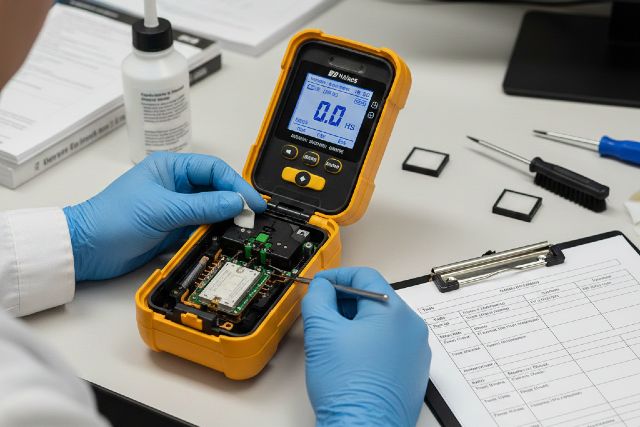

An h2s monitor is only useful if it’s trustworthy in the moment you need it. Hydrogen sulfide (H₂S) is especially dangerous because you can smell it at low levels, but your sense of smell can fade quickly even while the gas is still present. OSHA explicitly warns not to rely on odor due to “olfactory fatigue.” That’s why maintenance isn’t paperwork. It’s part of hazard control.
This article explains how to keep your h2s monitor accurate all year with a practical, field-ready routine. It covers bump tests, calibration strategy, sensor care, storage, documentation, and common troubleshooting scenarios, along with FAQ-style answers that work well for featured snippets.
What accuracy really means for an H2S monitor
Accuracy is more than “it turns on.” In day-to-day safety work, accuracy means the sensor responds to H₂S at the correct concentration, alarms trigger at your setpoints, and the reading is stable enough that you can make decisions quickly. When accuracy slips, it usually doesn’t fail dramatically. It drifts quietly, giving you slower response times or under-reading, which is the most dangerous failure mode because it creates false confidence.
It’s also important to remember that H₂S risk is not theoretical. NIOSH lists hydrogen sulfide as having an IDLH (Immediately Dangerous to Life or Health) value of 100 ppm, which underscores how fast conditions can become life-threatening in certain scenarios.
Bump test vs calibration
A bump test is a quick functional test where you expose the detector to a known concentration of test gas to confirm the sensor responds and the alarms activate. OSHA’s safety bulletin explains that ISEA updated its position statement to recommend a bump test or calibration check before each day’s use, following manufacturer instructions.
Calibration is a more thorough accuracy verification process using certified gas. It may include adjustment if the instrument is outside acceptable limits. Think of bump testing as confirming the detector “can detect,” while calibration verifies it “detects correctly.”
H2S monitor daily maintenance checklist
Daily maintenance is where most preventable failures are caught. The goal isn’t to create extra steps. It’s to avoid stepping into a space with a device that only looks ready.
Start with a fast visual inspection. Look for cracked housings, damaged clips, blocked sensor ports, and any sign of moisture or contamination around the inlet. If the ports are clogged, your sensor can’t “breathe” properly and response time can slow.
Power it on and let it complete its startup checks. If your model displays faults, don’t ignore them because “it usually works.” A sensor fault is the detector telling you it cannot be trusted today.
If your procedure allows a fresh-air zero, do it only in known clean air. This is a subtle but common failure point: if you zero in contaminated air, you can bias readings and reduce safety margin.
Then perform a bump test. OSHA’s bulletin, reflecting ISEA guidance, supports bump testing or calibration checking before each day’s use, following the manufacturer’s instructions. If the unit fails the bump test, remove it from service and run a full calibration or troubleshoot per your program. ISEA guidance also states instruments failing a bump test must be adjusted via full calibration before further use.
Weekly maintenance that prevents slow-response problems
Weekly care is mostly about preventing small buildup and minor wear from turning into a failed bump test on a critical day.
Clean the exterior with the manufacturer-approved method and keep solvents away unless the manufacturer explicitly allows them. In many industrial environments, the bigger issue isn’t visible dirt, it’s fine dust and grime that gradually blocks the gas path.
Check inlet areas and any filters or protective membranes your model uses. If airflow is restricted, the sensor’s response slows, and a “late alarm” is almost as bad as no alarm.
Review any stored logs or recent alarms. Even if readings were “fine,” recurring spikes, unusually frequent alarms, or longer-than-usual time to clear can indicate sensor stress or contamination. If you use a docking station, confirm it’s recording and timestamping correctly so your documentation doesn’t fall apart during an audit.
Monthly maintenance for drift control and confidence
Monthly checks are where a strong program separates itself from a weak one. A detector can pass daily bump tests and still gradually drift, especially if it’s exposed to harsh conditions.
Run a calibration check using certified gas at the concentration your procedure specifies. If it’s outside tolerance, perform a full calibration. If it repeatedly drifts month after month, treat that as a pattern and investigate root causes such as storage conditions, exposure to interferents, clogged filters, or a sensor nearing end-of-life.
This is also a good time to confirm alarm setpoints match your site’s risk assessment and written program. Many teams copy setpoints from an old site policy and never revisit them after work processes change.
Calibration frequency: set it by use conditions, not a calendar guess
There isn’t one “perfect” calibration interval for every site. A detector used occasionally in clean environments has different needs than a unit used daily in wastewater, oil and gas, confined spaces, or agriculture.
OSHA guidance emphasizes following the manufacturer’s instructions and using appropriate test gas for bump tests and accuracy checks. Manufacturer guidance often provides a maximum interval, but real conditions can require more frequent calibration.
For example, a Honeywell BW Clip Real Time operator manual states BW recommends performing a calibration at least once every 180 days (6 months), while noting accuracy depends on calibration gas standard accuracy and calibration frequency. Honeywell guidance documents commonly describe calibration frequency varying from every 30 to 180 days, and calibrating after a failed bump test.
A practical way to set your interval is to start conservative, review performance trends, and then adjust based on evidence. If your units often need adjustment, shorten the interval. If your units consistently pass checks with stable response time, you may be able to extend within manufacturer limits.
Seasonal maintenance: how summer and winter quietly ruin accuracy
Summer problems usually come from humidity, sweat, and heat cycling. When a monitor lives on a worker’s chest in high humidity, the inlet can accumulate moisture and grime faster than you expect. Condensation also happens when you move from air-conditioned vehicles into hot, humid process areas. Moisture can slow diffusion to the sensor and create unstable readings.
Winter issues often involve cold-soak conditions and then rapid warming. That temperature swing can create condensation inside the device. Cold also affects battery performance and can reduce runtime, which matters because low power can create unexpected shutdowns or reduced alarm strength.
A simple habit that helps across seasons is controlled storage. Store detectors in a clean, dry case, away from direct sunlight and extreme temperatures. If you operate in persistent high humidity, use a storage case strategy that reduces moisture buildup, while staying within manufacturer guidance.
Calibration gas and accessories: the maintenance behind the maintenance
Even if your process is perfect, bad gas or poor delivery equipment can undermine results.
Certified calibration gas should be within its expiration date and stored properly. Regulators and tubing should deliver consistent flow. If the flow is inconsistent, your bump test can look like a sensor problem when it’s actually a delivery problem.
If your site uses docking stations, build a quick verification routine. Confirm the dock is configured to your policies, it flags failures clearly, and it retains test records in a way you can actually retrieve later. This reduces “paper compliance” and improves real readiness.
Troubleshooting patterns you should recognize early
If your monitor repeatedly fails bump tests, it’s rarely random. It usually points to one of a few predictable issues.
One common pattern is slow response. If a unit alarms but takes longer than usual to react, suspect restricted gas path, clogged filters, or environmental contamination. Another pattern is frequent calibration adjustments. That can indicate sensor aging, exposure to interferents, or a unit stored improperly between shifts.
If your monitor reads oddly in fresh air, treat that seriously. Don’t “fresh-air zero” your way into silence unless you are confident you are in uncontaminated air, because incorrect zeroing can mask hazards.
When in doubt, follow the manufacturer troubleshooting guide and remove questionable units from service. The cost of downtime is tiny compared to the cost of a missed exposure.
Real-world scenario: how maintenance prevents the most dangerous failure mode
Consider a confined-space entry at a wastewater site on a humid day. The crew performs the daily bump test and one h2s monitor shows a sluggish response. Instead of forcing it into service, they swap it for a verified unit and send the sluggish one for calibration. Calibration confirms it was drifting out of tolerance.
That single maintenance decision avoids the most dangerous failure mode: a detector that appears “working” but under-reads or alarms late. In H₂S environments where smell cannot be trusted, an under-reading monitor can quietly turn a routine job into an emergency. OSHA warns that you can lose the ability to smell H₂S even while it remains present.
FAQs about H2S monitor maintenance
How often should I bump test an H2S monitor? OSHA’s safety bulletin notes ISEA guidance recommending a bump test or calibration check before each day’s use, in accordance with the manufacturer’s instructions.
How often should I calibrate an H2S monitor? Follow your manufacturer’s guidance and adjust based on site conditions. Some manufacturer documentation recommends calibrating at least once every 180 days (6 months), while other guidance notes calibration intervals can vary from 30 to 180 days and should be performed after failed bump tests.
What should I do if my H2S monitor fails a bump test? Remove it from service and perform a full calibration or troubleshooting per your procedure. ISEA guidance states instruments failing a bump test must be adjusted by full calibration before further use.
Can I rely on the “rotten egg” smell to detect hydrogen sulfide? No. OSHA and NIOSH warn that your sense of smell can become rapidly fatigued, so odor cannot be relied upon to warn of continuous presence or harmful levels.
What is the IDLH for hydrogen sulfide? NIOSH lists an IDLH of 100 ppm for hydrogen sulfide.
Conclusion
Keeping an h2s monitor accurate all year is about consistency, not complexity. Daily bump testing aligned with OSHA/ISEA guidance, calibration checks at intervals that match your environment, clean sensor pathways, correct test gas, and disciplined documentation work together to prevent silent drift and false confidence. Because H₂S odor can’t be trusted as a warning and conditions can become life-threatening quickly, maintenance is part of doing the job safely, every season.















Leave a comment