

If your finish line is fighting mysterious bare spots, crescent-shaped contact marks, or parts that slip mid-cure, there’s a good chance the problem isn’t your powder, paint, or oven — it’s your coating hooks. The “small” hardware that holds parts on the conveyor often decides whether you get a smooth, consistent finish or a day full of touch-ups and rework.
That matters because rework isn’t just annoying — it’s expensive. ASQ notes that many organizations see quality-related costs around 15–20% of sales (and sometimes higher), which is why preventing defects upstream is usually the fastest path to profitability.
This guide explains how coating hooks influence contact marks, grounding, slip-outs, and first-pass quality — and how to choose, maintain, and use them so parts come out right the first time.
What are coating hooks?
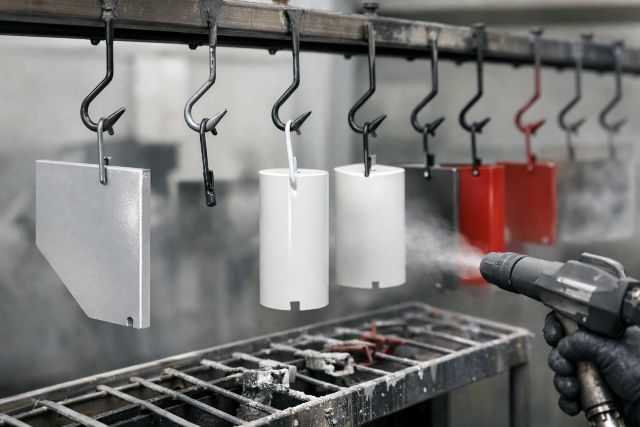
Coating hooks are metal hangers used to suspend parts during powder coating or liquid painting. They’re designed to hold parts securely through the booth and cure cycle, while also controlling where contact happens. In powder coating specifically, they also act as part of the grounding pathway, which directly influences how efficiently powder is attracted to the part.
When hooks are wrong for the job, you typically see three repeating problems: visible hook marks, parts that move or slip, and rework that clogs production.
Why coating hooks create marks on “good” parts
A hook mark is usually the predictable outcome of contact physics, not bad luck. Once you look at it that way, you can control it.
Too much contact area
If the hook sits like a pad against the part instead of making a small, intentional bite, you create a larger uncoated zone. With powder, that shows up as a clean metal “holiday” after cure. With liquid, it can become a thin, weak film area that scuffs easily during handling.
Inconsistent bite pressure
If the hook barely grabs the part, the part can micro-move from booth airflow, conveyor vibration, or thermal expansion in the oven. That micro-movement turns into scuffs, edge rubs, and intermittent contact that can affect powder deposition consistency.
Build-up turns hooks into insulation
Powder or paint build-up changes the hook’s geometry and reduces conductivity where you need metal-to-metal contact. Hook build-up is widely recognized as a contributor to weak grounding and inconsistent results, which is why regular hook and rack cleaning is emphasized in industry guidance.
The practical goal is not to pretend marks can be eliminated. The goal is to make the contact point small, stable, and placed in a non-visible or low-consequence area.
Why parts slip, rotate, or fall during coating
Slipping usually happens for mechanical reasons you can identify quickly once you know what to check.
The hang point fights the part’s center of gravity
If the center of gravity is not directly supported, the part will try to rotate until it finds a new “resting” position. In the booth, airflow can speed this up. In the oven, heat can make it worse by slightly relaxing thin hook wire or softening certain parts enough to shift.
The hook tip doesn’t seat consistently
A smooth edge plus a round hook tip is a recipe for rotation. Without a clear “seat” (a hole, notch, inside corner, or shaped capture point), you get orientation drift. Drift leads to shadowing, contact with adjacent parts, and scuffs after cure.
Build-up creates a false seat
When hooks get thick with coating, they stop sitting where you think they are. The part hangs a little differently each run, and “random” marks appear even though nothing else changed. Cleaning restores repeatability and often solves problems that look like paint or gun issues.
Coating hooks and grounding in powder coating
If you powder coat, grounding is a quality lever, not a technical detail. Powder guns can generate very high electrostatic voltages, and proper grounding is treated as mandatory in electrostatic powder coating systems.
Poor grounding can show up as uneven film build, weaker wrap, and more pronounced coverage problems in recesses and corners.
Faraday “dead zones” get worse with weak ground
The Faraday cage effect is a known phenomenon where charged powder avoids tight recesses and corners because of the way electric fields behave around the part’s geometry. Strong, low-resistance grounding is commonly discussed as part of improving penetration into these difficult areas.
If you see consistent thin film in corners plus random bare spots near hang points, it’s often a clue that the rack-to-hook-to-part contact path is not stable.
Choosing coating hooks for perfect finishes
Hook selection becomes easier when you stop thinking in terms of “one hook fits all” and start matching hooks to three realities: where the mark can live, how the part wants to hang, and how much stability the line demands.
Start with the appearance zone
If the part is cosmetic on all sides, your best strategy is a hidden hang point, such as a hole on a backside flange or an internal feature that won’t be seen after assembly. This turns the unavoidable contact into a non-issue.
If the part has a true hidden edge, you can prioritize stability and grounding more aggressively, because the mark location is already acceptable.
Match hook geometry to the part’s “natural seat”
Parts with holes usually hang more consistently and cosmetically because the contact sits inside a hole where marks are less visible. Parts hung from exposed edges need more care, because even small differences in bite location can show on a face or perimeter.
If the part is tubular, round, or top-heavy, assume you will need anti-rotation thinking. A single-point hang on a round seat invites drift.
Size the hook for load and heat
Hook wire that is marginal at room temperature can relax during cure, especially on heavy parts. When that happens, parts sag, rotate, or settle into contact with adjacent parts. If slips appear more in hot zones, hook strength and shape retention under heat are worth investigating.
Maintenance that prevents marks, slips, and rework
Hook performance degrades gradually, which is why many lines normalize defects until they spike. A simple maintenance rhythm usually stabilizes output.
Keep hooks and racks clean enough to stay conductive
Hook and rack cleaning is repeatedly framed as important because build-up reduces conductivity and degrades coating quality over time.
When you keep contact points consistently metal-to-metal, you reduce “mystery” variation and make your results easier to control.
Replace fatigued hooks before they become intermittent problems
Fatigued hooks lose tension and stop biting the same way. Those are the hooks that create intermittent defects, which are the hardest to troubleshoot because they don’t fail every time.
Standardize hang location and orientation
Even the best hook can’t save a process if operators place it differently on every part. Standard hang locations make defects repeatable. Repeatable defects are fixable defects.
A real-world scenario: improving rejects without changing powder, guns, or ovens
Imagine a line coating welded brackets with a visible front face and a hidden rear flange.
The team sees random bare crescents near the edge, occasional scuffs after cure, and a few parts rotating enough to create booth shadowing.
Instead of changing powder or gun settings, they change the hanging strategy. They move the hang point to a rear flange hole so the mark is hidden, they use a hook style that seats reliably in that hole, and they implement regular cleaning to prevent insulating build-up on hooks and racks.
Once hanging becomes stable and repeatable, defects stop being “random,” and reject rates typically become easier to control. Products Finishing has described many well-run powder operations with reject rates in the 2–8% range, which is a useful benchmark when evaluating whether your line is drifting due to racking and handling variation.
Troubleshooting by defect pattern
Hook marks getting larger over time
This commonly points to build-up increasing contact area or shifting where the hook seats. Cleaning and restoring the original hook tip profile often fixes it faster than any spray adjustment.
Thin film in corners plus occasional bare spots near hang points
This combination often suggests grounding inconsistency and geometry-driven electrostatic effects. Faraday-related coverage challenges are well documented, and grounding quality is frequently discussed as part of improving penetration into recesses.
Parts rotate, sway, or touch each other
This usually indicates a center-of-gravity mismatch or an unstable seat. Moving the hang point, adding a stabilizing contact, or switching to a hook shape that locks orientation is typically more effective than lowering airflow or slowing the line.
FAQ
What are coating hooks?
Coating hooks are metal hangers used to suspend parts during painting or powder coating. They support the part mechanically, control where contact happens, and in powder coating they contribute to the grounding pathway that helps powder deposit correctly.
How do coating hooks cause marks in the finish?
Marks usually happen when the hook contact area is too large, the bite pressure is inconsistent (allowing movement), or coating build-up changes hook geometry and reduces conductivity. Regular cleaning is widely recommended to prevent build-up from degrading quality.
Do coating hooks affect powder coating quality?
Yes. Proper grounding is treated as mandatory in electrostatic powder coating systems, and weak grounding can contribute to uneven deposition and poorer coverage in difficult geometries.
How often should hooks and racks be cleaned?
Often enough that build-up never changes the hook’s seating behavior or insulates contact points. Industry guidance emphasizes that keeping hooks and racks free from coating helps maintain grounding and transfer performance.
Conclusion
Better coating hooks don’t just reduce hook marks — they stabilize the entire finishing process. When hooks seat consistently, hold parts without movement, and maintain clean conductive contact, you get fewer bare spots, less rotation, and far less rework. That matters because quality-related costs can be significant; ASQ notes many organizations see quality costs around 15–20% of sales, so preventing defects at the racking stage can deliver outsized savings.
If you want the biggest improvement with the least disruption, treat coating hooks like precision tooling. Choose them based on where the mark can live, how the part wants to hang, and what your line conditions demand, then maintain them so their geometry and conductivity stay consistent day after day.















Leave a comment