
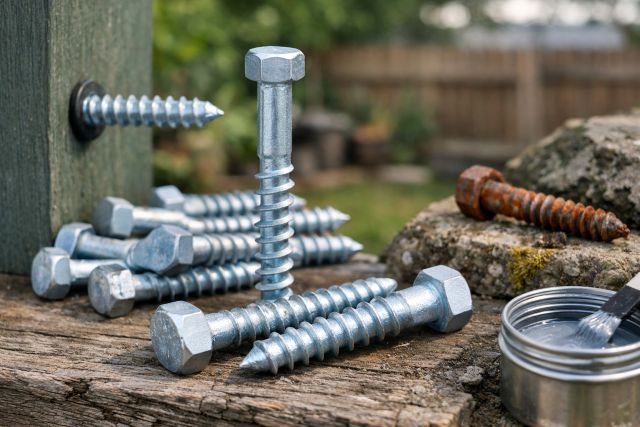

Outdoor builds fail in slow, frustrating ways. A connection loosens, a head stains the wood, or a fastener seizes when you try to service it. Choosing the right lag screws for exterior projects is one of the most important decisions you can make for decks, pergolas, fences, timber frames, and heavy outdoor framing. When lag screws are matched to the environment and installed correctly, they can hold tight for years. When they are mismatched, corrosion can begin early and quietly reduce long-term strength.
This article explains how outdoor corrosion works, which coatings last the longest, how treated lumber changes the equation, and the specific habits that prevent rust and extend service life. You will also find concise, featured-snippet-ready answers to common questions, along with real-world scenarios that make choosing lag screws easier in practice.
What are lag screws?
Lag screws are heavy-duty wood screws with coarse threads designed to clamp wood-to-wood or wood-to-metal connections under high load. They are commonly used in deck ledgers, posts, beams, and structural outdoor framing where strong withdrawal resistance and clamping force matter.
Why lag screws rust outdoors in the first place
Corrosion is not simply “water equals rust.” Outdoors, lag screws face repeated wet-and-dry cycles that reintroduce oxygen and accelerate the electrochemical reaction that creates corrosion. Salt and chlorides multiply the problem, which is why coastal air, pool areas, and salted winter roads are especially hard on fasteners. Chloride ions are aggressive because they attack protective films and speed up metal loss.
Wood chemistry also matters more than most people expect. Pressure-treated lumber and continuously damp wood can be more corrosive to fasteners than dry, untreated lumber. Many connector and fastener manufacturers publish compatibility guidance for treated lumber and exterior exposure, and it is worth following because their recommendations are based on testing and field performance.
There is also galvanic corrosion, which can happen when you mix metals. When dissimilar metals touch in the presence of water, one metal can corrode faster depending on the galvanic relationship and the surface-area balance. This is another reason it is smart to keep your fasteners, washers, and brackets in the same “family” of corrosion resistance when possible.
How coatings protect lag screws outdoors
Outdoor coatings protect lag screws in two key ways. The first is barrier protection, where a coating blocks water and oxygen from reaching steel. The second is sacrificial protection, where zinc coatings corrode first and shield the underlying steel even when the surface is scratched. This sacrificial behavior is one of the primary reasons galvanizing remains so widely used outdoors.
The best-performing systems often combine both approaches. A zinc layer provides sacrificial protection, and a supplemental topcoat improves barrier protection and slows down zinc consumption over time.
Lag screws for outdoor use: best coating and material options
Choosing the right lag screws outdoors comes down to exposure severity. Mild exposure can tolerate many finishes. Heavy rain, frequent wetting, and treated lumber require stronger corrosion protection. Coastal air and salt exposure often push the decision toward stainless steel, especially 316.
Hot-dip galvanized lag screws
Hot-dip galvanizing is a process where steel is coated by immersion in molten zinc, creating a tightly bonded zinc layer. For fasteners, hot-dip coatings are commonly referenced under ASTM standards for zinc coatings and fastener galvanization.
Hot-dip galvanized lag screws are popular because the zinc layer is generally thicker than electroplated zinc and provides sacrificial protection. In many climates, they are a dependable choice for decks, pergolas, and exterior timber connections.
If you want a more concrete way to compare “galvanized” claims, look for products that reference recognized specifications. As one example of how manufacturers define robust galvanization, Simpson Strong-Tie describes ASTM A153 Class C galvanization as having a minimum average zinc coating amount of 1.25 oz/ft² for certain fastener applications.
Hot-dip galvanized lag screws can still be consumed faster in harsh salt environments. The expected life depends heavily on the local corrosivity category, which is why resources like the American Galvanizers Association discuss coating life in relation to environmental exposure categories.
Mechanically galvanized lag screws
Mechanical galvanizing is another zinc-coating method commonly used for fasteners, with specifications referenced under ASTM B695.
Mechanically deposited zinc coatings can be specified by thickness class and are sometimes paired with additional coatings to improve corrosion performance. In practice, these systems can perform very well outdoors when they are part of a manufacturer-recommended connector-and-fastener system.
Zinc-plated lag screws
Electroplated zinc, often marketed as simply “zinc-plated,” is widely available and inexpensive. The tradeoff is that the zinc layer is typically thinner than hot-dip galvanizing. In protected outdoor areas, zinc-plated lag screws may perform acceptably. In full weather exposure, wet lumber, or high-corrosion environments, they are usually not the best choice.
Salt spray testing is commonly used to compare finishes, including ASTM B117. While it does not perfectly predict real-world life, it provides a standardized way to compare corrosion resistance under controlled conditions. Triangle Fastener describes ASTM B117 as a controlled 5% salt fog environment used to compare finishes by the time to corrosion.
If a listing only says “zinc-plated” with no additional performance data, assume it is best suited to lighter exposure unless proven otherwise.
Zinc plus polymer topcoat systems
Many modern exterior lag screws use a zinc base layer plus an organic or polymer topcoat. This type of system improves barrier protection and reduces zinc consumption, which can extend practical service life in typical outdoor conditions.
Manufacturers frequently publish their own corrosion guidance and salt spray results for coated fasteners. For example, Strong-Drive/Simpson literature discusses corrosion levels and reports performance results for certain coated fasteners in ASTM B117 testing.
These coated systems can be a great balance for many outdoor projects because they often drive smoothly, resist staining, and are designed with treated lumber compatibility in mind when used as intended.
Stainless steel lag screws
Stainless steel is often the best option when the environment is heavily corrosive, especially in coastal zones, marine air, or chlorine-exposed areas like pools. The most important distinction is stainless grade. Multiple industry sources note that 316 stainless includes molybdenum, which improves resistance to chlorides and typically makes it a better choice than 304 in coastal or salt-heavy conditions.
Stainless is not invincible. Crevice corrosion can occur in constantly wet, low-oxygen crevices, and stainless can interact galvanically with other metals if mixed. Still, for many outdoor builds where longevity and appearance matter, stainless lag screws are a premium option that can reduce rust staining and long-term corrosion risk.
How to choose the right lag screws by environment
For a covered patio or low-rain exposure, a quality coated system may be adequate, especially if the wood stays mostly dry. For general weather exposure with rain and snow, hot-dip galvanized lag screws are often a durable and cost-effective choice, particularly when matched with compatible washers and brackets.
For treated lumber that gets wet regularly, it is smart to rely on manufacturer compatibility guidance and use a corrosion-resistant finish intended for that use, such as hot-dip galvanized or a tested coated system recommended for treated lumber.
For coastal, marine, poolside, or salted-road environments, 316 stainless is frequently the best choice because chloride exposure can consume zinc coatings faster and cause earlier staining or corrosion.
Installation habits that prevent rust and extend lag screw lifespan
Even excellent lag screws can fail early if installation damages the coating or creates moisture traps. A correct pilot hole reduces driving torque, reduces heat, and helps prevent splitting. It also lowers the risk of scraping protective coatings off the shank and threads during installation. When driving feels like it is binding, backing the screw out, clearing debris, and re-driving can prevent coating damage.
Washer use is another practical longevity habit. A washer spreads load, reduces wood crushing, helps connections maintain clamping force as wood moves, and can reduce the chance that the fastener head grinds into the surface during tightening. At the same time, be mindful of water traps. The goal is a snug, properly seated head and washer, not an over-tightened joint that creates crushed wood fibers and small pockets that hold water.
Design details matter as much as metal choice. If you can prevent standing water near fastener heads by adding slopes, drip edges, and small drainage gaps where appropriate, you reduce wet-time. Corrosion is driven by time-of-wetness, so every design decision that helps the assembly dry faster supports longer service life.
Mixing metals should be minimized. Keeping your lag screws, washers, and connectors in the same corrosion resistance class helps prevent premature problems, and manufacturer guidance often emphasizes using matching or compatible hardware for the exposure level.
Real-world scenarios where lag screw choice matters
Imagine a pergola in a rainy but inland climate. It gets wet often, but salt is not a major factor. In that case, hot-dip galvanized lag screws with compatible washers and brackets are typically a strong choice because the thicker zinc layer provides sacrificial protection during repeated wet-and-dry cycles.
Now imagine a poolside structure where wind carries chlorinated moisture and the area stays damp. This is where many coatings that perform well inland can disappoint, and 316 stainless lag screws often become the more predictable long-term solution.
Finally, consider a deck ledger connection into treated lumber. It is structural, hard to inspect, and exposed to moisture. For these applications, many builders follow connector manufacturer guidance so that the fasteners and connectors are designed and tested to work together in the expected exposure and wood chemistry.
Frequently asked questions about lag screws outdoors
Are galvanized lag screws good for outdoor use?
Hot-dip galvanized lag screws are commonly a dependable outdoor choice because the zinc layer provides barrier protection and sacrificial protection, which helps even when minor scratches occur during installation.
What lasts longer outdoors, galvanized or stainless lag screws?
In mild and moderate exposure, hot-dip galvanized lag screws can last a long time and often provide good value. In chloride-heavy environments like coastal air and pool areas, 316 stainless often lasts longer because it has improved chloride resistance compared with 304 and many zinc-coated systems.
Can I use zinc-plated lag screws outside?
You can in light exposure or protected areas, but zinc-plated usually means a thinner coating than hot-dip galvanized. For full weather exposure, wet lumber, or harsh environments, hot-dip galvanized or a manufacturer-rated coated system is typically a safer pick. Salt spray testing such as ASTM B117 is often used to compare finishes, even though it is not a perfect real-world predictor.
Do lag screws rust faster in pressure-treated wood?
They can, depending on moisture and preservative chemistry. That is why manufacturer compatibility guidance for treated lumber and exterior exposure is valuable when selecting corrosion-resistant fasteners and connectors.
How do I prevent rust around lag screw heads?
Use an appropriate pilot hole to reduce coating damage, avoid over-torquing, use washers to distribute load, design surfaces so water does not pool, and avoid mixing incompatible metals. In salt or chlorine exposure, upgrading to 316 stainless often reduces long-term staining and corrosion risk.
Conclusion
The best lag screws for outdoor use are the ones that match your environment, your lumber type, and your long-term expectations. Inland projects with typical rain exposure often do well with hot-dip galvanized lag screws or a proven coated system, especially when hardware is matched for compatibility. Treated lumber and frequent wetting push you toward finishes and systems specifically recommended for that chemistry and exposure. Coastal and chlorine-heavy areas often justify 316 stainless because chloride exposure can overwhelm many coatings over time.
When you combine the right material choice with smart installation habits, lag screws stay stronger, cleaner, and easier to service later. The result is not just fewer rust stains, but a safer, longer-lasting outdoor build that holds up through real weather year after year.













Leave a comment