
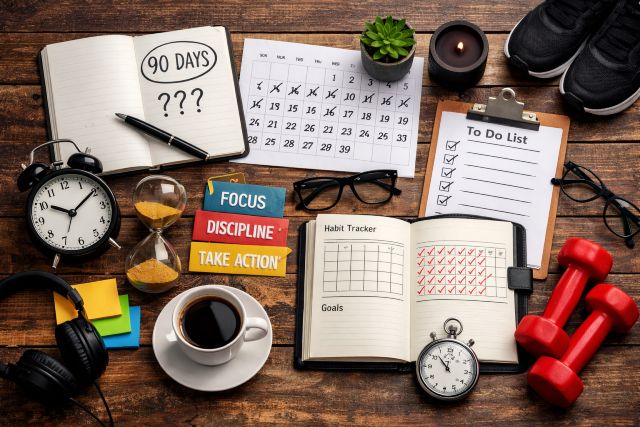

If you’ve ever started a new routine with energy and then watched it fade by week two, you’re not broken. You’re human. The missing piece usually isn’t information, it’s follow-through. That’s why days questions can be surprisingly powerful: the right question doesn’t hype you up, it makes you choose, and choices create consistent actions.
A 90-day window is long enough for real change to show up in your calendar, your output, and your self-trust. It also aligns with what habit research actually suggests. In a widely cited habit-formation study, the average time to reach a plateau of automaticity was about 66 days, and it varied by person and behavior. That means your “I should have this figured out by day 21” expectation is often the real problem.
This guide gives you a complete 90-day question system to transform productivity and discipline, with a simple way to use it daily so you don’t depend on mood. You’ll also see the research behind why it works, plus examples that make it feel realistic rather than motivational.
What “days questions” really are and why they work
Days questions are daily prompts that force clarity about what matters, what’s in the way, and what you’ll do next. They work because they shift you from vague intention to concrete action. Instead of “I’ll try to be disciplined,” you ask, “What is the smallest next step I will do today, even if I’m not motivated?”
There’s a strong research base for this style of self-regulation. One of the most effective tools is “if–then planning,” also called implementation intentions. The core idea is simple: you pre-decide what you’ll do in a specific situation, such as “If I feel the urge to scroll, then I will stand up and refill water first.” Meta-analytic work has found implementation intentions reliably improve goal achievement, often with meaningful effect sizes.
In other words, good questions don’t just help you reflect. They help you plan responses to real-life friction before friction shows up.
The 90-day structure that builds discipline without burnout
Think of these 90 days as three phases that stack on each other.
Days 1–30: Awareness and honesty
This phase is about seeing your patterns without judgment. You identify what you avoid, when your energy drops, and which “busy” activities don’t produce real results. You build the foundation: clarity.
Days 31–60: Systems and strength
Now you design a repeatable system that survives chaos. You reduce distractions, simplify planning, and create reliable start rituals. This is where you stop relying on motivation and start relying on structure.
Days 61–90: Identity and durability
In the last phase, discipline becomes less about force and more about identity. You practice recovery after bad days, protect your boundaries, and lock in what works so it lasts beyond the 90-day mark.
This sequencing matters because discipline is easier when you stop treating every day like a fresh willpower test. You build decision rules that run even when your brain is tired.
How to use this system daily in 10 minutes
Open a note (or a journal) and answer one question in 3–5 sentences. Then write one action you’ll do immediately after closing the note. If you want an easy rhythm, do one question in the morning and one in the evening, but you can also keep it to one per day and still get results.
If your biggest issue is starting, pair the question with a timed focus sprint. Break-structured work methods like Pomodoro are popular, and research continues to evaluate how different break strategies affect fatigue, motivation, and task completion. You don’t need a perfect method; you need a repeatable one.
Days Questions: the full 90-day set (use one per day)
Use these in order, or repeat the ones that hit your real problems the hardest. The point is not to answer perfectly. The point is to answer honestly and then act.
Days questions for clarity and baseline (Days 1–30)
Day 1 asks: What does “productive” actually mean for me this week?
Day 2 asks: What am I avoiding, and what is it costing me?
Day 3 asks: What are my top three outcomes for the next 30 days?
Day 4 asks: What distractions steal the most time from me?
Day 5 asks: When do I feel most focused, and why?
Day 6 asks: What do I do that looks like work but isn’t?
Day 7 asks: What’s one commitment I keep breaking, and what triggers it?
Day 8 asks: What would make today a win, even if nothing else happens?
Day 9 asks: What’s my biggest friction point when starting tasks?
Day 10 asks: What is one habit I’m ready to stop negotiating with?
Day 11 asks: What time of day is my brain sharpest?
Day 12 asks: What drains my energy faster than I admit?
Day 13 asks: What’s one environmental change that would make focus easier?
Day 14 asks: What’s my most common excuse, and what’s behind it?
Day 15 asks: What do I do right before I procrastinate?
Day 16 asks: What is one thing I can remove to reduce distraction today?
Day 17 asks: What is my minimum viable effort on a bad day?
Day 18 asks: What sleep or food choice affects my discipline most?
Day 19 asks: Where do I lose time in tiny gaps, like checking or switching?
Day 20 asks: What would I do if I couldn’t rely on motivation?
Day 21 asks: What are the two or three tasks that truly move my goals forward?
Day 22 asks: What will I say no to today to protect focus?
Day 23 asks: What’s the first step so small I can’t refuse it?
Day 24 asks: If today goes off track, what is my recovery plan?
Day 25 asks: What is one if–then plan I can set for my biggest distraction? This is implementation intention thinking in action.
Day 26 asks: What is my single most important time block today?
Day 27 asks: What do I keep overcomplicating?
Day 28 asks: What can I automate, template, or systemize?
Day 29 asks: What does “done” look like for my most important task?
Day 30 asks: What pattern did I discover about myself this month?
Days questions for productivity systems (Days 31–60)
Day 31 asks: What would happen if I worked on one priority for 60 minutes uninterrupted?
Day 32 asks: What’s my biggest source of task-switching today?
Day 33 asks: What is a realistic schedule I can actually keep?
Day 34 asks: Which tasks deserve my best hours, and which don’t?
Day 35 asks: What tool or notification is quietly breaking my attention?
Day 36 asks: What boundary do I need to set to protect deep work?
Day 37 asks: What is my start ritual that takes two minutes or less?
Day 38 asks: How can I make the right action easier than the wrong one?
Day 39 asks: What’s one commitment I can pre-decide with an if–then plan?
Day 40 asks: What did I do this week that I should repeat next week?
Day 41 asks: When pressure hits, what habit collapses first?
Day 42 asks: What do I do when I feel behind, and does it help?
Day 43 asks: What is the smallest non-negotiable that keeps my identity strong?
Day 44 asks: How do I talk to myself when I slip, and is it useful?
Day 45 asks: What would consistency look like at 70% effort?
Day 46 asks: What distraction can I add friction to today?
Day 47 asks: What triggers impulsive choices in my day?
Day 48 asks: What is the most effective break for me: walk, water, stretch, silence? Research on break-taking strategies continues to examine outcomes like fatigue and task completion.
Day 49 asks: What’s one win I keep dismissing that I should credit?
Day 50 asks: What would I do differently if I trusted my system?
Day 51 asks: What should I track weekly to improve without obsessing?
Day 52 asks: What is my lead measure (effort) versus lag measure (result)?
Day 53 asks: What is one habit that improves everything else?
Day 54 asks: Where am I trying to be perfect instead of consistent?
Day 55 asks: What would good enough look like today?
Day 56 asks: What is my biggest time leak, and what rule will stop it?
Day 57 asks: What does my calendar reveal about my real priorities?
Day 58 asks: What is one thing I can batch to reduce mental load?
Day 59 asks: What will I do when I don’t feel like doing anything?
Day 60 asks: What system is working best for me, and why?
Days questions for identity and long-term discipline (Days 61–90)
Day 61 asks: What kind of person am I becoming through my daily choices?
Day 62 asks: What promise can I keep today to build self-trust?
Day 63 asks: What does discipline look like when nobody is watching?
Day 64 asks: What do I want to be known for, to myself?
Day 65 asks: What’s one hard thing I can do today to strengthen identity?
Day 66 asks: What habit now feels more automatic than day 1? Remember that habit automaticity often takes longer than people expect, with averages around 66 days in classic findings.
Day 67 asks: What do I do that future-me will thank me for?
Day 68 asks: What do I do that future-me will resent?
Day 69 asks: What boundary protects my peace and performance?
Day 70 asks: What old story about myself needs to be retired?
Day 71 asks: What usually knocks me off track, and what’s my prevention plan?
Day 72 asks: What is my 24-hour reset protocol after a bad day?
Day 73 asks: What does burnout feel like early, and what are my warning signs?
Day 74 asks: What is one stressor I can reduce or reframe this week?
Day 75 asks: When I’m tired, what is my minimum standard?
Day 76 asks: What’s one supportive habit that makes discipline easier?
Day 77 asks: How can I make tomorrow simpler for myself?
Day 78 asks: What does rest mean for me, not avoidance?
Day 79 asks: What lesson are my recent failures trying to teach me?
Day 80 asks: What would I do if I assumed setbacks are part of the process?
Day 81 asks: What are the top three habits that changed my productivity most?
Day 82 asks: What is the next level-up: skill, system, or environment?
Day 83 asks: What should I stop doing to protect what I built?
Day 84 asks: What will I do weekly to maintain momentum?
Day 85 asks: What do I need to simplify so I don’t relapse into chaos?
Day 86 asks: What is the easiest way to restart when life gets messy?
Day 87 asks: What if–then plans should I keep permanently?
Day 88 asks: What would I tell someone building discipline from scratch?
Day 89 asks: What proof do I now have that I can follow through?
Day 90 asks: What is my next 90-day commitment, and what is my first step?
A realistic example: turning one question into discipline
Imagine you’re a freelancer with a big client deadline, or a student with exams coming. You keep “planning to start,” then you don’t. On Day 23, the question is: “What’s the first step so small I can’t refuse it?”
You answer: “Open the document and write one sentence.” That’s it.
Here’s the surprising part. Even if you stop after one sentence, you win because you proved you can start. Starting is the gateway behavior that makes everything else easier. When you repeat that daily, your identity shifts from “I procrastinate” to “I begin, even when I don’t feel like it.”
Common user questions and quick answers
People often ask whether daily prompts are “just journaling.” They aren’t, unless you keep them vague. A days-questions practice is decision-making plus action.
People also ask how long it takes to feel disciplined. Discipline often feels better once actions become easier to initiate, and habit research suggests automaticity can take weeks to months, not days.
Another common question is whether timed focus sessions help. They can, especially when paired with a question that clarifies the one priority you’re protecting. Research continues to map how structured break techniques, including Pomodoro-style intervals, influence outcomes like fatigue and task completion in specific contexts.
Conclusion: make the next 90 days inevitable
If you want a real transformation, stop demanding constant motivation and start building consistent decisions. Days questions give you a simple daily structure to notice what’s happening, choose what matters, and take a concrete step.
Over 90 days, you don’t just get more done. You build self-trust. You build systems that survive bad moods. You build the identity of someone who follows through, because you practiced follow-through one day at a time.

















Leave a comment