
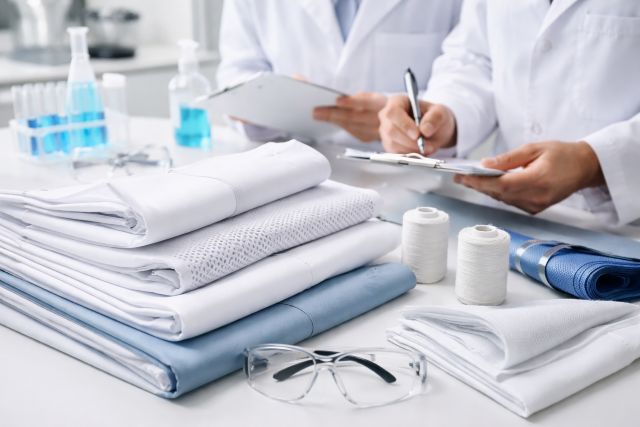

A lab coat is more than a uniform. It’s a piece of personal protective equipment that helps reduce exposure when spills, splashes, or contamination happen. And the fabric you choose changes everything: how comfortable you feel during a long shift, how quickly liquids soak through, whether the coat melts near heat, and how well it survives repeated laundering. That’s why major lab safety guidance stresses selecting a task-appropriate lab coat based on a risk assessment, not just preference or price.
If you’ve ever wondered why one lab coat feels breathable while another feels stiff and hot, or why some coats seem to “drink up” splashes, you’re really asking a materials question. The best fabric is the one that matches your hazards and work patterns, while staying wearable enough that you actually keep it on.
Why lab coat fabric is a safety choice, not a style choice
OSHA’s PPE requirements are clear that protective equipment must be provided, used, and maintained in a sanitary and reliable condition wherever workplace hazards make it necessary. In labs, those hazards can include chemical exposure, biological agents, and physical risks like heat or flames. NIH’s lab coat guidance and related safety communications reinforce that the “right” lab coat is the one selected for the task based on risk assessment.
Fabric determines four practical outcomes that show up in real work:
First, comfort and heat control. A coat that traps heat is the coat people “forget” to wear.
Second, barrier behavior. Some materials absorb splashes fast; others repel and bead.
Third, thermal performance. Some fibers melt and stick when exposed to heat, which can worsen injuries.
Fourth, durability and care compatibility. Your coat is only protective if it stays intact, clean, and functional after repeated washes.
That’s why “best fabric” depends on your dominant hazard, your laundering process, and the environment you work in.
Lab coat fabric basics: what “good material” really means
When manufacturers describe lab coat material, they usually talk about fiber content: cotton, polyester, blends, or specialty fibers. But performance is also influenced by weave, weight, and finishes.
A tighter weave can slow liquid penetration compared with a looser one. A heavier fabric can be more durable but may trap heat. A fluid-repellent finish can make splashes bead up, but repeated laundering may reduce that effect over time, which matters if you rely on repellency for routine splash work.
The most useful mental model is simple: fiber controls how the coat behaves under heat and how it feels; weave controls how easily liquids and particles pass through; finishes control how the surface reacts to splashes and contamination.
The most common lab coat materials and what they’re best for
100% cotton lab coats: breathable comfort with better heat behavior
Cotton lab coats are popular because they feel breathable and comfortable, especially in warm labs or long shifts. Cotton generally won’t melt like many synthetics, which is a meaningful advantage in environments where heat sources exist. That doesn’t automatically make cotton the safest choice for every lab, but it is a strong point when your work includes open flames or hot equipment.
The trade-off is that cotton absorbs liquids readily. If you work with frequent aqueous splashes or chemicals that can soak through, cotton can hold that liquid against the skin longer than a repellent-treated fabric would. NIH’s lab coat selection guidance emphasizes matching coat type to hazards, which is exactly where cotton’s comfort has to be weighed against splash behavior.
A realistic scenario helps here. Imagine you’re in a teaching lab doing low-risk procedures most of the day, but you occasionally handle corrosive cleaning solutions. A cotton coat may feel great for the lecture and bench time, but if you’re the one rinsing and wiping down at the end, you may prefer a coat with better splash resistance for that task. The “best” choice may even be having two coat types depending on work zones and procedures.
Poly-cotton blends: the durable workhorse for routine lab environments
Poly-cotton blends are common because they tend to resist wrinkles, hold shape, and survive repeated laundering well. In high-throughput environments such as clinical labs, durability matters because lab coats get washed often and replaced on schedules. Blends can also feel lighter than heavy cotton, depending on fabric weight and weave.
The key caution is heat. Polyester is a thermoplastic fiber, meaning it can melt at high temperatures. If your lab work includes open flames, spark risk, or higher heat exposure, a polyester-heavy coat may be a poor match. This is exactly why guidance documents and PPE toolkits stress selection based on hazards and risk assessment rather than convenience.
Blends make sense when your work is routine and your primary goals are cleanliness, durability, and all-day wear, without meaningful flame risk. They’re often a “default” choice in settings where coats are professionally laundered and replaced regularly.
100% polyester lab coats: easy care, but not for heat-prone tasks
All-polyester coats can look crisp and can dry quickly. They may be used in low-hazard areas, visitor situations, or roles where the coat is worn briefly and laundering convenience is the priority.
Still, it’s worth repeating the heat concern. If there’s a realistic chance of exposure to flames or high heat sources, polyester’s melting behavior can be a safety drawback. Even if your lab rarely uses flames, think about the exceptions, not just the routine.
Flame-resistant lab coats: when you need more than “doesn’t melt”
If your work includes meaningful flame risk, “natural fiber” is not the same as “flame resistant.” Flame-resistant lab coats use FR-treated fabrics or inherently FR fibers designed to resist ignition and self-extinguish. They’re chosen when the hazard profile justifies that extra layer of protection.
The most practical way to decide is to look at your lab’s hazard assessment and ask one question: if a flash event occurred, would melting, ignition, or sustained burning meaningfully change injury outcomes? If yes, a certified FR option should be part of the conversation. Risk-assessment-driven selection is emphasized in NIH guidance for lab coat choice and in broader PPE training resources.
Fluid-resistant and barrier-focused fabrics: better for frequent splashes and contamination control
In clinical and public health labs, splash and contamination control often move to the top of the list. CDC’s PPE Toolkit for laboratories is built around CDC recommendations and OSHA PPE standards and is intended to guide PPE choices and training. In those settings, a lab coat may overlap conceptually with protective apparel used in healthcare, where liquid barrier performance is often classified using recognized standards.
For example, ANSI/AAMI PB70 establishes a classification system for protective apparel in healthcare based on liquid barrier performance, and CDC’s PPE-Info standards page summarizes that purpose. FDA also lists ANSI/AAMI PB70:2022 in its recognized consensus standards database, describing its scope around barrier performance and classification for protective apparel.
That doesn’t mean every lab coat needs AAMI-level classification. It means if your lab coat is marketed as “fluid resistant” or “barrier,” you should look for what performance claims it can actually support, and how those claims hold up after repeated laundering.
How to choose the best lab coat material by hazard type
A good decision starts with your dominant hazard, then checks secondary hazards and comfort constraints.
If chemical splash is your main risk, prioritize fabrics and finishes that resist wetting and slow penetration. Tight weaves and repellency finishes can help, but you should also think about garment design and coverage. Some institutions publish detailed lab coat selection and care guidance that emphasizes choosing the right protection level for the specific work.
If heat or flame exposure is plausible, prioritize flame-resistant options and avoid polyester-heavy fabrics for those tasks. Cotton may feel safer than polyester around heat, but FR garments are a different category designed specifically for that hazard.
If biological exposure and contamination control are the main drivers, prioritize coats that support safe donning and doffing, maintain coverage at the wrists, and fit properly so sleeves don’t ride up. CDC’s lab PPE resources include training and job aids that reinforce correct use of lab PPE, including lab coats, in routine lab procedures.
If static control or low-lint requirements exist, fabric selection becomes as much about finishes and construction as fiber content. In those cases, “lab coat material” is shorthand for a broader spec that includes static dissipation and lint behavior.
Comfort factors that make people actually wear the lab coat
The most protective lab coat is useless if people remove it because it’s uncomfortable. Comfort is a safety issue because it influences compliance.
Breathability is the big one. Cotton tends to feel airy, while some barrier-focused fabrics can trap heat. If you’re in a warm environment, you may need to balance barrier performance with ventilation features and fabric weight. Fit and mobility matter too. A coat that binds at the shoulders makes reaching awkward, and that leads to rolled sleeves or partially open closures, both of which reduce protection.
Skin feel is another practical detail. Rough fabrics and stiff seams can lead to irritation during long shifts, which again increases the chance that people wear the coat incorrectly.
Design details that matter as much as fabric
Even with the perfect material, design choices determine exposure pathways.
Sleeve coverage is a frequent weak point. If cuffs don’t stay near the wrist, gloves can gap during movement. Some guidance documents specifically call out cuffed sleeves as a contamination-control benefit in biological or microbiology contexts, because they help prevent cuffs from contacting samples and surfaces.
Closures matter because they influence how quickly you can remove the coat in an emergency and how completely the front is covered during routine work. Length matters because it controls coverage area, especially when seated or leaning forward over a bench.
In practice, the best approach is to view “fabric + design + correct use” as one system. CDC’s PPE training resources reflect that mindset by combining selection guidance with donning and doffing education.
Lab coat care: the factor that quietly changes protection
A lab coat’s performance changes over its life. Repellent finishes can diminish. Fabric can thin at elbows and cuffs. Chemical staining can indicate contamination embedded into fibers.
OSHA’s PPE requirements include maintaining PPE in a sanitary and reliable condition. That’s the principle behind many lab policies that prefer controlled, professional laundering rather than home washing, especially when contamination is possible. If your coat can carry chemical residues or biological agents, washing it at home can create unnecessary exposure risks outside the lab.
If you want a simple replacement rule, think function-first. If the fabric is thinning, closures fail, stains persist after proper laundering, or liquids start soaking in quickly when they used to bead, the coat is no longer performing as intended.
FAQs about lab coat fabrics
What is the best fabric for a lab coat?
The best fabric for a lab coat depends on your hazards. Cotton is breathable and generally better around heat, blends are durable for routine work without flame risk, and FR or barrier-oriented materials are best when flame exposure or frequent splashes are part of the job. Risk assessment is the recommended starting point for selecting a task-appropriate lab coat.
Is 100% cotton safer than polyester in a lab?
Cotton is often safer around heat because it is less likely to melt, while polyester can melt at higher temperatures. But cotton can absorb and hold splashes, which can prolong skin contact in some chemical spill situations. “Safer” depends on whether heat exposure or splash exposure is the bigger risk in your work.
Do “fluid-resistant” lab coats actually work?
They can, but it depends on the fabric, the finish, and whether the coat’s performance is supported by standardized testing. Barrier classification systems like ANSI/AAMI PB70 exist for protective apparel in healthcare settings, and FDA recognizes the PB70 standard in its database. For lab coats marketed with barrier claims, it’s smart to ask what tests support those claims and how laundering affects them.
How often should a lab coat be washed?
Wash frequency depends on your lab’s contamination risks and policies, but PPE principles require that protective clothing be maintained in a sanitary and reliable condition. If a lab coat is visibly soiled or exposed to hazardous material, it should be cleaned promptly using approved methods.
Conclusion: pick a lab coat fabric that matches your hazards and your workday
Lab coat material matters because it changes both comfort and protection. Cotton lab coats often feel best and behave better around heat, but they can absorb splashes. Poly-cotton blends last longer and launder well, but they may be a poor fit for flame-risk tasks. FR and barrier-focused fabrics are worth it when your hazards justify them, especially in settings with credible flame exposure or routine splash and contamination risks.
The simplest way to make the right choice is also the most defensible: start with a risk assessment, select a lab coat fabric and design that fits the hazards, and maintain it so it stays sanitary and reliable over its lifespan. That approach aligns with OSHA’s PPE expectations and with major lab safety guidance on choosing task-appropriate lab coats.
















Leave a comment