
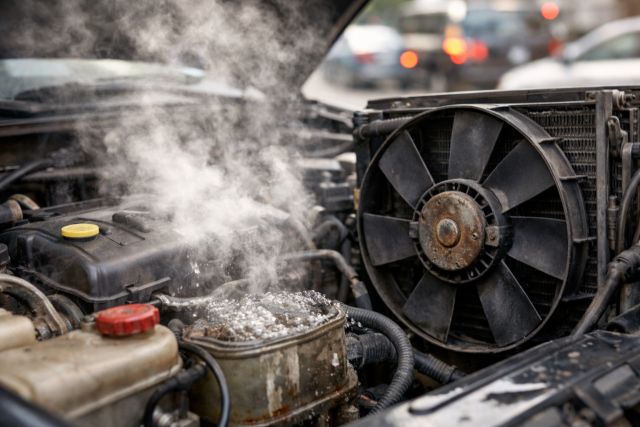

If your radiator fan turns on late, you’ll often notice a very specific pattern: the temperature gauge creeps up while you’re sitting at a stoplight, stuck in traffic, or idling with the A/C on—then it suddenly drops once the fan finally kicks in or you start driving again. That “overheats at idle but cools while moving” behavior is a classic sign that your cooling system is struggling when it has the least natural airflow.
At speed, air is forced through the radiator by forward motion (sometimes called “ram air”). At idle, that airflow disappears, so your engine depends heavily on the radiator fan, coolant circulation, and accurate temperature control. When the fan’s activation is delayed — even by a small margin — heat can spike quickly, especially in hot weather or with the A/C running.
What “Radiator Fan Turns On Late” Actually Means
A “late” fan isn’t always a faulty fan. Many modern vehicles are calibrated to let coolant temperature rise into a normal operating range before switching the fan on, and the fan can also be controlled differently depending on A/C demand and emissions strategy. It’s common for fan operation to begin around the low-200°F range on many vehicles, though the exact point varies by design and conditions.
So the practical definition of “late” is not “the fan waited longer than I expected.” It’s “the fan waited long enough that the engine temperature couldn’t stay stable at idle.”
If your temperature rises gradually to normal and then stays steady, the fan cycling on and off can be perfectly normal. If the gauge climbs beyond normal, approaches the red zone, or triggers warnings before the fan engages, then the activation is effectively “late” for your current cooling system health and environment.
Why Engines Overheat at Idle More Than at Speed
Idle is the worst-case scenario for radiator heat rejection. With little to no vehicle motion, there’s no strong airflow through the radiator unless the fan is pulling it. Under-hood temperatures also build as heat accumulates around the engine bay, which makes the cooling system work harder.
That’s why fan issues, airflow restrictions, and weak coolant circulation reveal themselves most clearly in stop-and-go driving. Many automotive diagnostic resources point to the cooling fan and its control circuit as a top suspect when overheating happens mainly at idle.
Radiator Fan Turns On Late: The Most Common Causes
Weak fan motor or worn fan assembly
A fan can technically “work” and still be ineffective. A tired motor, worn brushes, dragging bearings, or damaged blades can reduce airflow so much that the system can’t catch up until the temperature has already climbed too high. At highway speeds, you may not notice because forward motion forces air through the radiator. At idle, the weakness is exposed immediately.
A common real-world clue is when the fan comes on, but the temperature continues climbing at a stoplight. Another clue is a fan that sounds quieter than it used to, starts slowly, or runs inconsistently. Repair guides emphasize that a non-working or underperforming fan can lead to rapid overheating because passive airflow at idle is not enough.
Failing relay, fuse, wiring, resistor, or fan control module
Electrical issues often create the “late” symptom because the fan doesn’t engage when commanded, or it engages only after multiple attempts. Relays can degrade internally and become intermittent. On systems with multi-speed fans, a failed resistor or module can remove low-speed operation, leaving only high-speed. That makes it feel like the fan “turns on late,” because the remaining high-speed stage tends to kick in at a higher threshold.
Electrical causes such as relays, fuses, wiring faults, and modules are frequently cited as common reasons the fan doesn’t operate when it should.
Coolant temperature sensor problems
Modern vehicles rely on the coolant temperature sensor (often called the ECT sensor) to decide when to activate the fan. If the sensor reads cooler than reality, the ECU delays fan operation. This can be especially confusing because some vehicles use different signals for the dash gauge and for ECU control, so the gauge can look hot while the ECU still believes things are normal.
If you can view live data with an OBD2 tool, comparing the displayed coolant temperature to what you’d expect from the gauge and symptoms can quickly reveal a sensor that is lying or unstable.
Low coolant, air pockets, or improper bleeding
Low coolant reduces the system’s ability to move heat away from the engine. Air pockets can also distort temperature readings and reduce heat transfer, sometimes causing odd swings where the fan response doesn’t seem to match what you’re seeing on the gauge. This situation often appears after a coolant flush, hose replacement, radiator work, or any repair that introduced air into the system.
Many resources discussing idle-only overheating list low coolant and trapped air as common underlying causes.
Sticking thermostat or delayed opening
A thermostat that opens late or doesn’t open fully can cause the engine to run hotter than normal at idle. If hot coolant isn’t flowing properly to the radiator, the radiator cannot shed heat effectively, and the fan may not have enough “cooling leverage” even when it turns on. In some vehicles, sensor placement can also influence whether the ECU “sees” the heat early enough to command the fan.
Restricted airflow through the radiator and condenser
Even a perfectly timed fan can’t cool what it can’t breathe through. Dirt, bugs, leaves, bent fins, debris between the condenser and radiator, or partially blocked ducting can reduce the volume of air passing through. With the A/C on, the condenser adds heat to the air stream before it reaches the radiator, which can intensify idle overheating.
Weak radiator cap or loss of system pressure
Cooling systems depend on pressure to raise the coolant’s boiling point. If the radiator cap is weak and pressure drops, coolant can boil earlier, creating steam pockets that reduce cooling efficiency. One widely cited rule-of-thumb is that pressure raises boiling point by about 3°F per psi, meaning a typical 15 psi cap can significantly increase the temperature at which coolant boils.
When boiling begins, temperature can climb quickly at idle even if the fan eventually kicks on, because vapor doesn’t carry heat like liquid coolant does.
Quick, Safe Checks You Can Do Without Special Tools
A practical first check is to see whether the fan runs when you turn the A/C on. Many vehicles command the fan on (or sooner) with A/C to keep condenser pressures stable. If your A/C is on and the fan never runs, it strongly suggests an electrical control issue, a failed fan motor, or wiring/connector problems.
Another useful observation is whether your vehicle seems to have two stages of fan speed. If the fan never runs gently or at a lower speed but suddenly roars loudly only when the gauge is already high, that can indicate low-speed failure, which often presents as “late” fan operation.
You can also judge airflow strength carefully. With the hood open and keeping hands, tools, and clothing away from moving parts, you should feel a strong pull of air when the fan is running. If airflow is weak, the motor or blades may be the real problem even though the fan “turns on.”
Finally, do a visual inspection of the radiator and condenser faces. A flashlight often reveals packed debris or bent fins that can choke airflow enough to cause idle overheating.
A Smarter Diagnosis Using an OBD2 Reader
If you have even a basic scan tool that shows live data, you can solve the mystery faster by observing coolant temperature and fan command behavior. If the ECU is commanding the fan on but the fan isn’t running, the problem is almost always electrical or mechanical in the fan assembly or its circuit. If the ECU is not commanding the fan until very high temperatures, then the issue may be with sensor readings, wiring integrity to the sensor, or system conditions causing misleading data.
Why “Late Fan Activation” Can Still Be Normal, and When It’s Not
Because vehicles vary, a fan that starts later than you expect can still be normal if the temperature stays stable and doesn’t trend upward at idle. Many systems are designed to cycle fans based on temperature thresholds that can sit in the low-200°F range.
It’s not normal if the temperature repeatedly climbs toward the red zone at idle, if warnings appear, if you smell coolant or see steam, or if the cabin heater suddenly blows cold while the gauge reads hot, which can suggest low coolant or air pockets.
A helpful rule is that normal fan cycling restores stability quickly, while a real problem keeps trending hotter even after the fan engages.
What to Fix First, Without Guessing
Start by confirming coolant level when the engine is cold and checking for evidence of leaks. If coolant is low, topping off is only a temporary step; the real fix is finding the leak or the reason coolant disappeared.
Next, address airflow. Cleaning debris and ensuring the radiator and condenser fins aren’t blocked can dramatically improve idle cooling without replacing parts.
After that, focus on the common fan-control failure points. Relays, fuses, and connectors are frequent culprits, and intermittent behavior often shows up as delayed fan engagement. If the fan runs but airflow is weak, the fan motor or assembly may be failing.
Finally, if fan behavior still doesn’t match coolant temperature, move toward confirming sensor accuracy and thermostat operation, ideally using scan tool data to avoid replacing parts blindly.
FAQ: Featured Snippet-Friendly Answers
Why does my engine overheat at idle but not while driving?
At idle there’s very little natural airflow through the radiator, so the cooling system depends heavily on the radiator fan and efficient coolant circulation. If the fan is weak, delayed, or airflow is restricted, heat builds while stopped, but driving forces air through the radiator and helps cooling recover.
What temperature should the radiator fan turn on?
There isn’t one universal temperature because it depends on vehicle calibration, fan strategy, and A/C load. Many vehicles engage the fan around the low-200°F range, but the correct benchmark is whether your car stays stable at idle and doesn’t trend toward overheating.
Can a bad coolant temperature sensor make the fan turn on late?
Yes. If the ECU receives a cooler-than-real temperature signal, it may delay fan activation. A scan tool that displays live coolant temperature is one of the fastest ways to spot a sensor that reads implausibly low or behaves erratically.
Can low coolant cause the radiator fan to turn on late?
Yes. Low coolant and trapped air reduce heat transfer and can cause misleading temperature behavior that makes fan activation seem delayed or ineffective. This is a commonly cited cause of overheating that’s worse at idle, especially after cooling-system service.
Is it safe to keep driving if it overheats only at idle?
It’s risky because repeated overheating can damage head gaskets, warp components, and degrade coolant. If the gauge approaches the red zone or warnings appear, it’s safer to stop, cool down, and diagnose the cause instead of pushing the engine.
Conclusion
When your radiator fan turns on late, the engine often overheats at idle because idle is the moment your cooling system has the least help from natural airflow. The fix usually comes down to restoring early, strong airflow and accurate control: correct coolant level and bleeding, clean radiator/condenser airflow paths, and reliable fan activation through healthy relays, wiring, and a strong fan motor. If you can view OBD2 live data, you can quickly separate “ECU isn’t commanding the fan” from “fan is commanded but not performing,” which prevents unnecessary parts replacement.
If you share your car’s year, make, model, and whether the fan runs when the A/C is switched on, I can narrow this down to the most likely cause and the best next check.














Leave a comment