
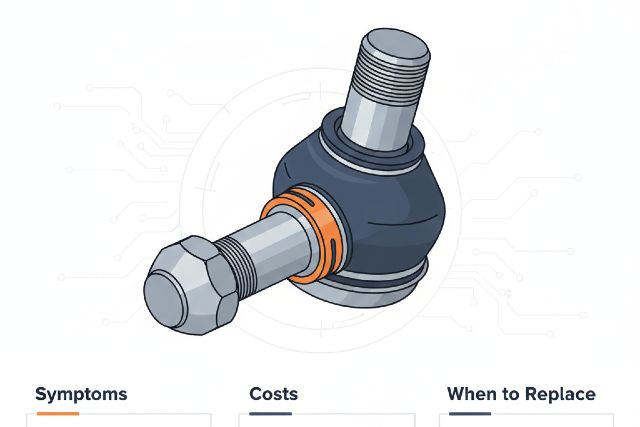

Ball joints are small parts with a big job. They sit at a critical connection point in your front suspension, helping your wheels move up and down over bumps while still turning smoothly when you steer. When ball joints wear out, the changes can feel subtle at first, but the consequences can get expensive fast through tire wear and alignment issues, and they can become a safety problem if wear becomes severe.
Drivers often notice the warning signs before a shop ever confirms the diagnosis. The challenge is that many front-end problems feel similar, so it’s easy to keep driving and hope it goes away. This article explains what ball joints do, the most common symptoms, how much replacement typically costs, and how to decide when to replace them based on real inspection logic rather than guesswork.
What Are Ball Joints and What Do They Do?
A ball joint is a pivoting joint that connects the control arm to the steering knuckle. If you picture a hip joint, you’re close. It allows movement in multiple directions, which your suspension needs because the wheel must travel vertically with the road while also rotating left and right as you steer.
Most vehicles use ball joints in the front suspension. Some have both upper and lower ball joints, while others rely on a single primary joint depending on suspension design. Another important detail is whether the ball joint is replaceable by itself or integrated into the control arm. That difference matters because it can dramatically change labor time and the final bill.
MOOG’s inspection guidance emphasizes that ball joint looseness can affect steering and suspension behavior and contributes to alignment and tire-wear complaints, which is often how the problem first shows up for everyday drivers.
Ball Joint Symptoms You’ll Feel While Driving
Ball joint wear rarely announces itself with one perfect, obvious symptom. It’s usually a pattern of changes that build over time, and the pattern is what makes the diagnosis more convincing.
Clunking or knocking from the front end
A dull clunk over bumps, potholes, or driveway transitions is one of the classic signs drivers report. The sound often appears when the suspension loads and unloads, such as when you roll over a speed bump or turn into a parking lot at an angle. As wear increases, the clunk tends to happen more frequently and with less provocation.
This symptom isn’t exclusive to ball joints, but when clunking is paired with steering looseness or abnormal tire wear, it becomes much more suspicious.
Loose, wandering, or vague steering
Worn ball joints can create play in the suspension’s pivot points. Behind the wheel, that can feel like the car doesn’t want to track straight, especially at highway speed. You might find yourself making small steering corrections more often than you used to. Some drivers describe it as “floaty,” while others say it feels like the front end is slightly delayed in responding.
If your vehicle used to feel planted and now feels less precise, worn ball joints are one possible reason, particularly if the change came gradually.
Uneven tire wear that keeps coming back
This is where ball joints can quietly cost you money. When a ball joint becomes loose, wheel alignment angles can shift under load, so the tire may scrub and wear unevenly even if the alignment looks acceptable during a quick check. MOOG’s materials directly connect looseness in ball joints with alignment and tire-wear issues, which aligns with what many shops see in real-world tire complaints.
If you’ve replaced tires sooner than expected and the wear looks uneven or “feathered,” it’s worth having the suspension inspected, not just aligned again.
Squeaking, creaking, or groaning over slow suspension movement
Some worn ball joints develop noise that sounds more like a creak than a clunk. It often shows up at low speeds, during turning, or while the suspension articulates into driveways. Noise alone isn’t proof, but it can point toward a joint whose lubrication has failed or whose protective boot has been compromised.
Visible torn boot or grease leakage
If the dust boot is torn, road grit and water can get inside. That contamination speeds up wear dramatically. A torn boot doesn’t automatically mean the joint is already unsafe, but it does mean the joint’s remaining life may shrink quickly, especially in wet or salty conditions.
Why Worn Ball Joints Can Become a Safety Issue
In early stages, worn ball joints usually cause inconvenience and expense. They can worsen handling feel, accelerate tire wear, and make alignment harder to maintain. But if wear becomes severe, the stakes get higher.
NHTSA recall documents describe scenarios where ball joint separation from the knuckle can lead to a wheel moving outboard and a loss of vehicle control. In one recall report, the defect description explicitly notes that a ball joint separating from the knuckle can cause the wheel to fall outward, creating crash risk.
This doesn’t mean every noisy front end is about to fail immediately. It does mean that once a shop confirms measurable looseness beyond specification, ball joints move from “annoying” to “address soon” in a very practical way.
How Long Do Ball Joints Last?
Ball joint lifespan varies because it depends less on a single mileage number and more on how the vehicle is used and where it’s driven. Rough roads, potholes, curb strikes, heavy loads, and larger wheels can all increase stress. Trucks and SUVs often wear front suspension parts faster simply because of weight and typical usage.
A more useful approach than chasing a mileage target is treating ball joints as inspection items. When symptoms appear, or when tires show unusual wear, a proper inspection is the reliable way to decide what to do next.
MOOG’s technical tip highlights that inspection method matters, particularly because some ball joints are load-carrying while others are follower designs. The correct test approach depends on which type you have.
How Mechanics Confirm a Bad Ball Joint
A good diagnosis is not guesswork based on noise alone. It’s an inspection that looks for play and boot condition in a way that matches your suspension design.
MOOG’s inspection document explains that load-carrying and follower ball joints must be checked differently, and it describes using lifting methods and leverage to evaluate looseness.
If you’re comparing repair quotes, one of the most useful questions you can ask is whether the shop confirmed looseness beyond specification, and how they tested it. A clear answer usually separates a measured diagnosis from a “parts cannon” approach.
Ball Joint Replacement Cost: What You Should Expect
Ball joint replacement cost depends on your vehicle, your region, and whether the joint is replaceable by itself or integrated into the control arm.
RepairPal estimates the average cost for a suspension ball joint replacement between $305 and $471, including parts and labor, and it breaks out labor and parts ranges as part of that estimate.
AutoNation Mobile Service gives a wider range and notes that ball joint replacement costs often fall between $180 and $550, reflecting how some vehicles are straightforward while others require more time or more expensive parts.
If you’re trying to sanity-check a quote, a number outside these ranges isn’t automatically wrong. Luxury vehicles, heavy-duty trucks, and designs that require more disassembly can push costs higher. Rust can also increase labor significantly because press-fit parts and fasteners may take longer to separate safely.
When to Replace Ball Joints
The smartest replacement timing is based on condition, not just age.
If a ball joint has measurable play beyond spec, replacement is typically the responsible call because looseness can worsen quickly and can affect steering precision and tire wear. If the boot is torn and the joint is already noisy or loose, replacement is usually the better value than trying to stretch it, since contamination accelerates wear.
If symptoms exist but looseness is not confirmed, it’s reasonable to push for a precise diagnosis. Many issues that feel like ball joints can also come from tie rods, control arm bushings, sway links, wheel bearings, or even tire problems. The goal is not to avoid replacing ball joints when they’re worn, but to avoid replacing them when they’re not the real problem.
One more practical point is repeat costs. If you replace one side and the other side is near the end of its life, you might pay labor and alignment costs twice. On the other hand, if the opposite side is still tight and healthy, replacing only the worn side can be perfectly reasonable. The “right” answer is whichever one matches what inspection shows.
Do You Need an Alignment After Ball Joint Replacement?
Often, yes. Even when ball joints aren’t the primary adjustment point for alignment on a specific model, suspension disassembly can shift geometry. Also, if the worn joint contributed to uneven tire wear, an alignment helps protect your tires and restores predictable handling.
If a shop replaces ball joints and does not at least discuss alignment, it’s worth asking whether your vehicle design and the work performed make alignment advisable.
Real-World Scenarios That Make the Diagnosis Clear
A common scenario is the “mystery tire wear” problem. A driver replaces tires sooner than expected, gets an alignment, and still sees the inside edges wearing quickly. Inspection finally reveals ball joint looseness that allows the wheel to change angle under load. After replacing the ball joints and aligning the vehicle, tire wear returns to normal. MOOG’s guidance linking looseness with alignment and tire wear is consistent with this kind of outcome.
Another scenario is the slow progression of noise. A light clunk appears over bumps, then steering starts to feel less connected, then braking over rough pavement feels less stable. The vehicle still “drives,” but the margin of safety and comfort shrinks as play increases. That’s the kind of progression where timely replacement pays off.
FAQ About Ball Joints
What are ball joints on a car?
Ball joints are pivoting joints in the suspension that connect the control arm to the steering knuckle, allowing the wheel to move vertically with the suspension while also turning for steering.
What are the most common symptoms of worn ball joints?
The most common symptoms include clunking over bumps, loose or wandering steering, and recurring uneven tire wear. Some vehicles also develop squeaks or creaks, especially if the protective boot is damaged.
Is it safe to drive with worn ball joints?
Mild wear may not be an emergency, but excessive looseness is a safety concern because severe wear can lead to separation. NHTSA recall documents describe ball joint separation scenarios that can lead to wheel movement and loss of control, increasing crash risk.
How much does it cost to replace ball joints?
Cost varies by vehicle and design. RepairPal estimates an average suspension ball joint replacement between $305 and $471, while AutoNation Mobile Service cites a wider range that often falls between $180 and $550 depending on the vehicle and parts.
Do I need an alignment after replacing ball joints?
Often yes, especially if suspension components were removed or if tire wear suggests alignment instability. An alignment helps restore handling and protect your tires after the repair.
Conclusion: Don’t Ignore Ball Joints When the Signs Add Up
Ball joints are easy to overlook because they’re out of sight, but they directly influence steering feel, alignment stability, and tire life. If you notice clunking, wandering steering, or repeated uneven tire wear, a proper inspection is the fastest way to avoid wasting money on tires and alignments that won’t hold.
Once wear is confirmed, replacing ball joints is usually the safest and most cost-effective move. It restores a tight suspension pivot, improves predictable handling, and reduces the chance of the severe failure scenarios described in NHTSA safety documents.














Leave a comment