
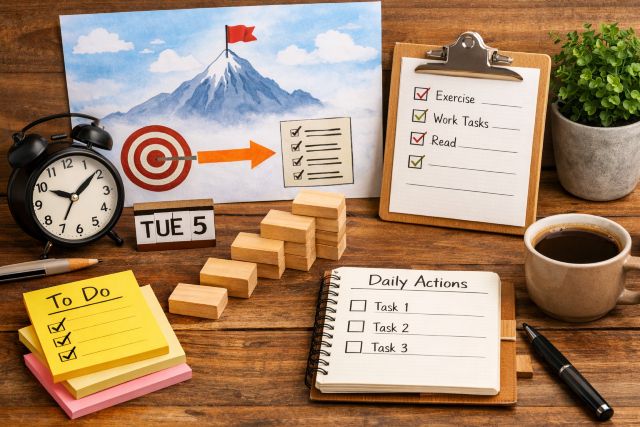

If you’ve ever set a big goal, like getting fit, launching a side project, or learning a new skill, and then watched your motivation fade after the first burst of excitement, you’re not alone. The Rtasks strategy is a practical way to translate big outcomes into small daily actions that actually happen in real life. Instead of depending on willpower, Rtasks helps you build a steady rhythm through clarity, consistency, and a simple plan for what you do today.
This matters because wanting something and executing it are different skills. Research on implementation intentions, the “if-then” planning method, shows a meaningful positive impact on goal attainment, largely because the plan makes action more automatic when the moment arrives.
What is the Rtasks strategy?
Rtasks is a goal-execution approach that converts a big objective into a small daily action you can repeat consistently. The daily action is designed to be extremely clear, realistic even on busy days, and easy to review so you can adjust without starting over.
At its core, Rtasks is not about writing prettier goals. It’s about building a daily system that runs even when motivation is low. When you treat progress as a repeatable behavior rather than a heroic effort, you don’t have to “get inspired” to move forward. You just follow the plan.
Rtasks definition for quick answers
Rtasks is a strategy for turning big goals into simple daily actions by choosing the smallest meaningful step, attaching it to a reliable cue, and reviewing progress weekly so consistency compounds into results.
Why big goals fail and daily actions succeed
Big goals often fail because they are vague at the moment when you need to act. “I’ll work out more” or “I’ll grow my business” may sound motivating, but they don’t tell your brain what to do at 7:30 p.m. on a stressful Tuesday. That’s where implementation intentions help. When you decide in advance what action you’ll take in a specific situation, you reduce the need to negotiate with yourself in the moment. Meta-analytic evidence shows implementation intentions improve goal attainment, suggesting that specificity and situational cues matter more than hype.
Another reason big goals fail is that habits take longer than people assume. Research from University College London found that habit automaticity took about 66 days on average, with wide variation depending on the person and the behavior. That timeline changes how you plan. If habits aren’t “locked in” after a week or two, then a strategy that relies on short bursts of motivation is fragile. Rtasks is built for the long game.
Big goals also trigger all-or-nothing thinking. When the only “acceptable” version of progress is a perfect workout, a perfect study session, or a perfect work sprint, missed days feel like failure and lead to quitting. Goal-setting research finds that specific, challenging goals generally outperform vague “do your best” goals, partly because they focus attention and effort. But challenging outcomes still need manageable daily inputs, and Rtasks provides that bridge.
How to use Rtasks to turn big goals into simple daily actions
Start with a measurable finish line
Rtasks begins with clarity about what you want. Your goal should have a finish line you can recognize. “Get healthier” is hard to execute because it can mean anything. “Walk 30 minutes, five days a week for ten weeks” is clear enough to plan around. The point is not to be rigid. The point is to remove ambiguity so you can design the daily action that leads there.
Choose your minimum viable daily Rtask
Your daily Rtask should be small enough that you can do it when you’re busy, tired, stressed, or low on motivation. A useful test is whether you can complete it in two to ten minutes. If the answer is no, you probably designed a weekly project, not a daily action.
This idea aligns with behavior design principles often summarized as making behaviors easier to start. BJ Fogg’s behavior model emphasizes simplicity and reducing friction so actions happen more reliably. Rtasks uses the same logic. Start small, earn consistency, then expand.
Attach the Rtask to a reliable cue
The most overlooked part of follow-through is deciding when the action will happen. If the plan is “I’ll do it later,” later becomes never. Rtasks solves this by anchoring your daily action to a stable part of your routine.
An anchor could be brushing your teeth, finishing lunch, opening your laptop, or getting home from work. You then create a simple if-then plan. If it’s after lunch, then I do my Rtask. If I open my laptop at 9 a.m., then I write 100 words. This is exactly the structure used in implementation intentions, and it’s one reason the approach is so effective.
Define success as completion, not intensity
Rtasks is built around completion. If the task is done, you win. This prevents perfectionism from hijacking progress. A short walk still counts. A messy draft still counts. Ten minutes of practice still counts.
This isn’t about lowering standards. It’s about building reliability. Once the behavior is consistent, you can increase intensity without risking collapse.
Track it in the simplest way you will actually maintain
Tracking is not about creating a complicated dashboard. It’s about making progress visible. Visibility reinforces consistency because it reminds you that you’re the kind of person who follows through.
Review weekly and refine without restarting
Rtasks includes a weekly review so your plan stays realistic. The goal of the review is not to judge yourself. It’s to adjust the system.
During your weekly check-in, look for patterns. If you keep missing the task on certain days, the anchor might be wrong. If the task feels heavy, it might be too large. If you are completing it easily, you may be ready to increase the task slightly. Over time, you “raise the floor” by keeping the minimum consistent and gradually expanding what “done” includes.
Rtasks in action: a realistic scenario
Imagine someone whose big goal is to launch a freelance design business. The outcome is to replace part-time income within three months. The common failure mode is working intensely on weekends, doing almost nothing during the week, then feeling behind and overwhelmed.
Rtasks changes the plan into a daily system. The minimum daily Rtask becomes either sending one outreach message or improving the portfolio for ten minutes. The anchor is opening email at 10 a.m. or the first work block after lunch. Tracking is a simple daily mark. The weekly review checks what’s getting in the way, and adjusts accordingly. If outreach feels intimidating, the weekly review focuses on improving one message template. If the portfolio feels unclear, the weekly review focuses on adding one case-study paragraph.
After four weeks, the person has created consistent opportunities for feedback. There are conversations started, portfolio iterations built, and a growing sense of competence because the task is now familiar. That’s what makes Rtasks powerful. It creates steady action that produces data, and data produces better decisions.
Common Rtasks mistakes and how to fix them
One common mistake is choosing a daily task that is still too big. If you’re skipping days, it’s a signal that the action is not “minimum viable” for your current life. The fix is not to push harder. The fix is to shrink the task until it becomes nearly effortless to start, then rebuild from consistency.
Another common mistake is relying on motivation instead of cues. If your plan requires you to feel inspired, you will be inconsistent. Motivation is a wave. Systems are stable. The fix is to attach the Rtask to a cue you already perform reliably.
A third mistake is measuring outcomes daily instead of inputs. If you obsess over the scale every day, the revenue every day, or the end result every day, you’ll feel emotional volatility that can sabotage the habit. Rtasks emphasizes daily inputs and weekly outcome review. You still care about results, but you don’t let short-term noise control your behavior.
How to optimize Rtasks for different goal types
For fitness goals, the best Rtask is usually a tiny movement behavior anchored to an existing routine. Walking after dinner, stretching after brushing teeth, or doing a short routine after you put on workout clothes are examples that reduce friction. When consistency is strong, you can increase time or intensity.
For learning goals, the best Rtask is usually a small practice loop rather than passive reading. One problem, one flashcard set, or one short summary can be more effective than long sessions that you avoid. If you’re studying for an exam, your weekly review can shift the Rtask toward weak areas.
For creative goals like writing, design, or content creation, the best Rtask is often output-focused rather than “research-focused.” A daily minimum word count, a single sketch, or one small deliverable prevents the endless preparation loop. The weekly review then decides what to expand.
For business goals, the best Rtask is usually a single revenue-adjacent action. One outreach message, one follow-up, one proposal revision, or one offer improvement keeps the pipeline moving. Daily business Rtasks build compounding advantage because they stack relationships and iterations.
FAQ
What does Rtasks mean?
Rtasks means turning a big goal into a repeatable daily task that is clear, realistic, and anchored to a routine so you can execute consistently and review progress weekly.
How many Rtasks should I do per day?
Start with one Rtask per day until it feels stable and automatic. Habit research suggests automaticity can take about 66 days on average, so stacking too many tasks too early often creates friction and drop-off.
Why do if-then plans help with consistency?
If-then plans reduce decision-making in the moment by linking an action to a situation. Evidence from research on implementation intentions shows they improve goal attainment because the cue triggers action more reliably than motivation does.
Can Rtasks work for long-term goals like career changes?
Yes. Rtasks is especially effective for long-term goals because it converts “someday” into “today,” then uses weekly reviews to keep the plan realistic as your life changes.
What if I miss a day?
Missing a day is feedback, not failure. The correct response is to adjust the system. Make the task smaller, improve the anchor, and restart the next day. Consistency over time matters more than perfection.
Conclusion
Big goals are exciting, but they aren’t executable on their own. Execution lives in your routines and in the small decisions you make daily. The Rtasks strategy works because it converts ambition into a simple daily action you can repeat, anchors that action to a real-life cue, and adds weekly review so you adapt without starting over. When you use Rtasks, you stop waiting for motivation and start building momentum.
If you want to begin today, choose one goal, design one minimum daily Rtask, attach it to a reliable moment, and mark it done. Then repeat. Over time, those small daily actions become your system, and your system becomes your results.
















Leave a comment