
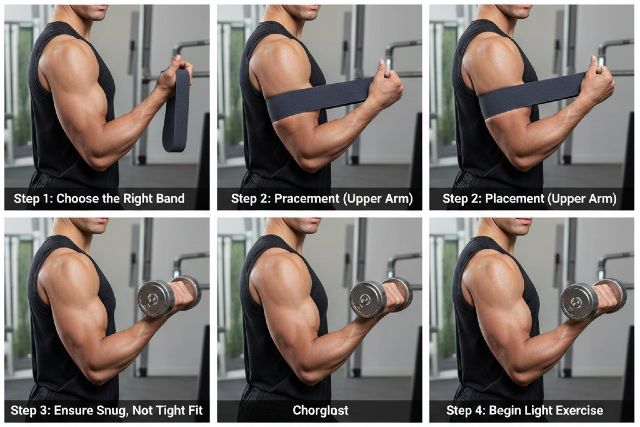

Arm banding is one of those training methods that sounds risky until you understand what it is and how to apply it correctly. In fitness, arm banding usually refers to wrapping a cuff or elastic band high on the upper arm to create partial blood flow restriction during exercise. Done correctly, arm banding can help men stimulate arm growth using lighter weights, which is useful for reducing joint stress, training around minor aches, or adding high-quality volume when heavy lifting is not ideal. Done incorrectly, it can lead to numbness, excessive discomfort, bruising, or other avoidable issues.
This article explains what arm banding is, why it works, what the science says, and how to do it safely and effectively with practical programming examples and clear answers to common questions.
What Is Arm Banding?
Arm banding is a training technique in which a band or cuff is placed near the top of the arm to partially restrict blood flow during exercise. The method is closely associated with blood flow restriction training, often shortened to BFR. The idea is to reduce venous return, meaning blood leaving the arm, while still allowing some arterial inflow. This creates a high-metabolic-stress environment that makes light weights feel much harder, which can trigger muscle-building signals even when the load is relatively low. Research-based guidance on BFR highlights the importance of cuff placement, individualized pressure, and sensible session design.
One important clarification is that “arm banding” can also be used in medical or cosmetic contexts to describe tissue bands after weight loss or surgery. If you are searching because of skin banding or visible tissue changes rather than training, you should use medical guidance instead of fitness advice.
Why Arm Banding Works for Men
Most men think bigger arms require heavier weights. Heavy training can work extremely well, but it also raises the cost in terms of joint stress and recovery, especially if you are adding extra arm volume on top of pressing and pulling work. Arm banding is popular because it can create a strong hypertrophy stimulus with loads that are much lighter than traditional strength training.
Studies and reviews commonly report that low-load BFR training can produce meaningful gains in muscle size, and in many cases results can be comparable to traditional high-load training when protocols are properly structured. This does not automatically mean it is better than heavy lifting. It means it is a valuable tool that can complement your training, especially if you need a joint-friendlier way to add arm stimulus.
Is Arm Banding Safe?
Arm banding can be safe when it is performed with appropriate pressure, correct placement, reasonable durations, and basic screening for risk factors. Modern guidance strongly emphasizes individualized pressure where possible, because the same “tightness” can mean very different levels of restriction depending on your arm size, the width of the cuff, and the material used.
Safety discussions in the literature and clinical guidance often focus on avoiding excessive pressure, limiting continuous restriction time, and paying attention to symptoms that indicate you should stop. A risk-focused review discussing BFRT applications highlights the importance of good protocols and medical considerations, especially when people have health factors that raise risk.
This information is educational, not medical advice. If you have cardiovascular disease, uncontrolled high blood pressure, a history of blood clots, vascular disease, or unexplained neurological symptoms, speak to a qualified clinician before using BFR methods.
Who Should Avoid Arm Banding or Get Cleared First
Clinical and rehab-oriented guidelines commonly recommend avoiding BFR or getting clearance first if you have a history of blood clots, known clotting disorders, uncontrolled hypertension, significant cardiovascular disease, peripheral vascular disease, pregnancy, active infection, open wounds near the cuff site, unexplained swelling, or ongoing numbness and nerve issues. These categories are repeatedly emphasized in clinic screening guidance for BFR.
Even if you feel healthy, it is still wise to be conservative with pressure and duration until you know how your body responds.
How to Do Arm Banding Safely and Effectively
Correct equipment matters more than most people think
The safest option is a purpose-built BFR cuff, especially pneumatic cuffs that can control pressure more reliably. Research-informed recommendations favor approaches that consider limb occlusion pressure rather than guessing tightness by feel. If you use improvised wraps, it becomes easier to over-tighten without realizing it, which is where many problems start.
Placement should be high on the upper arm
For arm banding, place the cuff as high as comfortably possible on the upper arm, close to the shoulder. Avoid placing it near the elbow or on the forearm. Proximal placement is standard in BFR guidance and helps reduce unnecessary pressure around joints and sensitive structures.
Pressure should be individualized when possible
The most evidence-based approach is to set pressure relative to your limb occlusion pressure, often called LOP, which is the amount of pressure required to stop arterial flow. Many protocols use a percentage of LOP, and upper-limb pressures are typically set lower than lower-limb pressures because arms occlude more easily. Educational and clinic resources frequently discuss upper-limb ranges around roughly 40 to 50 percent of LOP in common setups, adjusted to the individual.
If you do not have a way to measure LOP, keep tightness moderate and prioritize normal sensation in the hand and fingers. Your arm should not turn pale or cold, and you should not feel tingling or numbness developing during the set. If numbness starts, stop and deflate immediately.
Duration should be controlled and breaks should be built in
A common best practice is to keep restriction on during a short block of sets and then deflate between exercises. Staying restricted continuously for long periods is not smart. Many clinic guidelines emphasize managing work-to-rest patterns and using deflation to reduce risk and discomfort.
Loads should be light and execution should be strict
Arm banding is designed for low-load training, not for proving you are tough. Low loads with controlled reps, short rests, and good form are what create the intended stimulus. Reviews and practical guidance discuss low-load BFR as an effective method for hypertrophy and strength adaptations when heavier loading is not feasible or desirable.
Training Examples for Arm Banding
The simplest way to use arm banding is as a focused arm-growth block at the end of an upper-body session. This keeps your primary training normal while adding a targeted hypertrophy stimulus with lighter weights.
A biceps-focused approach works well with a curl variation like dumbbell curls, cable curls, or machine curls. You choose a weight that feels easy at first but becomes challenging as fatigue accumulates. The goal is a deep muscular burn without loss of hand sensation.
A triceps-focused approach can use pushdowns or overhead cable extensions with strict form. If your elbows are sensitive, pushdowns often feel more manageable than heavy skull crushers.
A combined approach alternates one biceps movement and one triceps movement so you get a balanced pump without turning the session into a marathon. This can be a useful way to add arm volume without making your elbows and shoulders angry.
The reason these short blocks can be effective is that low-load BFR can create hypertrophy-relevant stimuli that in many cases resemble those produced by heavier training, which is why it is so popular as an accessory method.
Mistakes That Make Arm Banding Risky or Ineffective
The biggest mistake is making the band too tight. More pressure does not equal more gains. Excessive pressure is more likely to cause numbness, sharp discomfort, or lingering irritation. Guidance consistently stresses individualized pressure and conservative application.
Another common mistake is placing the band too low on the arm. Placing it near the elbow increases the chance of uncomfortable compression and can aggravate sensitive areas.
Some men also try to use heavy weights while banded. That defeats the purpose and increases stress. Arm banding is meant to let you train hard with light loads.
Finally, ignoring symptoms is never worth it. If you feel numbness, persistent tingling, sharp pain, or unusual swelling, stop immediately and reassess.
How Often Should Men Do Arm Banding?
A practical starting point is one to two arm banding sessions per week, keeping the banded portion short. This tends to be enough to add meaningful volume without interfering with recovery. If you tolerate it well, you can experiment with slightly more frequency, but the better approach is usually consistency over time rather than cranking volume aggressively.
If your main goal is arm growth, arm banding works best as a supplement to a well-designed routine that already includes progressive overload through pressing, pulling, and some direct arm work.
FAQ: Arm Banding for Men
What does arm banding do?
Arm banding partially restricts blood flow so your muscles fatigue faster with lighter weights. That fatigue and metabolic stress can contribute to muscle growth signals even when loads are low, which is why BFR-style training is used for hypertrophy and rehab contexts.
Does arm banding build bigger arms?
It can. Many reviews report that low-load BFR can increase muscle size and can be comparable to high-load training under certain conditions, which makes it a useful tool for arm development when heavy loading is not ideal.
How tight should arm bands be?
The best approach is to use individualized pressure based on limb occlusion pressure and then apply a percentage appropriate for the upper limb. Many practical resources discuss upper-limb pressures lower than lower-limb pressures, often around the 40 to 50 percent LOP range in common protocols. If you cannot measure, keep it moderate and stop if numbness or persistent tingling appears.
Is arm banding the same as KAATSU?
KAATSU is often used as a branded term associated with blood flow restriction methods. In practice, many people use the terms interchangeably, although devices and protocols can vary.
Conclusion
Arm banding can be a safe, effective way for men to build arm muscle with lighter weights when it is applied with the right placement, pressure, and session structure. Use purpose-built cuffs when possible, keep the band high on the upper arm, favor individualized pressure instead of guessing, and keep your banded work short and focused. As a supplement to a solid training program, arm banding can help you add high-quality arm volume, chase a serious pump, and reduce the wear-and-tear that comes from always going heavy.















Leave a comment