
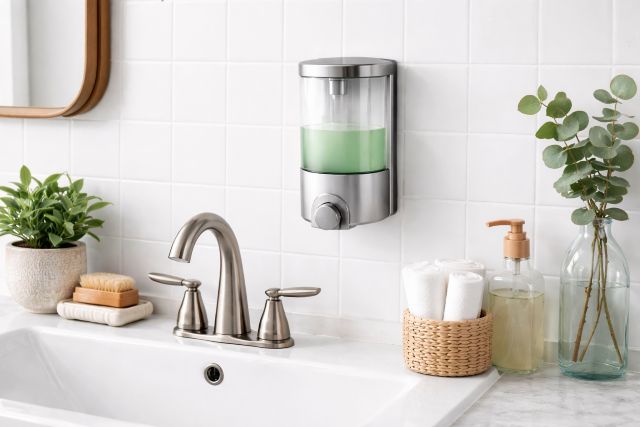

If your sink area constantly looks messy — water rings, sticky soap residue, random drips, and that mysterious “film” that appears overnight — you’re not alone. The sink is one of the busiest (and most contamination-prone) zones in a kitchen or bathroom. One simple upgrade that often makes a bigger difference than people expect is a wall mounted soap dispenser.
Unlike countertop pump bottles that sit in puddles, collect grime at the base, and get shoved around during cleaning, a wall-mounted dispenser lifts soap off the counter and creates a more controlled, hygienic setup. It’s not just about aesthetics. It’s about fewer touchpoints, fewer drips, and fewer places for gunk to build up — day after day.
Below are seven detailed, real-world reasons a wall mounted unit can keep your sink area noticeably cleaner, plus practical tips, common questions, and a quick setup guide.
1) It eliminates the “soap puddle” under the bottle
Countertop soap bottles almost always create a damp ring. Even if you’re careful, a pump bottle tends to drip after dispensing. That drip runs down the nozzle, collects around the neck, and eventually forms a sticky residue that glues itself to the counter.
A wall mounted dispenser fixes the root problem: there is no bottle base sitting in water. You’re removing a constant moisture trap — one of the key ingredients for grime buildup.
In kitchens, this matters even more because sinks can harbor bacteria. For example, a study highlighted by TIME reported fecal bacteria (including E. coli) appearing in a large share of household sinks, especially when sinks were visibly dirty. Reducing standing moisture and residue around the sink area helps you keep that zone from becoming a “sticky magnet” for whatever splashes nearby.
2) It reduces clutter, which makes cleaning faster (and more consistent)
Most sink counters turn into “mini storage”: soap bottle, sponge holder, brush, dish liquid, lotion, sometimes sanitizer. The more items you have, the more edges and bases you have to wipe around. Cleaning becomes annoying, so it happens less often—or less thoroughly.
A wall mounted soap dispenser clears counter space, which makes it easier to do quick wipe-downs. And quick wipe-downs are what keep a sink area looking clean all week—not just right after deep cleaning.
This is one of those underrated “behavior wins.” When the surface is mostly clear, you clean it automatically while you’re already there.
3) Fewer touchpoints can mean less germ transfer
Think about what touches a countertop soap bottle: wet hands, dirty hands, cooking hands, kids’ hands, guests’ hands. The pump head and the bottle exterior get handled constantly.
Research on soap dispensers has noted that dispenser exteriors can become heavily contaminated because they’re touched frequently. That’s not meant to scare you—it’s meant to explain why reducing touch surfaces matters.
Many wall mounted models also come in touchless/sensor options or use more controlled mechanisms that limit contact. In healthcare and institutional settings, studies have discussed how automated touchless dispensing and closed refill systems can minimize touch points and reduce cross-contamination opportunities.
Even in a normal home, the principle holds: fewer commonly-touched surfaces around a wet sink area typically equals less grime and fewer smudges.
4) You control dispensing better, which means less overuse and less mess
Countertop pumps often dispense inconsistent amounts—especially as they age. Too much soap leads to extra rinsing, more water splashing, and more residue around the sink and faucet.
Many wall mounted dispensers are designed for consistent dosing (particularly commercial-style units). That consistency reduces:
excess foam overflow
soap sliding off hands onto the counter
sticky buildup around handles and faucets
If you’ve ever noticed a “tacky” feeling on your faucet handle, it’s usually a mix of soap residue + minerals from water. Tightening soap portioning helps break that cycle.
Actionable tip: Start with a smaller dose setting. You can always increase it, but the goal is “enough to wash well without turning the basin into a bubble bath.”
5) It prevents bottle-base “biofilm” and hard-to-clean gunk
The grimiest part of a countertop bottle isn’t the pump — it’s the base. It sits in water, picks up toothpaste splatter or food droplets, then dries into a crust. Over time, you can get a thin biofilm-like layer that’s gross to scrub and easy to ignore.
A wall mounted soap dispenser removes that base entirely. You still clean the dispenser, of course — but you’re cleaning a smooth surface that doesn’t sit in puddles.
This also helps with that annoying “dirty outline” you see when you move your soap bottle and realize the counter is cleaner everywhere except under it.
6) It keeps your sponge/brush zone drier when paired with smart placement
A cleaner sink area isn’t only about soap. Sponges and brushes are notorious for holding moisture and spreading grime. The sink often becomes a wet ecosystem: sponge drips near soap bottle, soap bottle drips near sponge, and everything stays damp longer.
When you mount soap on the wall, you can create intentional zones:
soap over the basin
sponge holder mounted separately with drainage
clear counter space for quick wipe-downs
Even small changes in “water flow” around the sink reduce the amount of damp residue that leads to odor and buildup.
Actionable tip: Pair your wall-mounted soap with a draining sponge caddy (ideally also wall-mounted). Keeping both off the counter is the “one-two punch” for a cleaner sink.
7) It supports better hand hygiene habits (which indirectly keeps the sink cleaner)
People are more likely to wash hands when soap is clearly visible and easy to access. The CDC emphasizes that handwashing with soap is a key practice to reduce spread of illness.
Here’s the sink-cleanliness connection: when handwashing is easy, people tend to use the sink more intentionally and rinse residues away properly. When it’s annoying (soap bottle missing, pump clogged, bottle top sticky), people do quicker rinses or skip soap—leading to more grease, grime, and residue going down the drain and sticking around the basin.
Wall mounting also makes it harder for the soap to “wander off,” which matters in shared homes, offices, and guest spaces.
How to choose the right wall mounted dispenser for a cleaner sink
You don’t need the most expensive model. You need the one that fits your habits and your space.
Best features to look for
A sealed refill system or cartridge option can reduce contamination risks compared with open, “top-off” refilling approaches — a concern discussed in research on bulk/refillable soap systems.
If you prefer refillable, look for:
a wide opening for easy cleaning
a drip-resistant nozzle
a transparent window (so you refill before it sputters)
Material matters
Plastic is fine for most homes, but metal-front dispensers often wipe cleaner and look better longer. In humid bathrooms, corrosion resistance matters.
Placement tips (the part most people get wrong)
Mounting height and position decide whether you love it or regret it.
A simple rule:
Your hand should be able to dispense soap while staying over the basin.
That keeps stray drips from landing on the counter and handles.
Quick cleaning routine that keeps it spotless
A wall mount reduces mess, but it doesn’t make soap immune to residue. This 30-second routine helps:
Wipe the nozzle and front face every few days (especially if you use creamy soaps).
Once a week, wipe the wall area behind/under it.
If you have hard water, wipe nearby faucet handles too — soap + minerals is what creates that tacky film.
FAQs
What is a wall mounted soap dispenser?
A wall mounted soap dispenser is a soap container fixed to a wall, backsplash, tile, or mirror area near a sink, designed to dispense hand soap without a bottle sitting on the countertop.
Are wall mounted soap dispensers more hygienic than countertop bottles?
They can be, mainly because they reduce counter puddles and can reduce commonly touched surfaces. Research notes that dispenser exteriors can become contaminated due to frequent touching, and touchless/closed refill systems can reduce touch points and cross-contamination opportunities in higher-risk settings.
Do wall mounted dispensers damage tile or walls?
If installed with the right anchors or adhesive system (and on a suitable surface), they’re typically safe. Damage risk is highest with poor adhesive on textured surfaces or drilling without correct anchors.
Is touchless worth it at home?
In high-traffic spaces, yes. It reduces smudges and contact points and often keeps the dispenser cleaner-looking. Studies in healthcare contexts discuss benefits of touchless systems for reducing touch points and contamination risks.
What soap works best in a wall mounted soap dispenser?
Most work well with liquid hand soap. If your pump struggles, dilute very thick soap slightly (only if the manufacturer allows it). Foaming dispensers require foaming soap or compatible cartridges.
Conclusion: a cleaner counter starts with a smarter soap setup
A wall mounted soap dispenser is one of those small upgrades that pays you back every single day. It reduces countertop puddles, cuts clutter, improves dosing, and makes wipe-downs faster — so your sink area stays cleaner with less effort. And because sinks are busy, splash-prone zones, removing one of the biggest mess-makers (the bottle base) can make the whole space look and feel more hygienic.
If you want the biggest impact, mount the dispenser so dispensing happens over the basin, pair it with a draining sponge holder, and wipe the nozzle weekly. Simple, realistic habits — cleaner sink, consistently.











Leave a comment